

























![Kingdom Hearts Collection [I-III] Review](https://gazettely.com/wp-content/uploads/2026/10/Kingdom-Hearts-Collection-I-III-1-360x180.webp "Kingdom Hearts Collection [I-III] Review: KHII Holds Steady as Newer Entries Fluctuate 37")





Betrayal is a four-part British espionage thriller that tries to yoke high-stakes national security to the intimate breakdown of a marriage. The series stars Shaun Evans as John Hughes, a veteran MI5 operative whose career is flagging at the same moment a credible foreign threat arrives.
The show plants itself in a down-to-earth British reality, swapping glamorous spy-postcard settings for rain-slicked car parks in Stockport and the musty interiors of low-budget B&Bs. John launches a rogue investigation into an Iranian-backed terror plot, and that choice collides with a domestic life already cracking at the seams. The story keeps returning to the cost of a life built on secrecy, and it makes that cost feel immediate.
John moves through the fallout alongside his wife Claire (Romola Garai), a GP worn down by his evasions, and a new MI6 partner, Mehreen (Zahra Ahmadi). Each professional step forward brings fresh damage at home, and the series leans into the “spy as civil servant” idea with a grimness that fits its setting. This is espionage as a job that drains you slowly, measured in fatigue, paranoia, and the emotional hangover of decades spent performing different versions of yourself.
The Dinosaur and the GP: A Study in Friction
John Hughes is written as a particular species of intelligence dinosaur. He is irascible, he breaks rules, and he treats modern MI5 protocols like an insult delivered in memo form. Shaun Evans drops the intellectual polish associated with his famous turn in Endeavour and plays John as a man whose “good gut” keeps colliding with a bureaucracy that tracks resources and risk like it’s balancing a spreadsheet. John can be difficult and frequently obnoxious, and the office tension has a familiar rhythm: the old operator, the new system, and the mutual irritation that follows.
The bigger quake hits at home, in their Victorian semi. Romola Garai plays Claire with a bone-deep weariness that sits behind every line. She carries the grinding schedule of a GP, handles the chaotic needs of their children, and absorbs the collateral damage when John disappears into what he treats as a “terribly special” vocation. The show frames that imbalance as daily reality. John meets her legitimate concerns with airy humor or a calm that reads like dismissal, and the emotional labor stacks up scene by scene.
Their arguments sharpen through class. John’s Liverpudlian roots rub against Claire’s middle-class expectations, and the fights start sounding like proxy wars over social identity and personal history. The domestic material has its own pacing, built around familiar beats of repetition and escalation. Each exchange lands with the sense of two people stuck in an argument that began years ago and never really ended.
A previous infidelity with a colleague hangs over the narrative like something solid in the room. That history gives his professional partnership with Mehreen the feel of a pattern returning. The series suggests that professional lying corrodes the ability to tell the truth at home, and John carries that corrosion in his posture and his reactions. He registers as a man who dislikes what he has become, and he keeps running the same loop: dedication to the state, then retreat from the wreckage waiting in his living room.
Tradecraft in the Car Park
The central thriller line deals with a mass-casualty terror threat tied to Iranian interests, yet the execution stays strikingly small-scale. A criminal gang in Stockport surveils dissidents and carries out threats under the gray skies of Northern England.
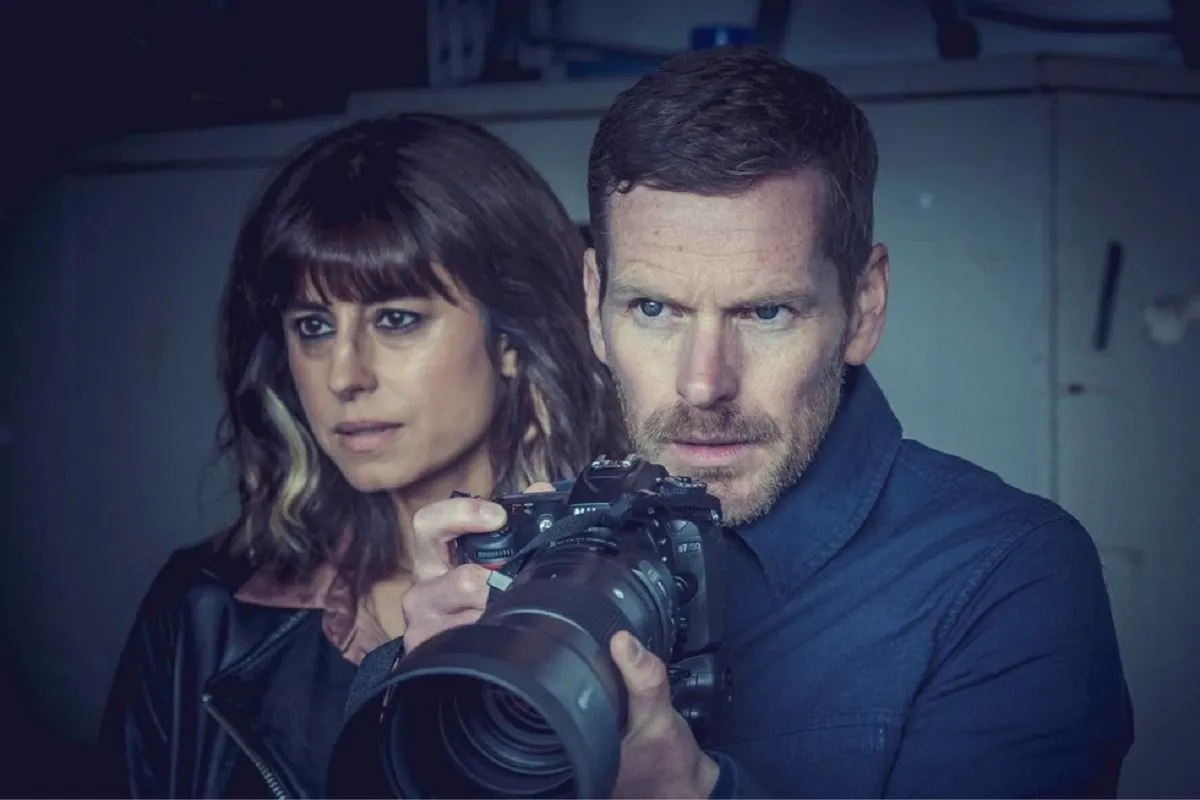
The show frames this as low-fi espionage, and it commits to the look and texture of that approach. John plants trackers, hacks laptops, and leans on sources in spaces chosen for their plainness. The work plays out like routine procedure punctuated by sudden violence, with the kind of grim practicality that makes the job feel clerical until it becomes lethal.
That scale choice affects the tone. The genre’s usual sheen gets peeled away, and what’s left resembles administrative work with spikes of danger. It also fits the series’ temperament: a spy story that finds drama in process and persistence, not in spectacle.
Structurally, the four-episode limit helps. The narrative moves without the drag that can haunt six-part dramas. Episode one sets a brisk pace, and episode three pushes hard toward resolution. The writing leans on cliffhangers, and some of them land like shortcuts, feeding the viewer information John has not reached yet.
That creates dramatic irony and keeps momentum ticking. The twists can start to feel familiar for anyone steeped in primetime rhythms, yet the show rarely loses its grip on forward motion. It stays committed to the grind of the work, and the tension comes from how quickly that grind starts shredding John’s private life.
The Bilious Beauty of the Munden
Visually, the series commits to a dour aesthetic. The cinematography favors bilious color palettes and oblique camera angles that echo the classic malaise of The Ipcress File. The show frames itself as an anti-Bond proposition and makes that argument through environment.
The locations are flat-roofed pubs, high streets littered with takeaway joints, and spaces that look lived-in and slightly worn down. The Merseyway shopping centre in Stockport becomes a key backdrop, and its recognizably bleak texture anchors the stakes in a reality that feels close enough to touch.
This approach extends to sound design and the show’s general tension temperature. The energy often sits closer to standard crime drama than high-octane thriller. The atmosphere runs on exhaustion. The series uses settings that feel like “edible mush” in the best sense: plain, filling, a little grim, and perfectly matched to a protagonist who looks permanently tired. Saving the world plays like grubby labor here, conducted in dirty car parks and fluorescent-lit interiors where heroism feels like a function of persistence.
The Playwright’s Pen and the Screen’s Demands
David Eldridge brings a playwright’s attention to psychology, and the script keeps circling the toll that deception takes. Dialogue frequently carries heavy exposition, bridging plot gaps and explaining the intricacies of MI5’s mental health support. Some lines land with a thud, especially when secondary characters announce John’s reputation before he has even sat down. Those moments feel like the show clearing its throat.
The performances keep the material moving. Shaun Evans stays likable even while John behaves like a professional headache, and he finds a bewildered vulnerability that suggests a man drowning in the choices he keeps defending. Zahra Ahmadi plays Mehreen as a steady counterpoint, and that steadiness gives scenes a needed ballast. The villains sometimes tip into cartoonish territory, complete with knives brandished with theatrical menace, and the show’s grounded textures strain a bit in those flashes.
Eldridge’s script feels strongest during the focus on the psychological obsession driving the central couple. The dialogue captures the cadence of a long-term argument where each word carries years of resentment, and each pause feels like a tactic. The show understands that a marriage can develop its own tradecraft.
The Gravity of the Primetime Potboiler
The series sets up a “double betrayal” idea, with national treason reflecting marital infidelity. It’s an ambitious pitch, and it bumps against the weight of “ITVness,” that gravitational pull that tugs complex ideas toward a familiar, “edible” format.
As the national security stakes climb, the marriage drama can drift to the side, sometimes even reading as a separate show playing in the next room. The question lingers inside the pacing: can Claire’s fatigue compete with an Iranian terror plot for attention once the thriller machinery really starts spinning?
Placed next to “prestige” spy dramas like Slow Horses or London Spy, Betrayal plays closer to a primetime potboiler. It prioritizes propulsion, and it keeps the gears turning with clean, efficient beats. That makes it sustaining television, even while it lacks the nourishment of more experimental genre entries.
It sits in the middle tier of modern British drama, comfortable enough to watch, grim enough to sting, and still willing to ask: does the terror threat make the personal betrayal hit harder, or does it shrink the domestic war into background noise?
Betrayal premiered on ITV1 and ITVX on February 8, 2026, as a gritty, four-part espionage thriller that strips away the usual glamour of the genre. The series follows John Hughes, a veteran MI5 operative whose professional life is crumbling just as a credible foreign threat emerges, forcing him to balance a high-stakes investigation with the messy reality of his failing marriage. Filmed on location in Liverpool and Manchester, the show offers a “down-to-earth” look at modern intelligence work, trading high-speed chases for the psychological toll of decades of secrecy. All episodes are currently available to stream as a box set on ITVX and STV Player.
Full Credits
Title: Betrayal
Distributor: ITV1, ITVX, ITV Studios
Release date: February 8, 2026
Rating: TV-MA
Running time: 46 minutes
Director: Julian Jarrold
Writers: David Eldridge
Producers and Executive Producers: Irma Inniss, Damien Timmer, Shaun Evans, David Eldridge, Julian Jarrold, Tom Leggett
Cast: Shaun Evans, Romola Garai, Gamba Cole, Zahra Ahmadi, Nikki Amuka-Bird, Omid Djalili, Matthew Tennyson, Hayley Tamaddon, Anthony Flanagan, Paddy Rowan, Waj Ali, Karim Kadjar, Emma Cunniffe
Director of Photography (Cinematographer): Felix Wiedermann
Editors: Kristina Hetherington
Composer: Adrian Johnston
The Review
Betrayal
Betrayal is a sturdy, if slightly dour, addition to the British espionage canon. It succeeds by grounding the high-stakes world of MI5 in the relatable, exhausting reality of a crumbling marriage. While it occasionally succumbs to the predictable rhythms of a primetime thriller, the soulful performances of Shaun Evans and Romola Garai elevate the material above standard procedural fare. It is a bleak, effective study of how professional lies eventually poison personal truths.
PROS
- Strong, vulnerable lead performances.
- Authentic, gritty Northern locations.
- Tight, four-episode pacing.
- Insightful look at "spy fatigue."
CONS
- Predictable "ITV-style" plot twists.
- Heavy-handed exposition in dialogue.
- Thriller stakes can overshadow the drama.
- Occasional "cartoonish" villain tropes.







