























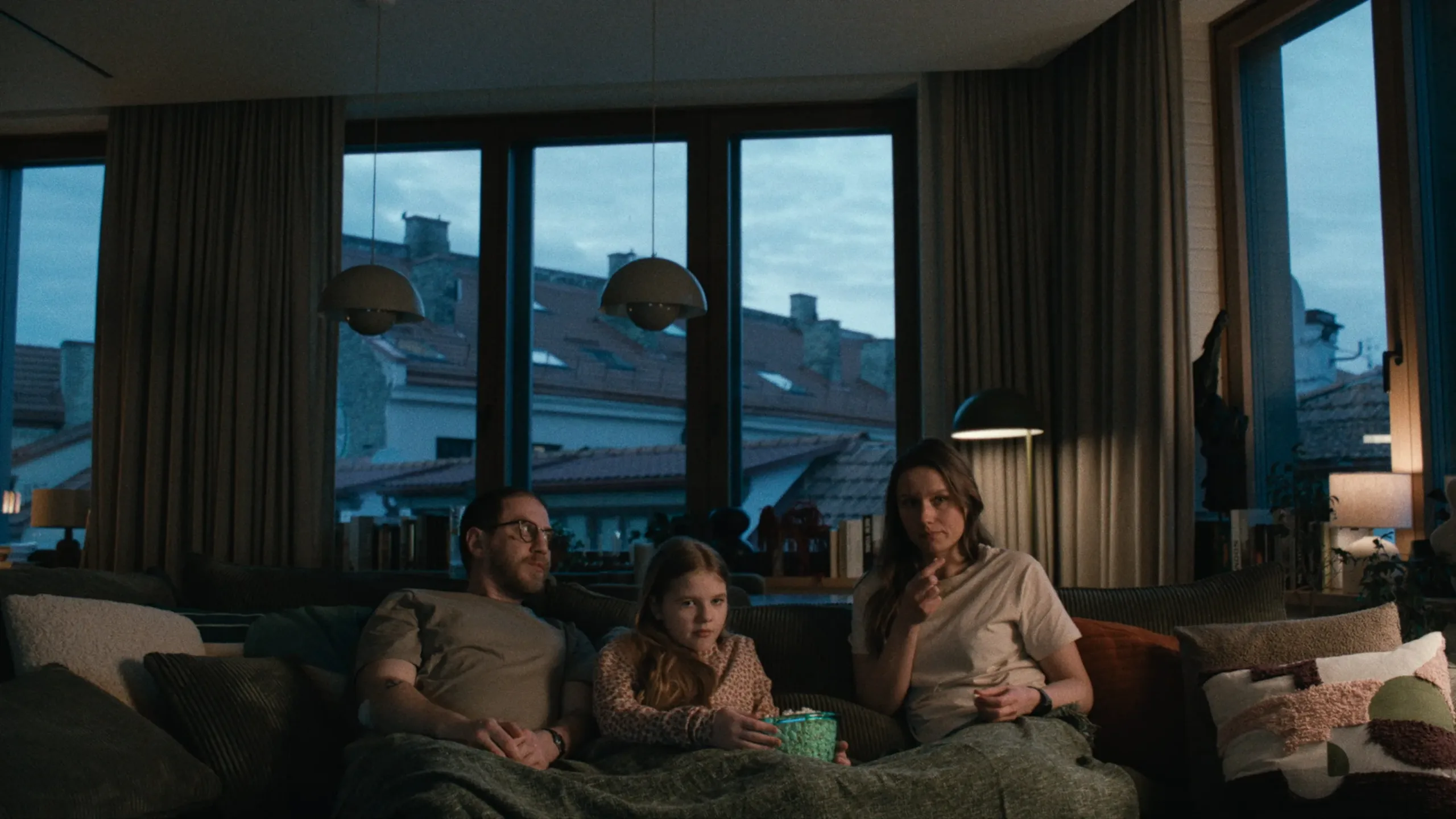

In the biting chill of a Lithuanian February, the sky over Vilnius presses down like a leaden ceiling, mirroring the inner weather of a union coming apart. Marija, a sharp executive at the height of her professional power, keeps the house moving with practiced rhythm. Vytas, her husband, drifts as a screenwriter surrounded by unproduced ideas and domestic stillness.
Their twelve-year history snaps shut inside the quiet shell of a parked car while their daughter, Dovile, practices her violin nearby. The catastrophe arrives with cruel timing. Hours after the foundation of their shared life gives way, the world outside splits open as Russia launches its invasion of Ukraine.
The film aligns these ruptures with dry, surgical precision, draining the image of comfort. It places the characters in a kind of purgatory where the end of a marriage sits beside the death of peace in Europe. Cold late-winter light falls across their faces and exposes an isolation that feels intimate, then suddenly cosmic, as if private grief can be measured against a continent’s alarm.
The Geography of Displaced Grief
The immediate wake of the split sends Vytas back into the cramped, psychic rooms of his childhood home. The generational divide turns into a daily front line. He stares at a television while his parents consume Russian state propaganda, a steady stream of distortion that deepens his estrangement. He walks among the ghosts of his past, pinned between old furniture and old scripts, and the space seems to shrink around him.

Marija returns to her desk at Hungry Rabbit, a company devoted to the production of disposable social media videos. Her commitment to professional order carries a haunting absurdity as her private life collapses and the continent catches fire. The nearness of the front lines plants a persistent, low-frequency dread beneath every exchange. Rituals continue because society insists they continue, yet the quiet corner needed to mourn a dead love keeps disappearing under the shadow of a larger tragedy.
Also Read






The film keeps repeating this ethical pressure: handle your personal ruins while sirens from a nearby war remind you that your suffering ranks small on the scale of history. That ranking does not soothe. It humiliates. It blocks the clean shape of grief and denies the mind a place to finish its own sentence. Their days become a suspended state, restless and anxious, with no room for emotional closure. The marriage ends, yet the ending refuses to arrive. The world continues to intrude, and the intrusion becomes part of the wound.
The Vanity of Virtue
As the conflict intensifies, Marija and Vytas move toward different forms of moral display, like two people searching for an exterior script that might explain interior damage. Marija opens her home to a Ukrainian mother and her children. The gesture offers purpose at first, a way to make the chaos speak a language of responsibility.
Shared living soon becomes its own quiet siege of kitchen messes and language barriers, and her empathy meets its limit in the space between intention and daily irritation. She quits her job over corporate ties to Russia, a decision that carries the weight of principle. The act also exposes the luxury built into her position, the kind that allows righteousness to function as a choice.
Vytas moves toward something more visceral. He joins street protests where he lies motionless in pools of fake blood. He lashes out at vehicles with Russian plates. The actions read as an attempt to force pain into a visible object, to make it public, physical, and legible. The political theater becomes a mask for a private ache that refuses to name itself. Their activism operates like self-soothing, a shield against guilt, a way to turn the failure of their marriage into something with a cleaner moral silhouette.
The presence of Marija’s secret lover, Jurate, complicates this terrain further. Betrayal sits inside the same frame as solidarity. The drive toward social justice begins to look entangled with escape, with the urge to outrun the messy truths waiting at home. The film watches them reach for virtue the way a drowning person reaches for driftwood. It holds open an uneasy question: how much of our public goodness is built from the rubble of private damage, and how much of that goodness survives contact with ordinary life?
Shadows in a Static Frame
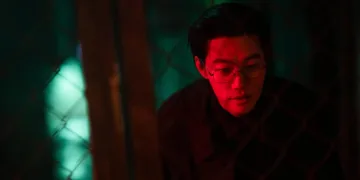
Andrius Blaževičius studies this human wreckage through the lens of Narvydas Naujalis, and the camera behaves like a detached witness. Wide, static compositions dominate, stretching space between characters and refusing the easy comfort of the close-up. The central moment of separation is captured through the glass of a car windshield in a single grueling take. The distance becomes the point. The audience turns into a watcher of a quiet implosion that remains just out of reach, close enough to sting, far enough to deny rescue.
As the story moves forward, the physical world begins a subtle decay. The bright, sterile perfection of Marija’s apartment gives way to clutter and shadow, a slow collapse that echoes the exhaustion settling into every room. Žygimantė Elena Jakštaitė and Marius Repšys play with striking restraint. Years of resentment leak through silence, through posture, through the careful avoidance of eye contact. Their bodies carry the weight of things never said aloud. They move through a city that still stands, through routines that still function, and yet the ground under meaning feels unstable.
The film refuses catharsis and refuses to tidy the wreckage into a lesson. It leaves Marija and Vytas standing among the remains of their lives, awake to the fact that some fractures persist long after the first blast fades into history’s background noise.
The war does not end their pain, and their pain does not end the war. Two disasters share the same calendar, and the human mind tries to live inside that coincidence. The result feels like an existential chill that lingers in the lungs, a recognition that repair has limits, and that survival can look like continuing forward with something broken still inside you.
How to Divorce During the War premiered at the 2026 Sundance Film Festival on January 26, 2026, where it earned the Directing Award in the World Cinema Dramatic competition. Set in Vilnius, Lithuania, in early 2022, the film examines the collapse of a marriage against the backdrop of the Russian invasion of Ukraine. Currently, the film is appearing at international festivals and is distributed by New Europe Film Sales. While it has not yet transitioned to major streaming services like Netflix or Amazon Prime, it is anticipated for theatrical and digital release later this year.
Full Credits
Title: How to Divorce During the War
Distributor: New Europe Film Sales, M-Films
Release date: January 26, 2026
Running time: 108 minutes
Director: Andrius Blaževičius
Writers: Andrius Blaževičius
Producers and Executive Producers: Marija Razgutė, Brigita Beniušytė, Vincent Quénault, Jeanne Geiben, Jessie Fisk, Jakub Kostal, Vratislav Šlajer
Cast: Marius Repšys, Žygimantė Elena Jakštaitė, Amelija Adomaitytė, Indrė Patkauskaitė, Gintarė Parulytė
Director of Photography (Cinematographer): Narvydas Naujalis
Editors: Anna Ryndova
Composer: Jakub Rataj
The Review
How to Divorce During the War
How to Divorce During the War is a stark, haunting meditation on the inconvenient timing of personal tragedy. Blaževičius masterfully captures the friction between domestic collapse and geopolitical ruin, refusing to offer easy comfort or false heroism. By focusing on the friction of daily life rather than the spectacle of combat, the film reveals the quiet, often selfish ways we attempt to survive a world in pieces. It is a demanding, emotionally distant experience that lingers like the chill of a Lithuanian winter.
PROS
- The use of static wide shots and long takes creates a powerful, voyeuristic tension.
- It bravely explores the performative nature of activism and the limits of middle-class empathy.
- Captures the specific, high-tension dread of living on the edge of a global conflict.
- The lead actors convey deep-seated resentment through subtle physical cues rather than melodrama.
CONS
- The clinical directing style may leave some viewers feeling detached from the characters' plight.
- The deliberate, observational speed requires significant patience.
- The impact of the divorce on the daughter, Dovile, feels secondary to the parents' existential crises.