








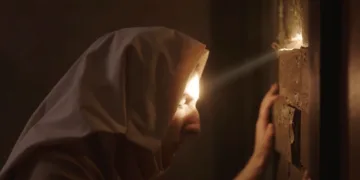














Revenge arrives here wearing a silver-grey bouffant and an accountant’s instinct for structural damage. Channel 4’s new A Woman of Substance understands Barbara Taylor Bradford’s saga as a fantasy of delayed correction: the poor girl is humiliated, the rich man retreats into cowardice, the house keeps standing, and decades later a woman with money decides that memory should have a balance sheet.
That is a dangerous way to adapt this material, because sincerity and ridiculousness are not enemies here. They are co-owners. The eight-part series moves between 1970s New York, where Brenda Blethyn’s older Emma Harte fights a corporate betrayal after leaked medical records send Harte Enterprises into panic, and early 1900s Yorkshire, where Jessica Reynolds’ young Emma works as a maid at Fairley Hall. One timeline is steel, marble, share prices, family treachery, and revenge speeches delivered like someone just discovered capitalism has lighting cues. The other is moorland, servant bells, dressmaking, sexual exploitation, and the long education of a woman who learns that class is less a ladder than a door slammed from the inside.
The show’s most honest idea is also its most melodramatic one: Emma does not become powerful because she transcends injury. She organizes around it. Call it grievance architecture. A person is wounded, then she builds a life sturdy enough to house the wound, decorate it, monetize it, and invite the offenders over for dinner.
Young Emma and the Price of Self-Revision
Jessica Reynolds gives the series its spine. Young Emma could easily become a costume-drama abstraction, all cheekbones and moral certainty, but Reynolds keeps giving her small refusals before the plot gives her grand ones. At Fairley Hall, Emma watches before she reacts. She notices who gets to be tired, who gets to be careless, who can damage another person and call it weather. Her early dressmaking scenes matter because the series treats them as intelligence in action. When Emma turns old garments into something desirable, she is not merely displaying talent; she is learning conversion. Fabric into value. Taste into leverage. Service into strategy.
Reynolds also lets Emma’s accent carry social pressure. When Frank, her brother, complains that she no longer sounds like herself, the line lands harder than many of the bigger speeches. The show is not subtle about class, but this moment is. Emma’s climb begins before the money. It begins when her voice becomes an instrument she edits for survival. There is a quiet cruelty in that. Mobility asks her to leave poverty, then charges her for every trace of departure.
The romance with Edwin Fairley gives the early episodes their necessary trap. Ewan Horrocks plays Edwin as a soft failure rather than a grand villain, which is smarter. The moorland meetings and cave-set intimacy have the heat modern period drama now seems contractually obliged to provide, yet Horrocks makes Edwin’s weakness visible inside the romance. His promises to Emma sound sincere because he believes them while saying them. Then Emma becomes pregnant, and sincerity folds under the first real consequence. That is Edwin’s whole tragedy, and Emma’s: he is not lying when he imagines himself brave. He is lying when he imagines bravery will cost nothing.
Also Read





Fairley Hall, or How Power Decorates Itself
Fairley Hall is the series’ best argument. The house is beautiful in the way oppressive systems often are, which is to say it has excellent taste and terrible ethics. The production design gives the estate atmospheric corridors, heavy rooms, intimate boudoirs, servant spaces, and those moors outside that seem to promise freedom while mostly providing a scenic place for ruin. The place looks stable, ancestral, inevitable. Then the behavior inside it reveals the rot.
Emmett J. Scanlan’s Adam Fairley turns aristocratic entitlement into a bodily condition. He does not need to raise his voice often, because the house has been built to amplify him already. In scenes with Adele, played by Leanne Best, his control has a chilling domestic casualness: she is wife, embarrassment, possession, and inconvenience, depending on the hour. With Olivia, played by Lydia Leonard, desire becomes another form of management. With servants, his authority is so complete that exploitation barely requires theatrical villainy. The performance works because Scanlan gives Adam a blankness that reads as privilege metabolized into personality. A smile from him can feel like paperwork for someone else’s suffering.
The show weakens itself when it spends too long inside the Adam, Adele, and Olivia triangle. The boudoir intrigue supplies scandal, certainly, and Best gives Adele a tragic volatility that keeps the material from turning into simple bedroom chess. Still, repetition creeps in. Adam wants, Olivia trembles or calculates, Adele collapses or lashes out, and the series returns to the same emotional furniture with new sheets. There is heat here, but also padding. By episode count alone, the bed becomes a supporting character.
Gerald’s treatment of Polly and Edwin’s abandonment of Emma make the Fairleys feel less like a family than a social mechanism. Each man demonstrates a different style of cowardice. Adam dominates, Gerald consumes, Edwin retreats. The women beneath them are asked to absorb the damage and remain narratively useful afterward. Emma refuses. The whole series depends on that refusal.
The People the Adaptation Keeps, and the Ones It Thins Out
The supporting characters around Emma reveal the strengths and losses of this version. Lenny Rush gives Frank an immediate emotional charge. His scenes with Emma do not need grand dialogue; the sibling bond is built through teasing, concern, and the painful intimacy of people who know exactly how little the world has budgeted for them. Will Mellor, as Emma’s father, gives the early family material a grounded warmth that makes Emma’s later choices feel less clean than the revenge fantasy wants them to be. When she pushes forward, the show wants the pep of ambition. Mellor and Rush keep reminding us that departure is not morally weightless.

Mac O’Neill is a more frustrating case. Niall Wright has charm, and the renamed character has clear functional importance as Emma’s loyal Irish friend and near-romantic possibility. Yet the writing too often treats him as a chorus of admiration. He punches, smolders a little, wears the rogueish earring, and marvels at Emma’s competence. This is useful to the plot and deadly to personhood. A character cannot survive on loyalty alone, unless the drama mistakes devotion for depth. This one sometimes does.
The reduction of the Kallinski family narrows the show’s social imagination. Emma’s story gains force when class oppression sits beside other forms of exclusion, because Leeds at the turn of the century was not populated only by aristocrats, servants, and handsome emotional liabilities. Removing much of the Jewish immigrant strand makes Emma’s awakening feel tidier, less historically textured. The series modernizes the sexual politics and sharpens the revenge, yet it loses some of the civic density that would make Emma’s rise feel embedded in a fuller world.
This is the adaptation’s central bargain: it gives Emma a cleaner dramatic burn, then sacrifices some of the smoke.
Camp, Craft, and the Strange Dignity of Excess
Brenda Blethyn’s older Emma exists in a different theatrical climate. Her 1970s New York scenes are visibly less convincing as geography, with streets and spaces that rarely persuade the eye that the production has crossed the Atlantic. Yet Blethyn almost turns that artificiality into fuel. Her Emma belongs to a world of corporate melodrama, gleaming offices, glamorous costumes, hostile children, and lines about revenge that deserve their own pension plan. When she confronts her eldest daughter, Blethyn moves from contempt to hurt with enough force to suggest that the empire did not cure Emma’s loneliness. It gave her better rooms in which to experience it.
The problem is that older Emma often functions as a frame rather than a full dramatic engine. The marketing may lean on Blethyn, but Reynolds carries the hours. This imbalance is not fatal, since the younger timeline has the richer material, but it leaves the 1970s sections feeling like an appetizer served after the main course has already begun. Blethyn is vivid enough that the show creates a hunger for scenes it does not always provide.
The eight-episode structure cuts both ways. The early Fairley Hall material benefits from space: Emma’s work, her family, her romance with Edwin, her first humiliations, and her sharpening eye for power all need time. Later, the middle of her rise can feel strangely rushed, as if the show has spent so much energy explaining the wound that it hurries through the building of the empire. The transformation from maid to seamstress to business owner should be the great procedural pleasure of the saga. Here, some of that process arrives in leaps.
Still, A Woman of Substance has the courage of its absurdity, which is rarer than it sounds. It does not wink at the deathbed advice, the cave sex, the Fairley villainy, the corporate coup, or Emma declaring revenge as a life’s work. It commits. At times this produces glorious nonsense. At other times, it produces real feeling. The difference is less stable than reason would prefer, which is unfortunate for reason. Television, naturally, carries on without asking permission.
The series premiered on Channel 4 on March 11, 2026, and is available for streaming on the Channel 4 platform. Based on the bestselling novel by Barbara Taylor Bradford, the drama follows Emma Harte’s journey from an impoverished maid in Yorkshire to a powerful international business mogul over the course of six decades.
Where to Watch A Woman of Substance Online



Full Credits
Title: A Woman of Substance
Distributor: Channel 4
Release date: March 11, 2026
Rating: TV-MA
Running time: 60 minutes
Director: John Hardwick, Samantha Harrie, Richard Senior
Writers: Katherine Jakeways, Roanne Bardsley
Producers and Executive Producers: Charlie Palmer, Beth Willis, Joe Innes, George Faber, Katherine Jakeways, Roanne Bardsley, The Barbara Taylor Bradford Trust
Cast: Jessica Reynolds, Brenda Blethyn, Emmett J. Scanlan, Lydia Leonard, Leanne Best, Ewan Horrocks, Harry Cadby, Will Mellor, Lenny Rush
Director of Photography (Cinematographer): Andrew McDonnell, Tony Slater Ling, Simon Archer
Editors: Natasha Wilkinson, Keelan Gumbley
Composer: Jack Halama
The Review
A Woman of Substance
A Woman of Substance understands revenge as a building project: first the wound, then the scaffolding, then the empire. Its eight episodes sometimes mistake repetition for scale, especially in the Fairley bedroom intrigues, but Jessica Reynolds gives Emma Harte a fierce moral temperature, while Brenda Blethyn supplies the mythic glare. The result is uneven, overstuffed, frequently absurd, and still hard to resist. Melodrama wins, which is embarrassing for reason and excellent for television.
PROS
- Jessica Reynolds’ commanding Emma
- Brenda Blethyn’s grand camp force
- Strong Fairley Hall atmosphere
- Sharp class-revenge engine
- Lavish costumes and interiors
CONS
- Padded eight-episode structure
- Thinly written Mac O’Neill
- Reduced Kallinski material
- Repetitive bedroom intrigue
- Rushed middle of Emma’s rise