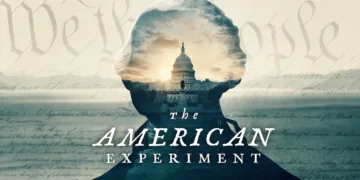






















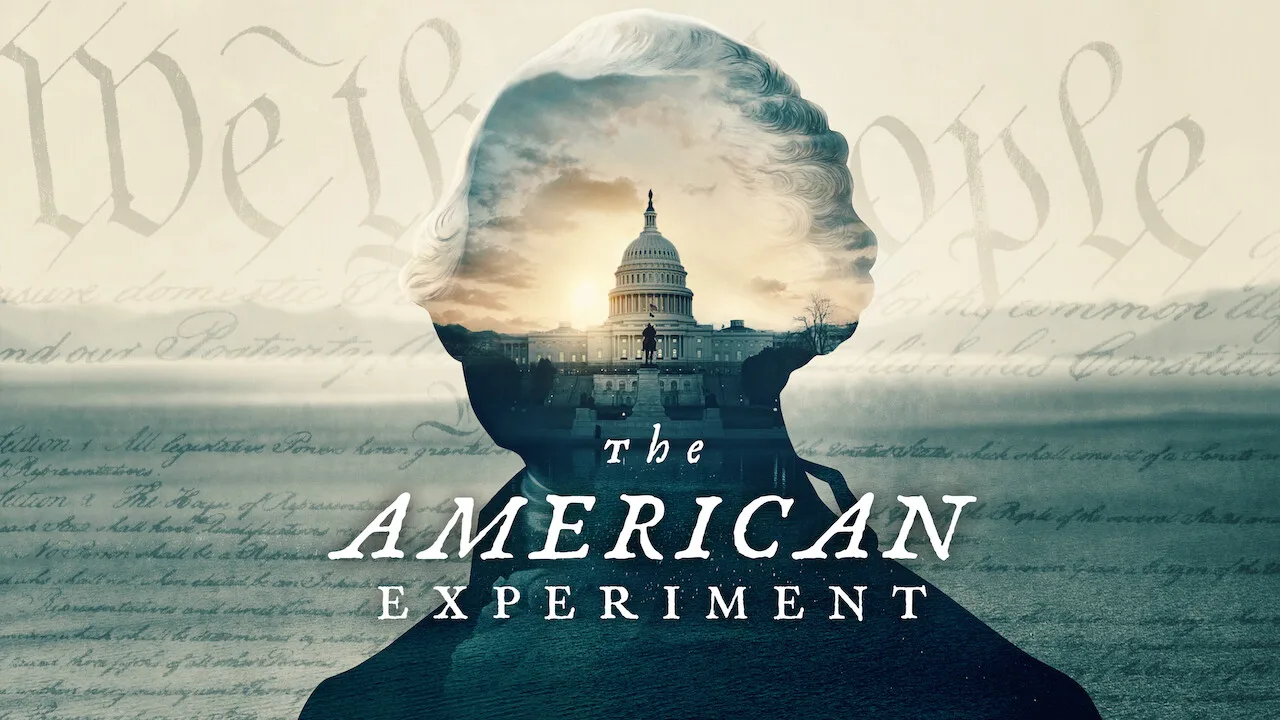

Civics lessons rarely benefit from suspense, which is why this five-part Netflix series is at its sharpest when it treats the founding as a sequence of near-failures. The American Experiment, directed by Brian Knappenberger and executive produced by Tom Hanks, looks at the United States from the French and Indian War through the Revolution, the Constitution, and George Washington’s presidency. Its real subject is less the birth of America than the number of ways that birth nearly went wrong.
The series arrives for the country’s 250th anniversary with the posture of a public institution: sober, balanced, polished, and very aware that someone in the room is ready to complain about bias. That caution sometimes flattens it. Yet the structure has a useful spine. Each episode asks viewers to see democracy as a system built under stress, by people with courage, vanity, blind spots, land interests, and deeply selective definitions of freedom. That is a better premise than birthday candles.
The Revolution as a Chain Reaction
The early episodes move through familiar material with clean cause and effect. George Washington’s role in the French and Indian War is used to show that the future revolutionary hero first enters the story as a British officer who helps ignite a wider imperial conflict. From there, the series tracks colonial resentment over taxation, the Boston Massacre, the Boston Tea Party, Lexington and Concord, and Bunker Hill.
This is where the show is most useful as a primer. It explains why British attempts to raise revenue after the Seven Years’ War turned colonial frustration into organized resistance. The series does not assume rebellion was inevitable, and that helps. A detail about the tea dumped into Boston Harbor, which was cheap enough that the colonists could have simply bought and drunk it, gives the protest a sharper narrative function. This was not destiny in powdered wigs. It was a choice, followed by another choice, followed by a war that the colonists were very capable of losing.
The problem is repetition of historical shape. If the viewer already knows the route from taxation to rebellion to constitutional argument, the first half can feel like a sturdy classroom version of events. The storytelling is sound, yet soundness has its limits. There are only so many times a series can cut from a historian to a map to a musket line before the machinery starts to show.
The Museum Has a Good Lighting Budget
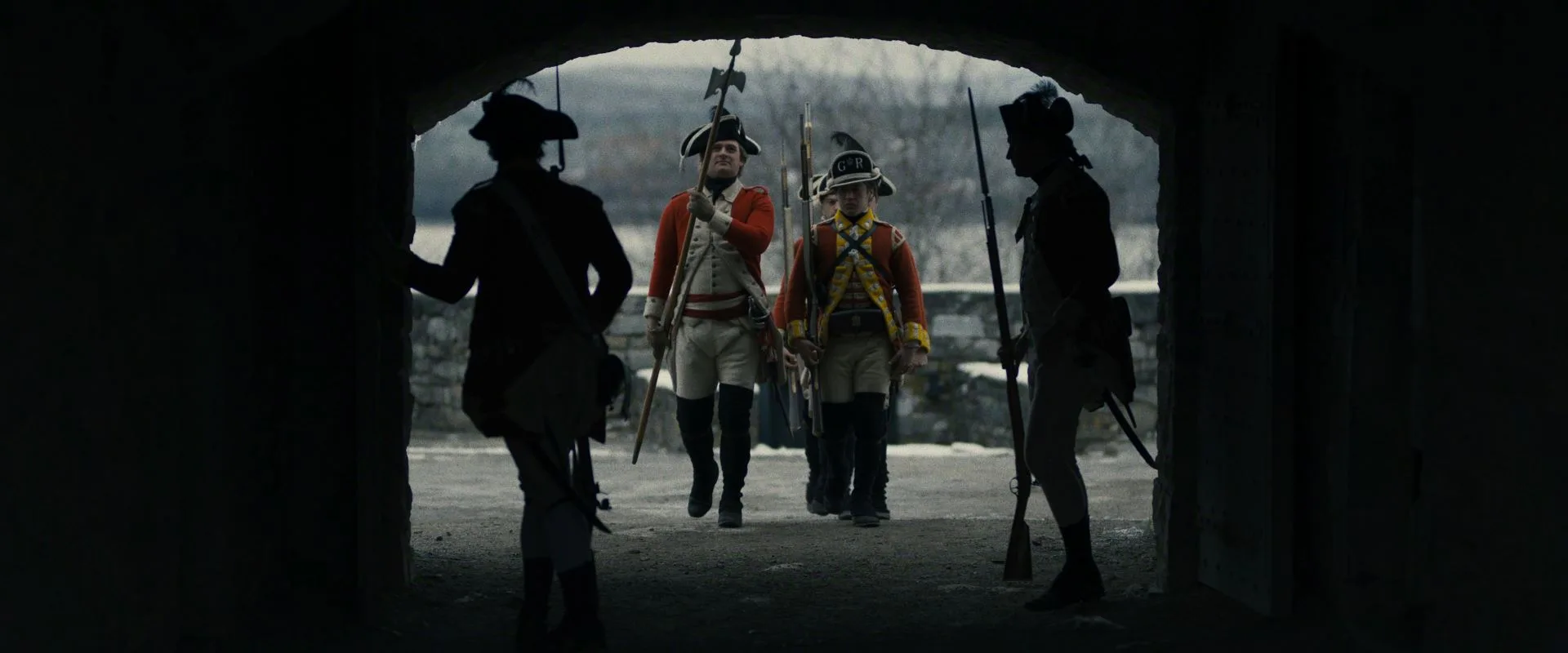
Knappenberger’s visual approach is controlled and legible. Documents, portraits, maps, preserved letters, and printed materials are framed with the careful symmetry of a museum display. The reenactments avoid cheap frenzy. Battle scenes lean on smoke, shouting, musket fire, and bodies moving through confusion, while the Continental Congress material emphasizes the less cinematic labor of argument: men in hot rooms building rules that would outlive most of their intentions.
The voice work gives the archival material a needed human pulse. Martin Sheen reads George Washington’s writings with enough gravity to make the correspondence feel reflective rather than embalmed. The series also uses actors for John Adams, King George III, and other figures, turning letters into scenes without pretending those scenes are full drama. It is a sensible compromise. History television often struggles between page and performance. This series keeps one hand on the document at all times.
Pacing is the craft issue that cuts both ways. Five-plus hours is brisk for the amount of material covered, but early sections are crowded with names, battles, grievances, committees, and founding principles. The show is clearest once it reaches “We The People,” where the argument moves from what happened to what the structure of the country permitted, protected, and refused to confront. The spine tightens there. Before that, the series is organized. After that, it has pressure.
The Contradictions Were in the Blueprint
The strongest section of The American Experiment comes when the Constitutional debates expose slavery as the crisis the founders managed by deferring it. The Atlantic slave trade, the three-fifths compromise, and the political power granted to enslavers are treated as structural facts, not unfortunate footnotes. That choice matters. A country cannot be understood through its ideals alone when its governing document also counted human beings for the benefit of the people holding them captive.
The series is careful to widen that argument. Indigenous nations are excluded from the negotiations that reshape the continent around them. Women are left outside the vote for generations. Washington’s own land interests in the Ohio Valley complicate the cleaner schoolbook version of his revolutionary motives. These are not decorative corrections. They are load-bearing parts of the story.
The modern footage gives this argument its bluntest edge. Civil rights marches, Black Lives Matter protests, and the January 6 attack on the Capitol appear as reminders that the old questions did not stay old. Who gets freedom? Who counts? Who accepts defeat? Who benefits when the rules bend? The series sometimes stops just short of making its connections with full force, especially when it lets montage do work that analysis should finish. The footage knows what it means. The script occasionally acts as if politeness is a civic duty.
The Talking Heads and the Weight of Their Records
The bipartisan roster is both smart television structure and a recurring distraction. Hillary Clinton discussing the Electoral College has obvious relevance, especially when she calls it an “abomination.” Mike Pence reflecting on the certification of the 2020 election also belongs here, since the peaceful transfer of power is one of the series’ central stress tests. Al Gore’s presence sharpens that thread, given his own role in certifying a result that cost him the presidency.
Other choices are harder to separate from the careers attached to them. Ted Cruz praising George Washington’s restraint invites the kind of viewer reaction no editor can fully control. Rand Paul discussing tyranny, Kamala Harris parsing freedom, Nancy Pelosi, Jamie Raskin, and Stephen Breyer offering institutional memory: each appearance serves the series’ wish to stage democracy as argument. The trouble is that argument on camera can look tidy in a way politics rarely is. Everyone sounds measured because the edit requires them to. Democracy, conveniently, has been given good media training.
Still, the structural idea works. By placing current figures beside historians, Native scholars, constitutional experts, and archival voices, The American Experiment makes its case through collision. The founding was unfinished because the founders were unfinished. The country remains unstable because the design invited conflict, postponed moral reckoning, and trusted future citizens to repair what the original architects could not, or would not, fix. That is a hard enough lesson for a respectable Netflix docuseries. Hard lessons count.
The American Experiment is a prestigious five-part historical documentary series that premiered on Netflix on June 24, 2026, ahead of the nation’s 250th anniversary. Co-produced by Tom Hanks’s Playtone and Luminant Media, the series explores the founding of the United States from the Revolutionary War through the drafting of the Constitution and the first presidency. It reexamines the radical premise of whether a people can truly govern themselves by combining cinematic historical reenactments with contemporary, bipartisan interviews from major political figures and historians across the ideological spectrum. You can watch all five episodes of this docuseries streaming exclusively on Netflix.
Where to Watch The American Experiment Online


Full Credits
Title: The American Experiment
Distributor: Netflix
Release date: June 24, 2026
Rating: TV-MA
Running time: 5 episodes (approx. 50–60 minutes per episode)
Director: Brian Knappenberger
Writers: Brian Knappenberger
Producers and Executive Producers: Tom Hanks, Gary Goetzman, Brian Knappenberger, Sarah Huisenga
Cast: Martin Sheen, Hillary Clinton, Mike Pence, Al Gore, Jamie Raskin, Lisa Blunt Rochester, Rand Paul, Stephen Breyer, Kamala Harris, Ted Cruz
Director of Photography (Cinematographer): Samuel Russell
Editors: Aaron Fairley, Bryan Storkel
Composer: John Dragonetti
The Review
The American Experiment
The American Experiment works best as a civic refresher with a structural conscience. Its reenactments, document readings, and historian chorus make the founding feel contingent rather than ordained, while its modern political commentary gives the series its necessary pressure. The weakness is depth: five episodes can explain the Revolution, the Constitution, slavery, partisanship, and January 6, but the stitching shows. A sturdy primer, then, with enough spine to avoid becoming a birthday card.
PROS
- Strong Washington material
- Clear historical structure
- Polished reenactments
- Useful modern parallels
- Wide political range
CONS
- Familiar Revolution timeline
- Early episodes feel dense
- Present-day links can be underdrawn
- Some talking heads distract