

























![Kingdom Hearts Collection [I-III] Review](https://gazettely.com/wp-content/uploads/2026/10/Kingdom-Hearts-Collection-I-III-1-360x180.webp "Kingdom Hearts Collection [I-III] Review: KHII Holds Steady as Newer Entries Fluctuate 37")



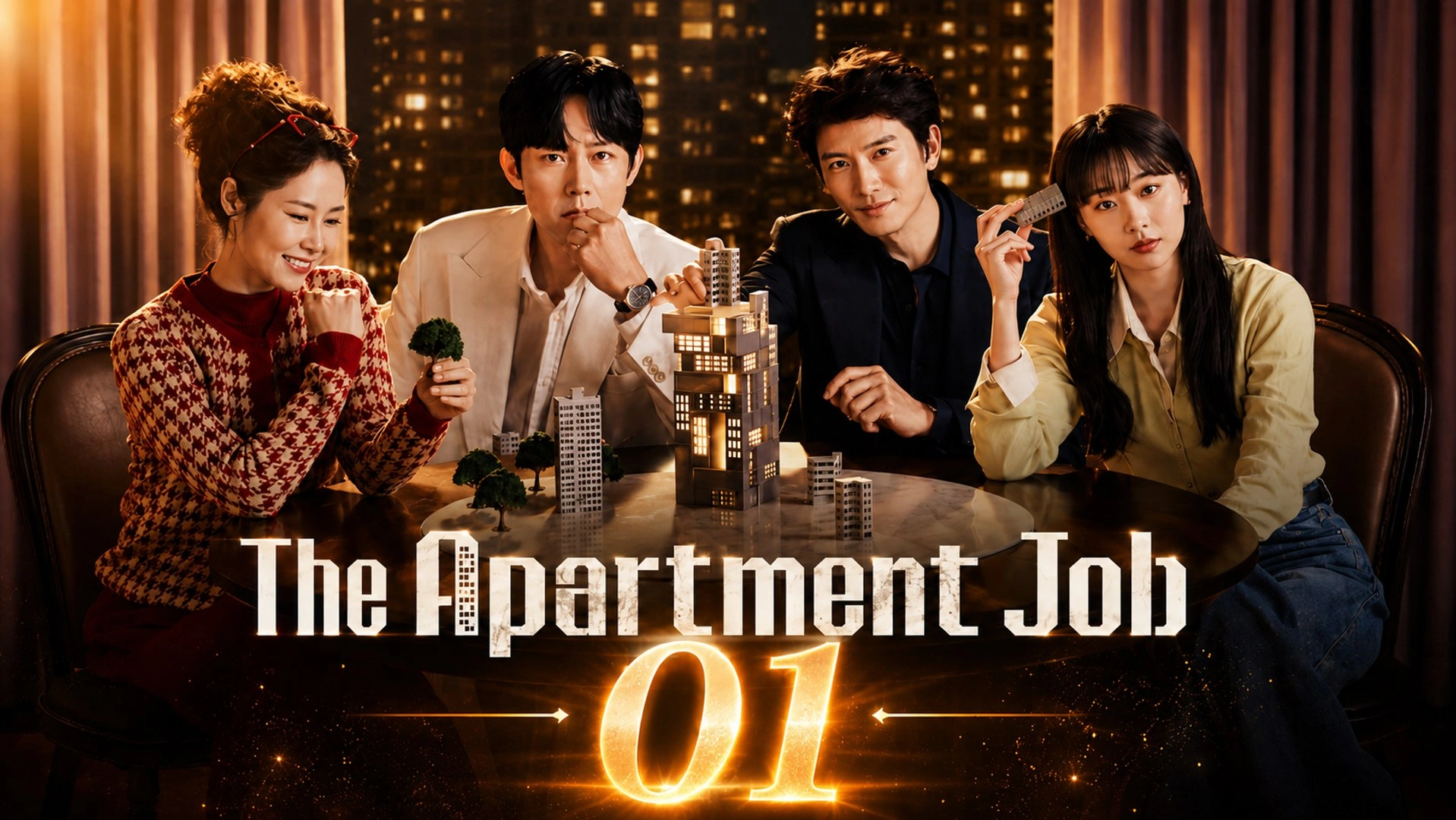

Turning a residents’ association election into a criminal entry point gives The Apartment Job its sharpest idea. Television has spent years treating penthouses as symbols of power. This series looks downstairs, toward the management office, where repair contracts, parking complaints, and committee votes offer their own routes to wealth.
Park Hae-kang runs HK Trading & Investment, a polished front for an illegal gambling operation. He studies debtors before approaching them, mapping their finances, property, and family weaknesses with the care of a private bank that has misplaced its compliance department. His authority rests on preparation. His position within Seoul’s wider power system rests on obedience.
During a hike with senior officials, Hae-kang carries luggage, arranges favours, distributes money, and offers to retrieve a lighter from the city. The sequence makes the hierarchy unmistakable. He may command Kyung-nam, Big Guy, and Je-gil inside HK Trading, yet men with legal and political titles treat him as a useful servant.
Their private One Club turns government into a membership scheme. Prosecutors, judges, media executives, and political operatives discuss national influence while tending bonsai trees at Pine Tree Farm. Police Commissioner Kwak Ju-gwon learns that entry will cost 10 billion won, so investigator Son Dae-un transfers the bill to Hae-kang. When Hae-kang cannot pay, Dae-un uses an audit and arrests to seize his employees and Park Yong-man, the older criminal who raised him. The law appears here mainly as a premium service for powerful subscribers.
Hae-kang receives three months to collect the money and free Yong-man. A debtor nicknamed Lizard proposes the solution: win control of an apartment complex’s residents’ association, gain access to its long-term repair reserve, and steal enough to settle the demand. The scheme is absurd, but the show understands that corruption rarely announces itself through masked thieves and laser grids. Sometimes it arrives through an inflated flooring invoice.
A System with Many Floors
The opening episodes create a moral field where nobody can claim clean hands. Hae-kang operates a gambling den and corners debtors with information gathered from their private lives. Lizard has been raising maintenance charges and repair bids to siphon money from apartment residents. Lee Chung-won, the wealthy penthouse resident, settles a parking dispute with smooth manners before terrorizing the offending tenant inside an indoor golf room.
Against them stand officials who turn public institutions into collection agencies. This flattening of morality keeps the series from presenting Hae-kang as a disguised civic hero. His loyalty may be sincere, but sincerity does not erase the people hurt by his business. The contrast lies in scale. Hae-kang collects debts for profit. Dae-un orders arrests to finance a colleague’s access to political power. One method is criminal. The other is criminal with stationery.
Lizard’s explanation of apartment finances gives the premise its social bite. He claims that stealing four billion won from 1,200 households was possible through inflated costs. Hae-kang lives in a complex containing roughly 10,000 households, where years of resident contributions have created a reserve large enough to solve his crisis.
The show’s target is the administrative distance between collective money and individual attention. Residents pay gradually, the fund grows quietly, and control passes to people most occupants barely know. Theft thrives inside that gap.
Episode 2 reinforces the point through small disputes. Women planting saplings are confronted by a resident who uproots them. Parking violations produce arguments that management staff cannot resolve. Residents complain that the current association president ignores family concerns. Jang Suk-jin questions why the repair reserve contains so much money.
Each incident appears trivial beside the One Club’s national manoeuvring, yet the same habits govern both spaces: private deals, informal authority, concealed incentives, and public systems managed through personal loyalty. The apartment complex becomes a reduced model of the country’s elite network. The furniture is cheaper. The behaviour survives intact.
This is where The Apartment Job feels especially attuned to contemporary television. Streaming dramas often turn corruption into spectacle, offering secret rooms, encrypted ledgers, and elegantly dressed villains. Here, institutional rot reaches viewers through maintenance fees and election paperwork, areas of life designed to discourage curiosity through boredom. Imagine discovering that civic apathy had production value.
The Family Photograph
Hae-kang’s first fundraising plan turns marriage into a cash event. After noticing the gifts collected at a celebration, he stages a wedding and hires Kang Ha-ri to be his bride for five million won. When guests demand a kiss, she charges another two million. Their brief thumb-kiss has the mechanical tenderness of two people approving a transaction at a payment terminal.

Ha-ri’s bargaining makes the scene. Ha Yoon-kyung does not play her hunger for money as a fixed comic expression. The calculation passes across her face. Discomfort becomes interest, interest becomes negotiation, and negotiation becomes performance. When Hae-kang’s men sing and dance at the reception, her reaction captures the strange humiliation of being paid well enough to remain in an intolerable room.
The wedding leaves the crew 6.5 billion won short, pushing Hae-kang toward Lizard’s plan. Yet becoming a building representative requires a convincing image of domestic stability. Other candidates have spouses and children. Hae-kang has employees, debtors, and a criminal record that would make an awkward campaign leaflet.
His solution is to extend the wedding performance for three months.
Ha-ri agrees to play his wife after he offers 100 million won, with 30 million paid in advance. Lizard receives debt forgiveness for becoming Hae-kang’s father. One associate lends his son to the household after Hae-kang promises educational support. The episode closes with the group posing for a formal family portrait, each smile backed by a separate financial arrangement. The image carries the series’ strongest contradiction. Hae-kang constructs a false family to rescue the man he regards as his real father.
A flashback explains that loyalty. Hae-kang’s gambling-addicted father once used him as collateral for a loan from Yong-man. Yong-man later burned the agreement and released the boy from that obligation. Hae-kang chose to stay. Their bond grew inside a criminal system, yet it provided the stability his biological family denied him.
Ha-ri’s deception carries a different social pressure. She has failed the bar exam and survives through temporary work, including posing as a parent during a school event. Her sister Ha-jeong still believes she is building a legal career and continues buying her clothes and supporting her financially. Ha-ri’s shame comes from dependency, not laziness. She gives free advice to an elderly inheritance client and confronts a man who dismisses a sexual-harassment complaint as a mistake, actions that help cost her a job measured through paying cases rather than useful counsel. The law office evaluates her through revenue. The criminal evaluates her through performance. Guess which institution offers the better salary.
Straight Faces, Bad Plans
Ji Sung gives Hae-kang enough control to make his comic failures register. He is intimidating while collecting debts and decisive when he rams the car of a resident blocking a parking space. Put an election application in front of him, though, and his certainty begins to collapse. The contrast works because Ji Sung never turns Hae-kang into a clown. He plays a skilled operator discovering that apartment respectability requires a different form of deception.
His scenes involving Yong-man expose the fear beneath that composure. During the prison visit, Hae-kang’s attention narrows. He has sold his apartment and car, collected outstanding debts, and dismissed his employees in an attempt to protect them. Their decision to return gives the criminal crew a warmth that the One Club lacks. The series is careful about where loyalty exists. The respectable men at Pine Tree Farm share interests. Hae-kang’s employees share risk.
Ha Yoon-kyung gives the first two episodes their fastest comic rhythm. Ha-ri can turn a pause into a counteroffer, then shift from greed to guilt once Ha-jeong enters the scene. Her dismissal from the legal consultation office lands because the script ties it to specific conduct. She refuses to flatter a client accused of harassment, physically defends herself when he becomes aggressive, and has failed to convert consultations into profitable cases. The system punishes her for professional failure and moral clarity at the same time.
Kim Won-hae’s Lizard creates disorder through confidence. He explains embezzlement with the tone of a man offering household budgeting advice, then accepts a role as Hae-kang’s fake father once debt relief enters the conversation. His usefulness depends on the fact that he understands apartment corruption from experience. His danger comes from the same source.
Park Byung-eun’s Lee Chung-won brings a quieter threat. When a resident damages his car, Chung-won invites him to the golf area and turns practice swings into intimidation. His courtesy never drops. Violence delivered with a customer-service voice remains violence, but it is apparently easier to schedule.
Too Many Schemes, One Working Engine
The premiere moves through an illegal gambling office, Ha-ri’s temporary jobs, Ha-jeong’s concealed work, the One Club, Yong-man’s arrest, Hae-kang’s childhood, the fake wedding, and Lizard’s apartment proposal. The velocity creates energy, yet the quantity of names and financial arrangements can obscure the line connecting them.
Several scenes ask the viewer to identify who is bribing whom before the relationship has settled. The story knows where it is going. It occasionally forgets that the audience has just arrived.
Episode 2 improves the structure by concentrating the drama inside the apartment complex. The landscaping argument, parking dispute, management-office tension, candidate applications, and resident gossip all feed the election plot. Hae-kang’s goal becomes easier to track: create a family, win local trust, gain control of the reserve, and free Yong-man.
The formal family portrait gives the series a repeatable comic engine. Each member must maintain a role they accepted for different reasons. Ha-ri needs money and wants to help her sister. Lizard wants his debt erased. The borrowed child’s future is part of the bargain. Hae-kang needs them to look ordinary, a difficult assignment for people introduced through gambling, fraud, and paid impersonation.
The surrounding threads now need to tighten around that con. Ha-jeong works inside the same management structure Hae-kang plans to exploit. The current president pressures her to continue an unnamed second job. Suk-jin is already questioning the reserve. Chung-won’s connection to the elite network remains unresolved. These plots can increase the pressure on the fake household. They could also pull the series apart.
The tonal movement poses a similar risk. Broad wedding comedy sits beside wrongful imprisonment, sexual harassment, political coercion, and Chung-won’s controlled sadism. So far, the performances prevent the shifts from feeling careless. The laughter comes from the mechanics of deception rather than from the harm surrounding it.
The first two episodes find their clearest identity once the grand conspiracy reaches the residents’ association. National power may be discussed among judges and political fixers, but the show’s richest arena is a place where neighbours fight over saplings and somebody quietly controls billions of won. Television keeps searching for new sites of political drama. It may have found one beside the recycling bins.
The series premiered on July 11, 2026, and is available to stream on Netflix with new episodes released every Saturday and Sunday. The story follows a former gang boss who infiltrates a high-end apartment complex by running for president of the residents’ association to recover hidden illicit cash, only to find himself fighting local corruption and becoming an accidental hero.
Where to Watch The Apartment Job Online


Full Credits
Title: The Apartment Job
Distributor: JTBC, Netflix
Release date: July 11, 2026
Running time: Approximately 70 minutes per episode
Director: Jo Yong-won
Writers: Kim Yoon-young
Producers and Executive Producers: SLL, Red Nine Pictures
Cast: Ji Sung, Ha Yoon-kyung, Moon So-ri, Park Byung-eun, Jung Soon-won, Hwang Hee, Kim Won-hae, Baek Hyun-jin
The Review
The Apartment Job
The Apartment Job turns apartment governance into a miniature portrait of institutional corruption, where repair reserves, resident elections, and family respectability become tools for theft. Ji Sung and Ha Yoon-kyung keep its crowded setup buoyant, especially during the fake wedding and the negotiation that creates their rented household. The premiere overloads the screen with officials, debts, and secret arrangements, yet Episode 2 finds a sharper engine once the con enters the apartment complex. Television has discovered that homeowners’ associations can support a crime thriller. Disturbingly, it makes sense.
PROS
- Ji Sung’s flexible comic authority
- Ha Yoon-kyung’s expressive timing
- Sharp apartment-politics premise
- Entertaining fake-family construction
- Corruption presented across social levels
CONS
- Overcrowded premiere
- Too many names introduced quickly
- Uneven tonal shifts
- Several underdeveloped side plots







