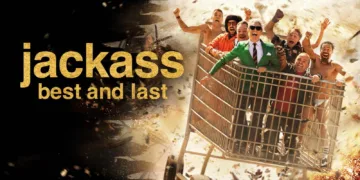
















The body remembers what the franchise pretends to forget. Every fall, every electric shock, every blast of fecal absurdity in Jackass: Best and Last arrives with an echo from 25 years of men treating pain as a shared language. Earlier Jackass films made injury feel elastic, a cartoon law applied to human skin. This one knows the skin has aged. The joke still lands, then limps.
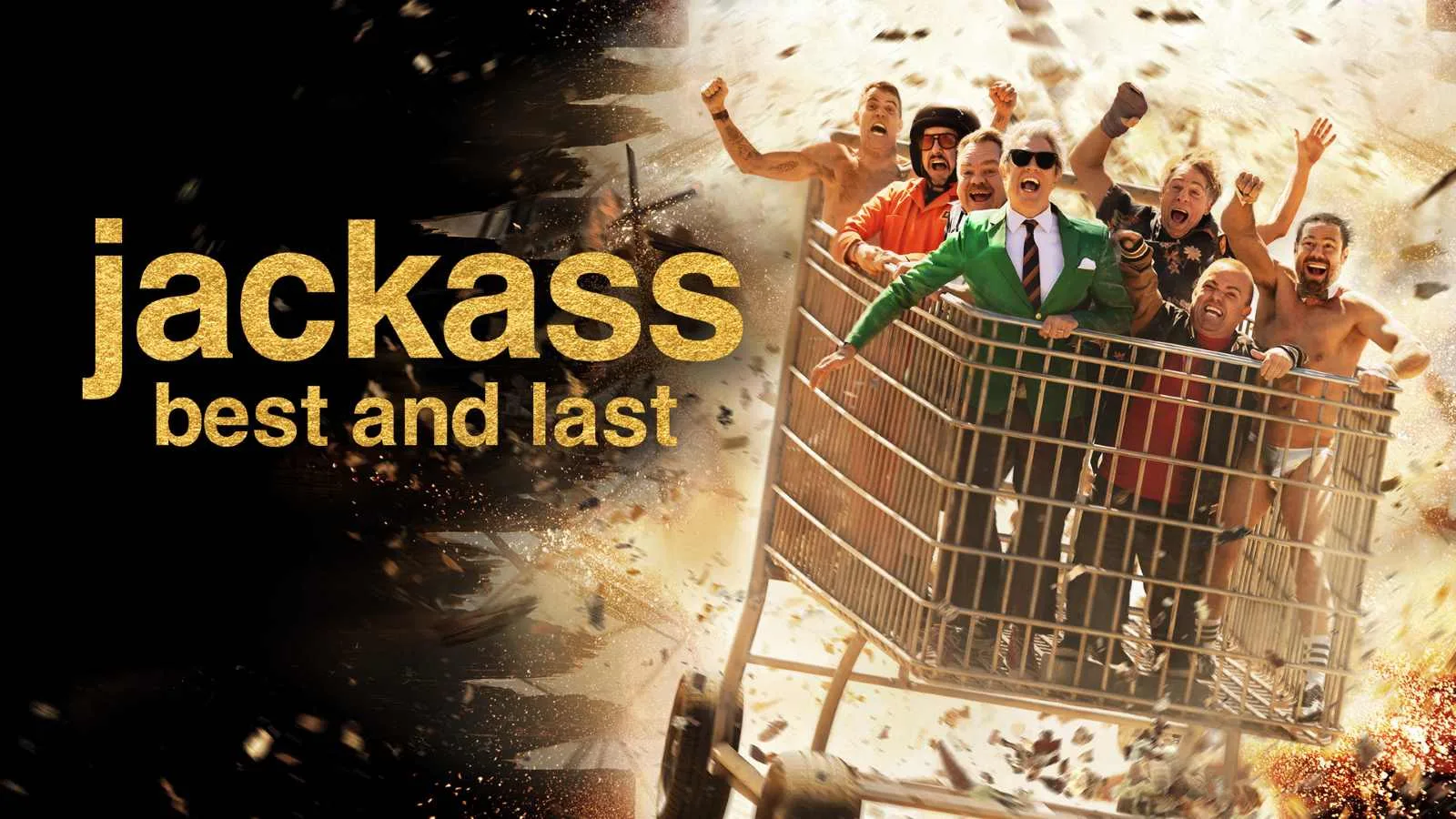
Jeff Tremaine’s farewell is shaped like a living wake, part new stunt film, part documentary, part memory dump from a group that has spent a quarter century turning humiliation into affection. Johnny Knoxville, Steve-O, Chris Pontius, Preston Lacy, Dave England, Jason “Wee Man” Acuña, and Ehren “Danger Ehren” McGhehey return with the newer Jackass Forever cast around them, including Sean “Poopies” McInerney, Zach Holmes, Jasper Dolphin, and Rachel Wolfson. The title promises finality. The film keeps testing how final a goodbye can feel when everyone is still laughing through the damage.
The Archive Bleeds
Tremaine opens the film by digging beneath the franchise’s own origin myth: Knoxville in 1998, still close to Philip John Clapp, shooting himself in the chest while wearing a bulletproof vest and padding himself with adult magazines. It is a stupid image, naturally. It is also the entire grammar of Jackass in miniature. Risk, performance, fear, and a boyish need to see if the body can become evidence.
The film’s best archival passages understand that old footage does not gain power simply because viewers have seen it before. It gains power when time changes the wound. Knoxville’s unaired escaped-convict bit, where he enters a hardware store in handcuffs asking for a hacksaw, now plays like a rough sketch for the franchise’s public-space chaos. The Brad Pitt abduction prank has the strange innocence of early celebrity mischief, a moment when a movie star could turn his own kidnapping into street theater outside a hot dog stand.
Steve-O’s porta-potty launch, the “Poo Cocktail Supreme,” still has a sickly grandeur. The slow-motion rise and fall of a sewage-filled capsule is disgusting, yes, but the film frames it as a landmark in escalation, a monument built from waste and bad judgment. Ryan Dunn’s toy-car X-ray bit carries a quieter ache. The film refuses funeral softness; it remembers him through the exact kind of idiocy he gave to the group. That feels honest.
Bam Margera’s restored presence in archival footage has a similar sting. His absence from the present is never turned into a grand statement, yet seeing him again inside old chaos gives the farewell a missing limb. The film knows what cannot be repaired, so it lets memory stand near the fracture.
Middle Age as Body Horror
The new material is smaller than the old legend around it. That reduction is visible in the sets, in the scale, in Knoxville’s role. He is no longer the man stepping first into impact. After the bull injury from Jackass Forever, he has become a pale-haired master of ceremonies, a smiling architect of pain who often stands at the edge of the frame while other bodies take the hit. There is mischief in that shift, and a sadness too. The ringleader survives by moving away from the center.
Steve-O gives the film its most committed new suffering. The robot rectal exam, performed with chunky peanut butter as lubricant, is exactly as graceful as that description suggests. It works because Tremaine lets the setup breathe long enough for dread to curdle into laughter. The joke is primitive. The timing is precise.
The colonoscopy-prep Twister stunt is the film’s clearest vision of aging through the Jackass lens. These men are no longer merely tempting broken bones. They are facing the medical rituals of middle age and converting them into communal collapse. The sight of bodies twisting on the mat after drinking laxatives would be unbearable if it were not staged with such ritualistic devotion. It is vile. It is also, somehow, about time.
“The Escape Room From Hell” gives Knoxville one of his sharper late-period roles: not victim, but designer. The room becomes a little theater of fear, electricity, and forced choice, with Ehren again serving as one of the franchise’s great sacrificial figures. Sean “Poopies” McInerney comes closest to inheriting the old appetite for punishment, taking grotesque lip injections and genital shocks with alarming commitment. Zach Holmes’ body, especially his rear end, becomes a recurring instrument of disgust. Jasper Dolphin’s ram sequence has blunt physical force. Rachel Wolfson, sadly, is left too often at the edge, a frustrating retreat after her stronger arrival in Jackass Forever.
The Jamiroquai-inspired opening sequence lacks the deranged spectacle of earlier movie intros, especially the Jackass Forever Godzilla set piece. It feels thin, almost polite by franchise standards. A strange word for this crew, but there it is.
Laughter With Gray Hair
The emotional force of Best and Last rests in the contrast between young footage and present bodies. Gray hair, slower speech, old scars, loose skin, tattoos that have aged with their owners. The film keeps placing the past beside the present until the franchise looks less like a prank machine and closer to a record of what time does when it is invited to keep hitting.
Knoxville tears up on set, and the moment lands because Jackass has never been clean about feeling. These men do not express affection through speeches. They express it by laughing beside a friend who has been electrocuted, vomiting behind the camera, or placing a hand on a shoulder after a stunt goes wrong. Their tenderness has always arrived wearing filth.
The return to the bull footage gives the film its strongest argument for stopping. We see the first take, judged insufficient. Then comes the second, the one that ends with Knoxville badly hurt. The logic is terrifying because it is so simple: the body offers a warning, the camera asks for a better version. Pontius cracks a joke after the injury, softer than usual, and that slight change in tone says plenty. Laughter arrives, but it arrives wounded.
That is the dark beauty of the franchise at its best. The stupidity is real. The love is real too. Neither cancels the other.
The Animal Problem
The film’s ugliest ethical problem remains its use of animals. The ram repeatedly butting Jasper, the bull footage, and the snake-based fear setups all point to a comic instinct that has not aged well. Human performers consent to pain, embarrassment, and lifelong damage. Animals do not join the joke. They react from fear, agitation, or confusion, and the laughter changes temperature when the target is no longer fully willing.

This matters because Jackass has never needed animals to be riotous. A robot, a laxative game of Twister, a terrible escape room, a porta-potty launched toward the sky: the human cast offers enough ruin. The franchise is at its purest when everyone inside the stunt has agreed to be ridiculous. When an animal is forced into the bit, the old anarchic joy hardens into something meaner.
Repetition also wears the film down. Pontius’ naked antics, the endless genital trauma, the fecal fixation, and the underwear-heavy Zach Holmes material still produce laughs, but expectation dulls the edge. Shock becomes rhythm. Rhythm becomes habit. Habit is dangerous for a franchise built on the illusion that anything might happen next.
The Door Half Closed
The title may be lying. Brands rarely die with dignity, and the younger cast could carry some altered form of this machinery forward. Yet Best and Last feels final for the version of Jackass that matters most: the one held together by Knoxville’s grin, Steve-O’s deranged discipline, Pontius’ sunny indecency, Ehren’s doomed patience, Tremaine’s blunt staging, and the group’s talent for turning pain into a private weather system.
The film is not one of the strongest entries. Too much of it leans on memory. Too many new stunts feel boxed in by age, caution, or limited imagination. Still, its weakness becomes part of its meaning. These bodies cannot do what they once did. The laughter knows it. The camera knows it. Knoxville’s face, wet with farewell before the next stupid idea begins, knows it most of all.
Jackass: Best and Last is gross, uneven, ethically bruised, and strangely tender. The body finally says what the franchise spent 25 years trying to shout down: enough. Then someone laughs, and for one last second, enough has to wait.
Jackass: Best and Last is a reality slapstick comedy film that premiered theatrically in the United States on June 26, 2026. Directed by Jeff Tremaine and produced alongside franchise stalwarts Spike Jonze and Johnny Knoxville, this fifth and final main installment serves as a hilarious, chaotic farewell to the iconic stunt crew. The film features a wild combination of brand-new, death-defying stunts alongside never-before-seen footage and a retrospective look at the team’s greatest, most painful hits spanning over 25 years. Audiences can catch this raucous celebration of camaraderie and foolishness playing exclusively in theaters nationwide.
Where to Watch Jackass: Best and Last (2026) Online










Full Credits
Title: Jackass: Best and Last
Distributor: Paramount Pictures
Release date: June 26, 2026
Rating: R
Running time: 92 minutes
Director: Jeff Tremaine
Writers: Jason “Wee Man” Acuña, Tory Belleci, J.P. Blackmon
Producers and Executive Producers: Jeff Tremaine, Spike Jonze, Johnny Knoxville
Cast: Johnny Knoxville, Steve-O, Chris Pontius, Jason “Wee Man” Acuña, Dave England, Danger Ehren, Preston Lacy, Rachel Wolfson, Jasper Dolphin, Sean “Poopies” McInerney, Zach Holmes
Director of Photography (Cinematographer): Dimitry Elyashkevich
Editors: Erkan Özekan
Composer: Toygar Işıklı
The Review
Jackass: Best and Last
Jackass: Best and Last is a farewell built from bruises, waste, old footage, and strange tenderness. Its new stunts feel smaller, and the animal material still leaves an ethical bruise the laughter cannot cover. Yet the film finds real feeling in aging bodies remembering what they survived together. Knoxville’s tears, Steve-O’s punishment, Dunn’s ghostly presence in old clips, and the bull footage turn stupidity into a record of time passing through flesh.
PROS
- Genuine farewell feeling
- Strong archival context
- Knoxville’s visible emotion
- Steve-O and Poopies commit fully
- Ryan Dunn footage lands quietly
CONS
- New stunts feel smaller
- Clip-show padding
- Animal stunts remain troubling
- Rachel Wolfson underused
- Gross-out repetition dulls impact