


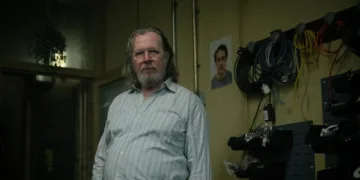

























Peter has converted grief into interior design. The walls are blue, his late wife’s yellow belongings are sealed in the attic, and a giant metal shark appears to have crashed through the roof. Rebekah Fortune’s Learning to Breathe Under Water understands that depression can become a domestic system, arranging where people sit, what they discuss, and which rooms remain emotionally inaccessible.
Five years after his wife’s death, Peter, played by Rory Kinnear, lives with his young son Leo in a house governed by silence. He makes toast, washes dishes, produces strange art and avoids explaining any of it. In the opening meal, Richard Kendrick’s camera places father and son within separate arches, sharing a table while occupying different visual compartments. The composition turns their relationship into a floor plan.
Peter’s shark installation presents the central contradiction. It is a spectacular public gesture created by a man determined to disappear. He has placed his anguish above the neighbourhood, then refused to translate it for anyone living beneath it. Call it architectural mourning: pain given shape because language has become intolerable.
Leo uses the sculpture differently. Through a hole above his bedroom, he climbs inside the shark and tells it what he cannot tell his father. The synthetic animal becomes the household’s most functional parent, which is funny until the implications settle.
The Child Who Watches Everything
Leo describes Peter’s depression as a black hole he wishes he could pull from his father’s brain. The line carries the blunt logic of a child trying to solve an adult condition through imagined surgery. Richard Brabin’s screenplay, drawn partly from his own childhood, keeps Leo close to that uncertainty. He understands that Peter is unwell. He does not understand why his mother’s belongings are hidden or why mentioning her changes the air in the room.
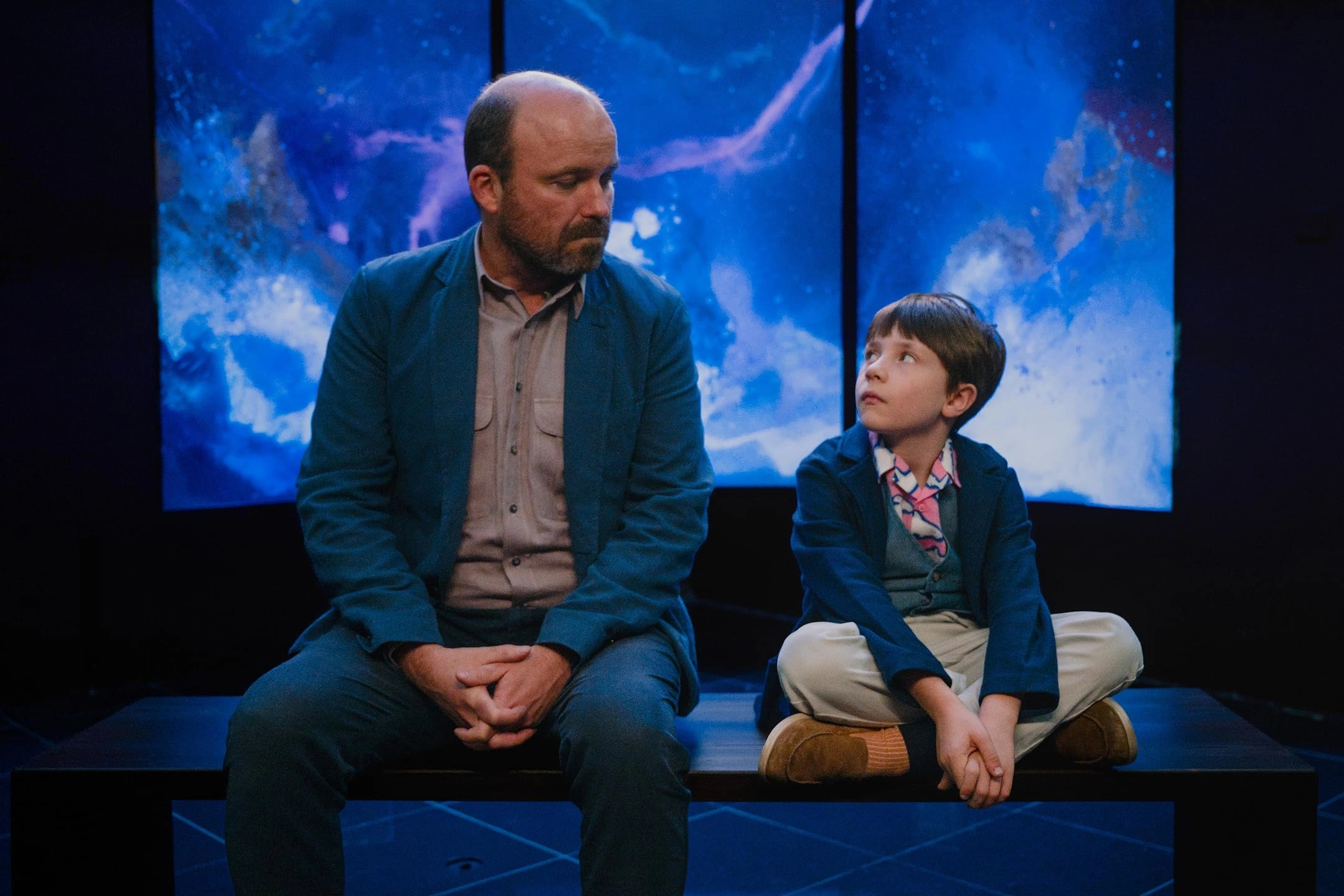
Ezra Carlisle gives Leo a physical vocabulary of restraint. His fingers tap when conversation becomes difficult. His shoulders tighten before he asks a personal question. When Anya tells him he is funny, he replies that people say that without laughing. Carlisle delivers the sentence with such solemn precision that comedy and concern arrive together.
Fortune rarely abandons Leo for adult exposition. Peter’s motives remain incomplete because Leo receives them incompletely. His mother survives through objects, half-memories and the chair he insists must remain available for her at the kitchen table. Death, from his position, has failed to explain its seating arrangements.
Hand-drawn and stop-motion flourishes externalise Leo’s thoughts without converting the film into fantasy. These images follow his lateral associations, then disappear before whimsy can become an emotional shortcut. The device works because Carlisle never plays Leo as an enchanted movie child. His wonder coexists with vigilance. He notices everything because nobody tells him enough.
A Stranger at Breakfast
Anya enters the house through colour and noise. Maria Bakalova’s Bulgarian au pair wears bright clothes, talks continuously and begins changing the family’s meals. Her presence initially feels almost aggressive beside Peter’s cultivated stillness. A cheerful breakfast can resemble an invasion when misery has established tenancy.
Bakalova keeps Anya from becoming a saintly repair service. She can be impatient, overly direct and convinced that movement will help people who have built their lives around immobility. Her warmth gains credibility through specific acts: watching cartoons with Leo, listening to his explanations and inviting him into conversations without demanding an immediate confession.
Her effect on Peter is slower. Kinnear communicates his resistance through gestures that seem delayed by water pressure. He pauses before answering simple questions, lowers his eyes during strained exchanges with Leo and approaches ordinary chores with exhausted concentration. When he plays A-ha’s “Take On Me” on his wife’s untouched piano, grief emerges through muscle memory. The scene does not require a speech. His hands remember a life his voice has spent years denying.
The screenplay briefly loses that trust when Anya explains the shark’s meaning too plainly. Her heated speech names emotional connections the production design and performances have already made visible. The scene resembles someone attaching labels to a sculpture after the audience has understood it. Kindness does not need a diagram.
Learning to Surface
May Davies’ production design gives Peter’s depression a palette. The blue rooms create an underwater sensation, while the yellow objects associated with his wife retain the warmth he has locked away. The contrast is direct, perhaps excessively so, yet Fortune finds subtler uses for space. Doorways divide bodies. Empty areas remain inside frames. Leo’s bedroom ceiling turns safety into a literal opening toward damage.
Sound repeatedly interrupts emotional drift. A song cuts off before comfort can settle. The toaster snaps Peter and Leo back into routine. Sam Hodge’s editing uses these abrupt stops to show how quickly fragile connection can collapse into habit.
The final act moves faster than the earlier material has earned. Peter’s willingness to confront his grief, reconnect with Leo and re-enter ordinary life arrives through steps that feel compressed beside the patient accumulation of silence that precedes them. The film also comes close to treating routine and discipline as sufficient answers to long-term depression. Its own images argue otherwise. A house built around absence cannot be repaired by opening a window.
Fortune’s gentleness survives that acceleration because recovery never erases the dead or assigns Anya the role of replacement mother. Peter begins speaking. Leo begins sharing his world with people rather than objects. The shark remains on the roof, absurd and impossible to ignore, much like grief once someone finally stops pretending it belongs indoors.
This comedy-drama premiered at the Karlovy Vary International Film Festival in June 2026. The story follows an eight-year-old boy named Leo who, after the death of his mother, finds comfort in his best friend—a giant metal shark his artist father built into the roof of their home—until a spirited au pair arrives to help the family move forward.
Full Credits
Title: Learning to Breathe Under Water
Distributor: Bankside Films (International Sales)
Release date: June 2026 (World Premiere at Karlovy Vary International Film Festival)
Running time: 95 minutes
Director: Rebekah Fortune
Writers: Richard Brabin
Producers and Executive Producers: Jack Tarling, Patrick O’Neill, Nan Davies, Amy Gardner, Sophie Green, Ali Jazayeri, Keith Kehoe, Stephen Kelliher, Ivan McMahon, Hanneke Niens
Cast: Rory Kinnear, Maria Bakalova, Ezra Carlisle
Director of Photography (Cinematographer): Richard Kendrick
Editors: Sam Hodge
Composer: Alexander Reumers
The Review
Learning to Breathe Under Water
Grief turns Peter’s home into an aquarium without water: everyone moves slowly, speech arrives muffled, and the shark in the roof becomes the healthiest listener available. Rebekah Fortune keeps this metaphor alive through divided frames, blue interiors and Leo’s illustrated thoughts, while Ezra Carlisle gives the film its steady pulse. The rushed final act explains feelings that earlier scenes had expressed with greater honesty, yet the film’s kindness rarely becomes emotional coercion. Healing remains awkward, partial and dependent on opening the door.
PROS
- Ezra Carlisle’s restrained performance
- Precise child’s-eye perspective
- Expressive production design
- Kinnear’s physical portrayal of depression
- Animation used with restraint
CONS
- Recovery accelerates too quickly
- Anya’s shark speech is overly direct
- Some symbolism lacks subtlety