




















Joe Nixon’s problem is supposed to be vodka. His actual problem is time. At 40, Joe has reached the point where professional fluency can begin to resemble cultural illiteracy. He is a successful advertising executive, confident enough to expect a promotion to Chief Creative Officer, yet his latest campaign lands like a fossil wrapped in corporate jargon. His boss tells him that he no longer understands younger consumers and gives him 72 hours to prove otherwise. Joe responds as ad men in crisis often do: he turns human beings into data.
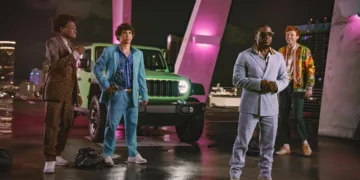
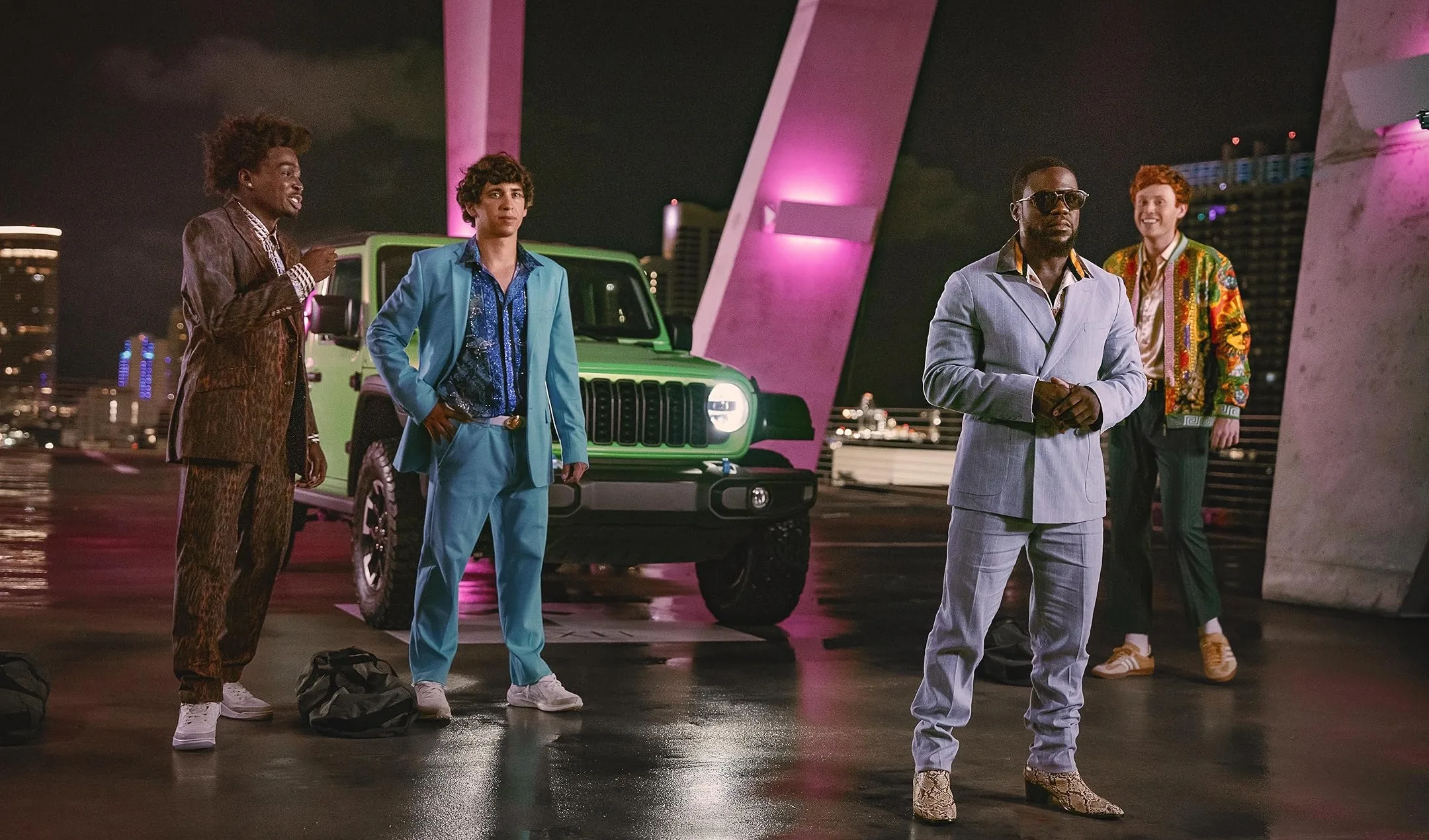
An accidental invitation to a Miami bachelor-party group chat offers him four test subjects. Mason is the groom. Nick is the possessive lifelong friend. Hunter is recovering from betrayal. Freshman is the cheerful fool whose face usually reaches the punchline before the script does. Joe sends them money, rents a waterfront mansion, arrives with a suitcase of vodka, and quietly records them through a necklace camera. He calls this research. The younger men suspect he may be predatory.
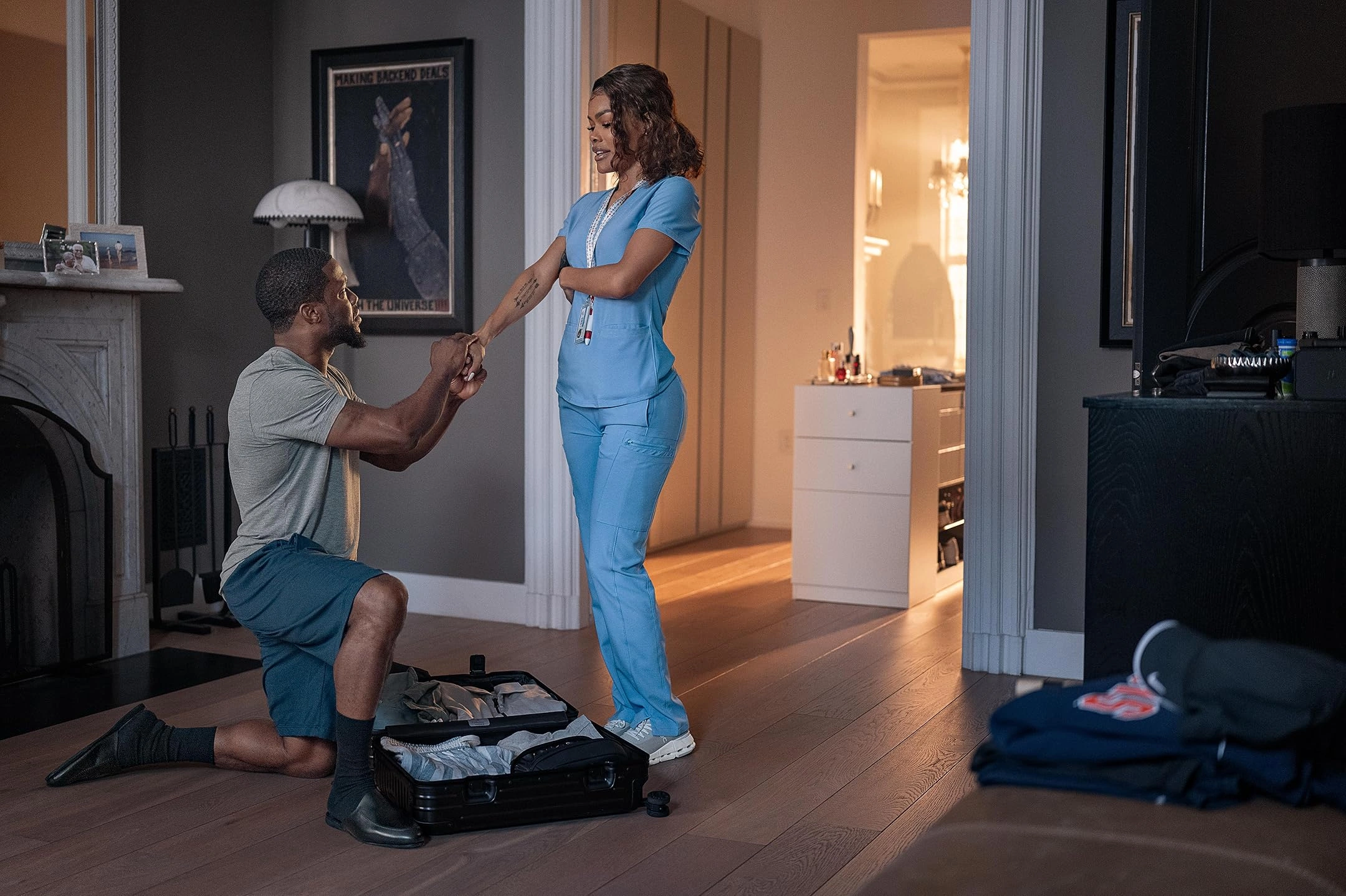
That suspicion is one of the film’s sharper jokes because it exposes the moral strangeness of the setup. Joe is purchasing access to intimacy, then treating the resulting friendship as proprietary information. His girlfriend Jennifer, played by Teyana Taylor with grounded restraint, recognizes the same habit in their relationship. She wants a proposal. Joe keeps postponing commitment until his career reaches some imaginary safe point. The film sees the parallel, then loses interest in it. This happens often.
Generational Research, Conducted Badly
The comic engine should be simple: Joe wants to understand Gen Z, yet every attempt reveals how little he understands anyone. The group calls him “Unc.” He cannot follow their emotional check-ins. His references die in the air. Before a night out, he drinks Pepto-Bismol as if preparing for chemical warfare, then vomits over the men he hopes to impress.
There is a useful idea buried here. Joe mistakes relevance for imitation. He believes that slang, drinking stamina, and knowledge of party etiquette can restore his authority. What the younger men need from him is far less marketable. Mason needs honest advice about marriage. Nick needs to admit that his anger comes from fear of losing his oldest friend. Hunter needs space to speak about heartbreak without becoming a joke. Freshman needs somebody to listen long enough to realize that his stupidity has a strange internal logic. Joe keeps collecting surfaces.
Call this demographic panic, the moment when a person encounters a younger generation and assumes it has arrived to invalidate him personally. The film occasionally catches that anxiety with precision. Joe laughs too loudly at jokes he does not understand. He spends money whenever conversation fails. He uses his age as proof of wisdom, then behaves with less judgment than everyone around him.
I began to suspect that the generational satire was sharper than it first appeared. Then Hunter makes an Eat Pray Love reference, the dialogue reaches for another Will Smith slap joke, and the suspicion collapses. The younger characters are written as a rotating set of internet gestures rather than as people formed by a specific culture. Most are near 30, weakening the alleged divide. Joe is treated as an archaeological discovery at 40. By that logic, the rest of us should be displayed behind glass.
The hidden-camera subplot could have forced Joe to confront the ethics of his research. Instead, the device becomes another prop waiting for the plot to remember it.
Ricardo Montana Takes Control
A bachelor-party comedy has a natural form. Put several fragile men in a place designed for pleasure, remove ordinary social consequences, then watch their friendships reveal themselves under pressure. 72 Hours decides this is insufficient and introduces a drug lord.
Joe gains access to a yacht party by misusing a police badge. There he meets Jaze, played by Michael Mando with the controlled menace of a man who wandered in from a different production. Jaze forces Joe to take cocaine to prove he is not law enforcement. The drug awakens “Ricardo Montana,” Joe’s heavily accented imitation of Al Pacino in Scarface.
The first transformation works. Hart replaces Joe’s anxious chatter with operatic criminal confidence, and the suddenness gives the scene a genuine jolt. Jaze mistakes this performance for evidence that Joe is a rival. The younger men watch their awkward benefactor become a coked-up gangster caricature. For a brief moment, the film’s absurdity has shape. Then Ricardo returns. And returns.
The joke becomes infrastructure. It drives confrontations with Jaze, supports a Chinese-accent routine, and excuses Hart’s loudest habits. The film acknowledges the racial ugliness of the persona, which appears to function as permission to keep using it. Self-awareness is not absolution. Sometimes it is merely a receipt.
From there, the screenplay adopts what might be called escalation faith: the belief that every weak gag can be redeemed by making the next one larger. Joe fights a hostile bachelorette party inside a moving limousine. The men become stranded on an island. Smugglers appear with whale genitalia. Bodily fluid reaches Joe’s face. A jellyfish sting swells his features into grotesque makeup. Katt Williams arrives for a slapstick confrontation that depends on public history outside the film.
The problem is not vulgarity. Vulgar comedy can be exact, architectural, almost elegant in its preparation. Here, shock arrives without pressure behind it. The whale contraband completes no setup. The swollen face alters no relationship. Each incident occupies space, creates noise, then leaves behind no comic residue.
Mike Epps appears as an overzealous police officer. Andy Garcia arrives late and gets laughs by standing still. His restraint exposes the film’s central misconception: energy and timing are separate resources.
Performers Trapped in Functions
Hart throws himself into every humiliation. He vomits, panics, fights, snorts, screams, and allows the camera to hold on his swollen face. His willingness to surrender dignity remains one of his strongest qualities as a screen comedian. Joe becomes likable during quieter exchanges with Mason, when the frantic performance drops away and a tired man appears.
The script drags him back toward old targets. Joe is short. Joe is angry. Joe is insecure about masculinity. Joe believes volume can defeat embarrassment. The younger men call him old, vintage, and an angry leprechaun. These jokes fit Joe’s cultural obsolescence, yet the film repeats them with habitual comfort. It wants to satirize Joe’s stale repertoire while relying on that repertoire for laughs.
This creates a strange double image. Hart appears to be mocking his own inability to change and refusing to change at the same time. I admire the honesty of that contradiction. I wish the film knew what to do with it.
Marcello Hernández gives Nick’s hostility a clean edge, especially when Joe begins to replace him as Mason’s confidant. The writing reduces Nick’s fear of abandonment to jealousy, but Hernández keeps suggesting an older wound beneath the irritation. Mason Gooding brings sincerity to Mason’s doubts about marriage, particularly when the party briefly quiets and he asks Joe for guidance. Ben Marshall’s Hunter receives a betrayal in his backstory and little room to turn it into behavior.
Kam Patterson makes Freshman feel less programmed. His open expressions and misplaced certainty create pauses the dialogue did not plan. He reacts to Joe’s disasters with a combination of awe and delayed comprehension, which gives several scenes their only unpredictable rhythm.
Taylor’s Jennifer has the thankless task of representing adulthood from another location. Her phone calls are measured, specific, and grounded. She asks Joe for a decision. The screenplay asks her to wait until he completes his weekend lesson. Kevin Dunn and Zach Cherry briefly suggest a drier workplace comedy about an executive whose instincts have calcified, then Miami swallows the office whole.
The Fear of Becoming Yesterday
The film’s best subject is Kevin Hart. Joe is told that his instincts no longer connect with the audience he needs. He responds by repeating old references, performing confidence, and insisting that access can be bought. Hart enters the same trap. His established persona meets younger comedians who look at him with confusion, boredom, or reluctant affection. Character and performer begin to overlap.
This could be intentional. I think parts of it are. Joe’s failed jokes often sit in uncomfortable silence, and the younger cast does not rescue him with easy laughter. His money opens doors but cannot produce intimacy. His attempt to study youth culture reveals a man frightened by his own expiration date.
Tim Story, who directed Hart in Think Like a Man and Ride Along, frames most scenes around that fear without fully recognizing it. The camera waits for Hart’s reaction, then arranges the ensemble around him. Miami becomes a sequence of purchasable spaces: mansion, yacht, club, limousine, island. None acquires a comic geography. The editing rushes between disasters and frequently cuts before a reaction can sharpen the preceding line.
The 105-minute runtime feels less like abundance than distrust. Silence might reveal that the group’s bond is thin. A quieter scene with Jennifer might expose how badly Joe has treated her. A longer Mason-Nick exchange might transform plot obligation into grief. The film keeps moving.
Streaming is the unspoken final irony. Hart performs for the roar of a crowd, but 72 Hours arrives in living rooms, where exertion can be examined in private. Joe believes relevance can be regained through imitation. The film proves the opposite every time Ricardo Montana returns.
72 Hours is a comedy film released in 2026 that you can watch exclusively on Netflix. The story follows a 40-year-old executive trying to save his flailing career who is mistakenly added to a group text and winds up joining a group of twenty-somethings on a wild bachelor party trip to Miami.
Where to Watch 72 Hours (2026) Online


Full Credits
Title: 72 Hours
Distributor: Netflix
Release date: 2026
Rating: R
Running time: 105 minutes
Director: Tim Story
Writers: Jon Hurwitz, Hayden Schlossberg, Kevin Burrows, Matt Mider
Producers and Executive Producers: John Davis, Kevin Hart, Josh Heald, Jon Hurwitz, Hayden Schlossberg, Tim Story, Luke Kelly-Clyne, Bryan Smiley, Will Packer
Cast: Kevin Hart, Marcello Hernández, Mason Gooding, Kam Patterson, Ben Marshall, Teyana Taylor, Michael Mando, Andy García, Zach Cherry, Kevin Dunn, Mike Epps
Director of Photography (Cinematographer): Larry Blanford
Editors: Peter S. Elliot, Ladd Erickson
Composer: Christopher Lennertz
The Review
72 Hours
72 Hours accidentally discovers a sharp subject: the terror of becoming culturally obsolete while still performing the routines that once made you valuable. Then it panics, snorts cocaine, adopts a Scarface accent, and throws itself at a whale penis. Kevin Hart’s willingness to look ridiculous remains intact, and Kam Patterson occasionally finds life inside the wreckage. The film’s smarter generational comedy keeps getting mugged by its own criminal subplot. Call it relevance anxiety with a Netflix budget and no attention span.
PROS
- Hart’s committed physical performance
- Kam Patterson’s unpredictable delivery
- A potentially sharp generational premise
- Andy Garcia’s restrained cameo
CONS
- Exhausting crime-plot escalation
- Repetitive Ricardo Montana routine
- Thinly written younger characters
- Teyana Taylor’s thankless role
- Uneven editing and comic timing