





The Angels blasting from a beach-house radio should promise cheap booze, bad dancing, and the kind of night everyone remembers differently. Mia’Kate Russell’s Penny Lane Is Dead turns that familiar teenage freedom into a trap, then keeps tightening it until the walls are streaked red.
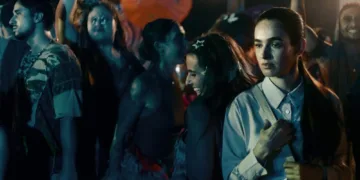
Set in coastal Australia during the summer of 1986, the film gathers three recent school graduates for a private celebration. Penny Lane (Bailey Spalding) has been accepted into law school and appears ready to outrun the small world around her. Toni (Tahlee Fereday), Penny’s childhood friend and secret girlfriend, has received rejection letters instead. Amy (Alexandra Jensen) arrives carrying a teddy bear, a small detail that immediately communicates how little prepared she is for the cruelty ahead.
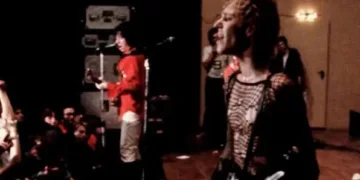
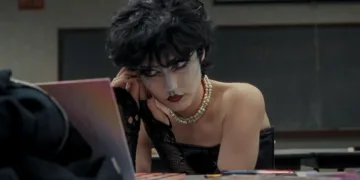
Russell creates a convincing period atmosphere through denim shorts, cigarette stashes, surf culture, frosted cupcakes, and Australian pub rock. Production designer Erica Ockenden and costume designer Anita Seiler build 1986 through ordinary textures rather than decorative nostalgia. The beach house feels lived in, which matters once every familiar room becomes part of the pursuit.
Poison in the Icing
Kat (Sophia Wright-Mendelsohn), Penny’s cousin, enters with four cupcakes labelled using insults. The joke curdles when she crushes pills into Penny’s icing, leaving her cousin unconscious while she needles Toni and Amy.
The opening act works because Kat’s arrival disrupts relationships that already contain pressure. Penny is leaving for university. Toni fears being left behind. Amy stands between them, watching a friendship change shape without knowing where she belongs. The screenplay gives each woman a distinct emotional position before the violence starts.
Wright-Mendelsohn plays Kat as someone constantly testing the room for weakness. She can sneer at Penny one moment, demand affection from her older boyfriend the next, then retreat into wounded silence when challenged. Russell refuses to provide a clean explanation for her hatred. Jealousy, humiliation, and dependency are visible, yet none excuse her decision to drug Penny or invite Angus into the house.
That lack of explanation initially makes Kat frightening. Her behavior cannot be solved through a convenient childhood revelation. Later scenes flatten her into a simpler source of spite, which leaves Wright-Mendelsohn working hard to preserve contradictions the script has begun discarding.
The Party Changes Genre
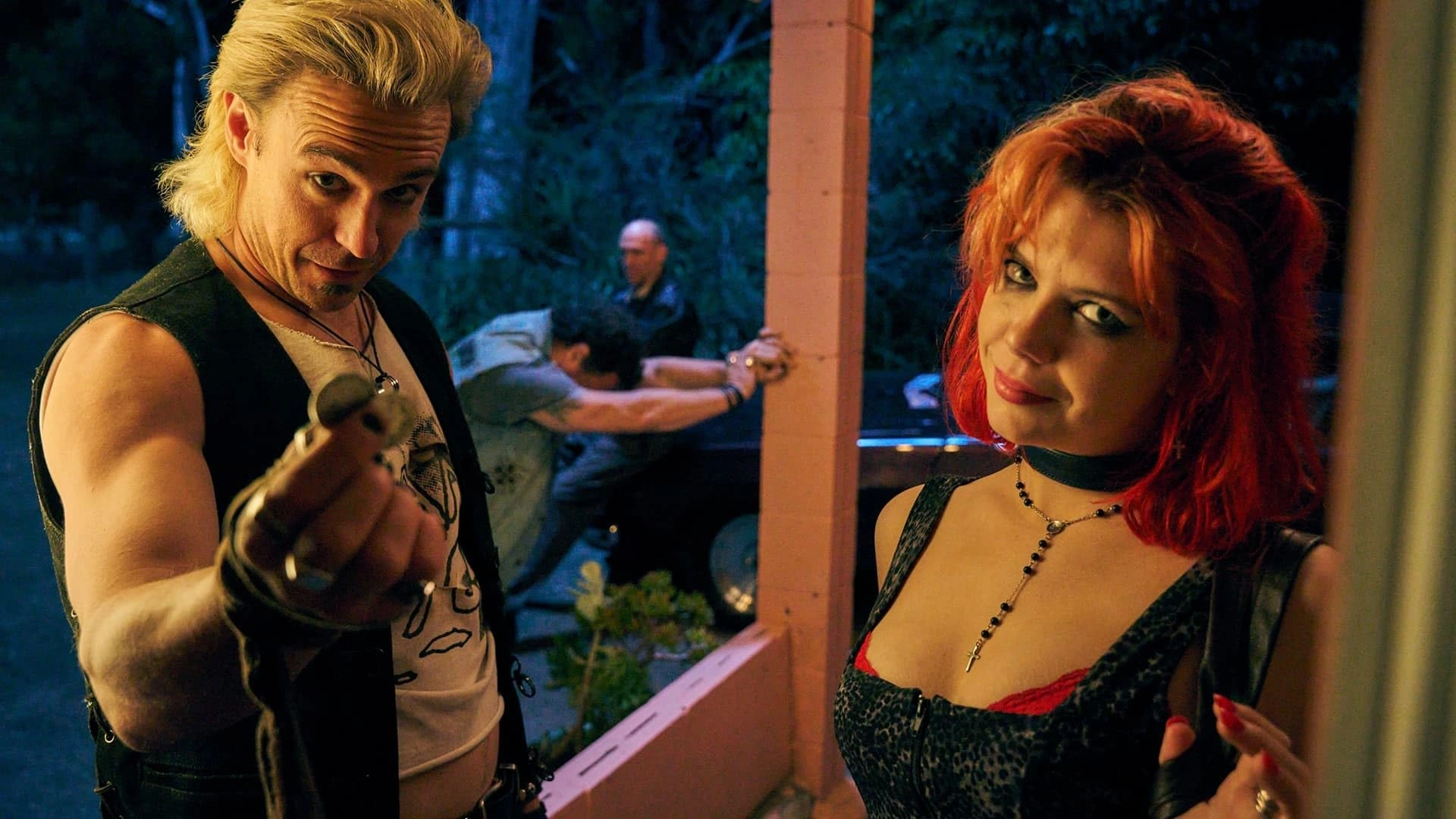
Angus (Ben O’Toole) arrives with Rodowsky (Fletcher Humphrys) and Merrick (Steve Le Marquand), turning a hostile gathering into a home invasion. Angus prowls through Penny’s room, touches her belongings, and treats violence like an audition for the hardened criminal he wishes he were. O’Toole makes every boast feel rehearsed. The squeak of his leather pants becomes an audible punchline, right up to the point where his behavior stops being remotely funny.
Merrick provides a useful counterweight. Le Marquand plays him as an older criminal irritated by Angus’ theatrics, focused on completing a drug deal and leaving. His impatience creates dry comedy, yet his refusal to intervene also confirms his complicity. He understands the danger clearly. He simply prefers convenience.
The film’s hardest problem arrives after Angus assaults the drugged Penny while Kat takes photographs. Russell then returns to broad criminal farce, grotesque injuries, and splatter comedy. Horror can shift registers. A tonal turn works when one mode changes how we understand the other. Here, the rape-revenge material and the slapstick often sit beside each other without a stable relationship.
Russell can direct both styles. The tense movement through bedrooms and corridors shows a strong command of space, while the attackers’ mounting incompetence generates sharp comic beats. The trouble lies in the transition. A brutal scene ends, a goofy exchange follows, and the emotional weight appears to vanish until the film needs it again.
Toni Takes the House Back
Fereday becomes the film’s strongest presence once Toni is forced into survival mode. Her physical performance gives the final act credibility. She moves quickly through tight passages, uses furniture and doorways to offset the men’s strength, and reacts to each injury as damage rather than action-movie decoration.
Toni’s transformation also remains connected to Penny. She is fighting from grief, love, panic, and fury, not from a sudden discovery that she has always been an expert killer. When she arms herself with a curved blade, the image lands because the weapon looks unwieldy in her hands before she learns what she can do with it.
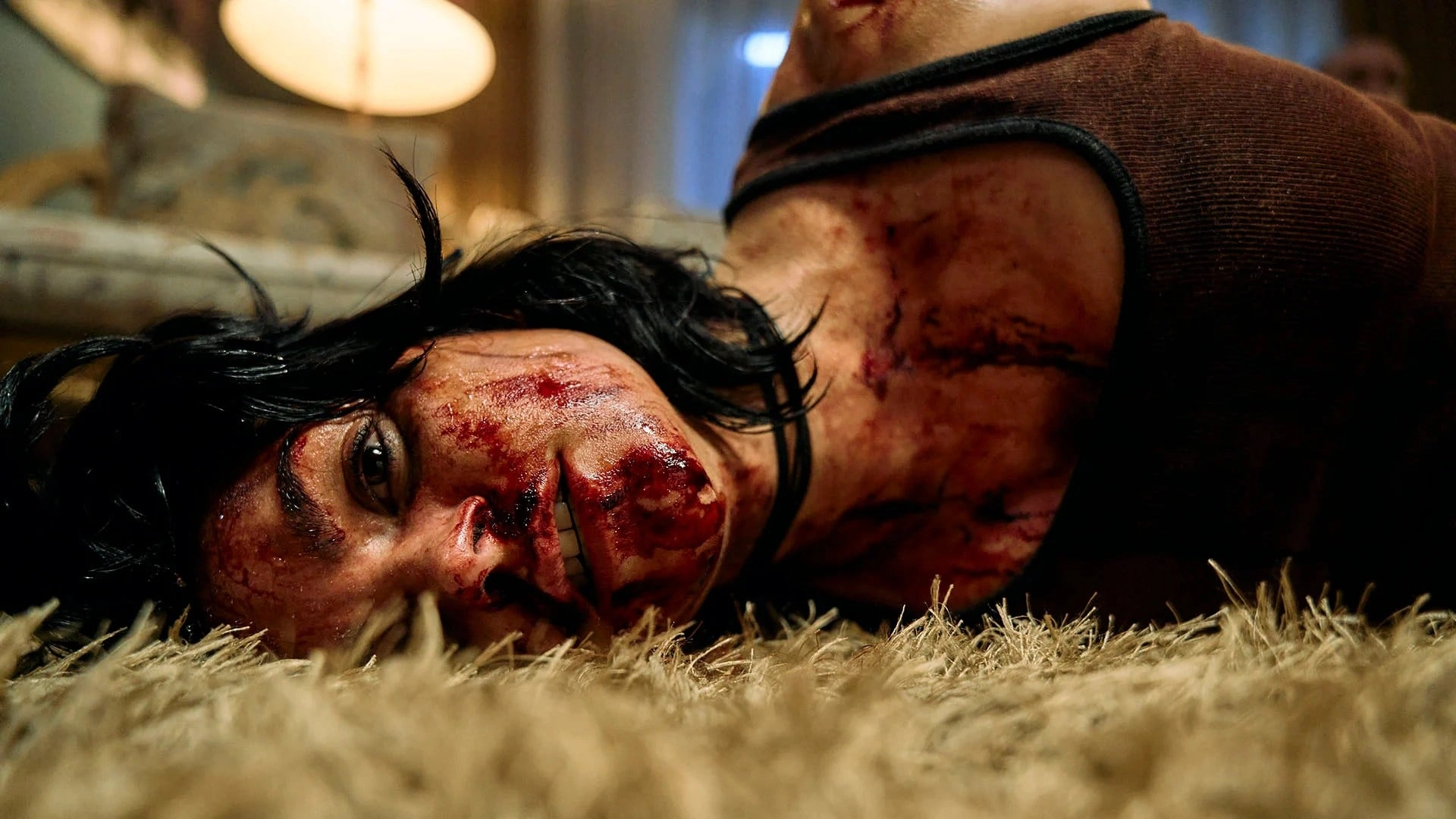
Russell’s background in makeup, prosthetics, and special effects becomes impossible to miss. An ankle injury is staged through angle, timing, and practical material so the audience understands the damage before the victim finishes reacting. A cheese grater attack carries the crude ingenuity of grindhouse cinema. Faces become slick with thick blood rather than polished digital spray.
The sound work strengthens those effects. Bubbling drug paraphernalia, leather rubbing against itself, wet impacts, and sudden gunfire make the house feel physically hostile. Every surface seems capable of cutting, trapping, or betraying someone.
Amy receives less attention than the other women. Jensen gives her nervous humor and fragile sincerity, especially in the early scenes with her teddy bear, but the screenplay never develops her fear into a full dramatic movement. Penny also becomes an absence for much of the film, leaving Spalding’s bright early performance to survive through Toni’s memory of her.
The romance-charged final image reaches for queer reclamation inside a genre built around women’s suffering. It is bold, wounded, and emotionally clear. The road to that image is far less controlled, filled with confident craft and clashing impulses that Russell has not yet taught to coexist.
Penny Lane Is Dead is an Australian horror comedy film that premiered on October 18, 2025, at the Adelaide Film Festival, with streaming availability on Shudder. The story follows three best friends celebrating university acceptance at a remote beach house during a scorching summer, where a disastrous prank turns the evening into a violent fight for survival.
Full Credits
Title: Penny Lane Is Dead
Distributor: Umbrella Entertainment, Shudder
Release date: October 18, 2025
Running time: 90 minutes
Director: Mia’Kate Russell
Writers: Mia’Kate Russell
Producers and Executive Producers: Julie Ryan, Ari Harrison, Andre Lima, Carly Maple
Cast: Sophia Wright-Mendelsohn, Tahlee Fereday, Alexandra Jensen, Bailey Spalding, Steve Le Marquand, Fletcher Humphrys, Ben O’Toole, Matthew O’Sullivan
Director of Photography (Cinematographer): Liam Gilmour
Editors: Dan Lee
Composer: Pascal Babare, Chiara Costanza
The Review
Penny Lane Is Dead
Penny Lane Is Dead has the practical gore, sharp period detail, and fearless performances needed for a terrific Australian punk-horror film. Tahlee Fereday turns Toni’s beach-house fight into bruising physical storytelling, while Sophia Wright-Mendelsohn makes Kat frighteningly unstable. Mia’Kate Russell stages suspense and bodily damage with real skill, especially during the drugged cupcake setup and the final chase. The problem is tonal control. Sexual violence, broad criminal comedy, and splatter spectacle collide without enough space for any one register to settle.
PROS
- Convincing 1980s Australian setting
- Ferocious practical gore
- Tahlee Fereday’s physical performance
- Sophia Wright-Mendelsohn’s volatile Kat
CONS
- Severe tonal whiplash
- Mishandled sexual violence
- Amy receives little development
- Kat becomes too one-dimensional