
























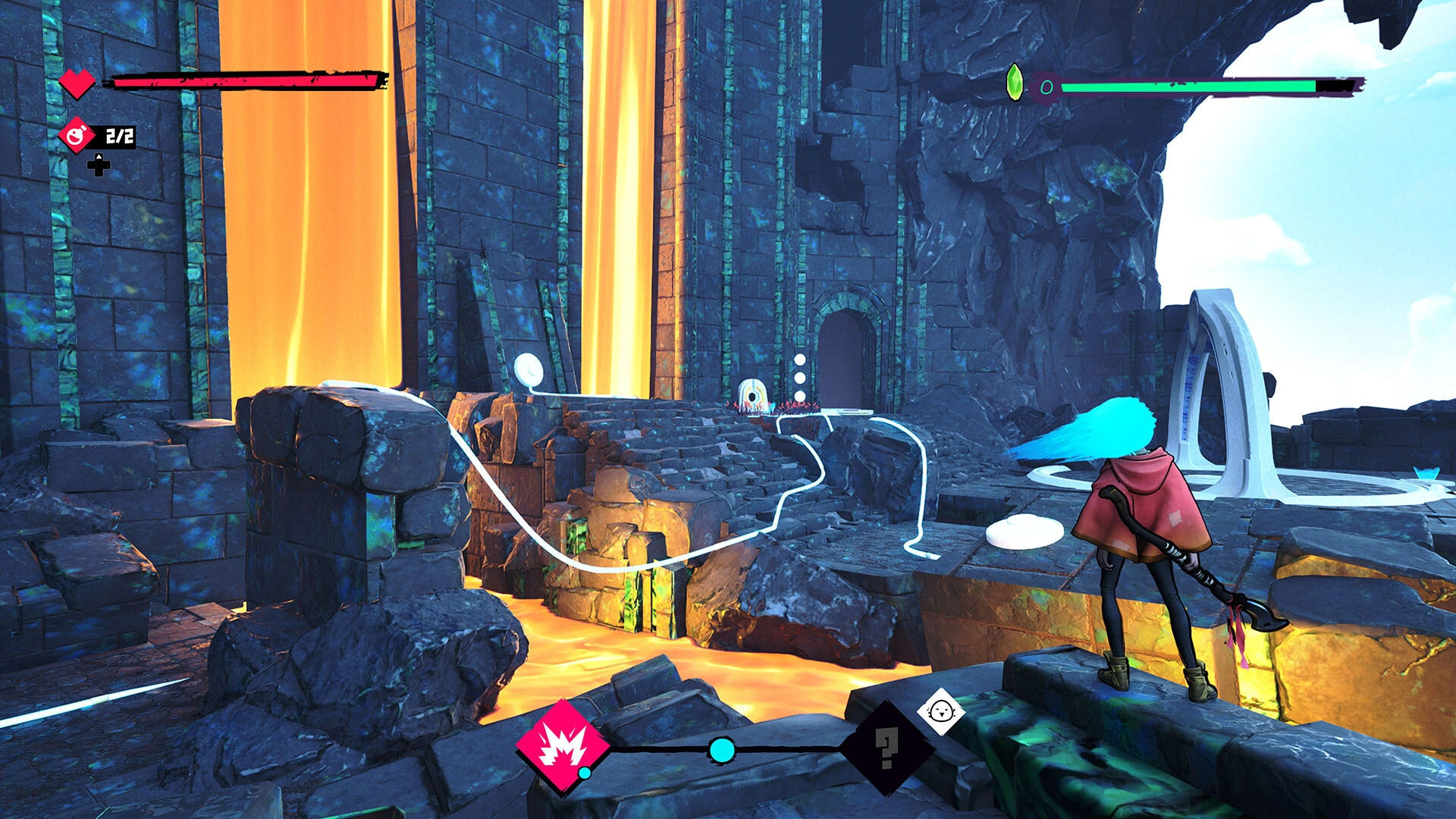

Rolling One through a grate as a living sphere of water feels like a mechanic pulled from the era when action-platformers were allowed to be strange before they were expected to be cinematic. Fading Echo carries the playful experimentation of a forgotten PlayStation 2 or Xbox 360 title, then builds its identity around one rule: every liquid changes how One moves.
Emeteria’s debut takes place on Corel, a fractured planet being consumed by Paradox Corruption. One and her mother, Rahne, are searching for resources when an encounter inside an ancient structure fuses the young traveler with Æther and throws her into the Echoverse.
Guided by an artificial construct named Vellum, she must reactivate dormant Æther Sources and reconnect a world coming apart. The premise gives Fading Echo a familiar save-the-world frame, yet its best storytelling happens through movement. One does not simply cross Corel. She absorbs it.
The World in a Droplet
Water form is the foundation. One can slide beneath grates, pass through narrow openings, travel inside suspended tubes, and carry Æther Cores between machines. Those actions soon become part of a larger elemental language.
Touching lava turns water into steam, letting One glide over long gaps. Toxic Waste creates an explosive vertical jump and weakens enemies. Paradox Corruption places a tethered return point, allowing One to move away and instantly snap back within range. Combining Toxic Waste with lava creates radiated lava, linking the upward launch of one element with the glide of the other.
The strongest puzzles ask the player to think about these properties in sequence. A core may need to cross a room where One can fit beneath a grate but the object cannot. A timed switch may require laying down toxic liquid, changing form, activating a device, then returning through a Paradox tether before the door closes. Later areas introduce Shadows, altered versions of Corel where platforms, routes, and objects shift between realities.
Here, Fading Echo compares favorably with the action-platformers it resembles. Older games often built whole levels around one temporary power. Each element here remains relevant and begins interacting with the others. The design grows through combination rather than replacement.
Exploration is less reliable. The Bastion hub sends One toward several regions in a flexible order, and restored Æther Sources open shortcuts, skills, and return routes. The lack of a dependable map becomes a serious problem once similar ruins, portals, and moving platforms begin overlapping in memory. Discovery can feel satisfying. Retracing an unfinished route can feel like reconstructing a dream from poor directions.
The Kick Wins Again
Combat uses the same elements with far less development. One has a short light-attack string, a sweeping strike, a dodge, special abilities, and a kick capable of launching enemies across an arena. The intended rhythm is clear: identify an elemental coating, create the correct pool, then knock the target into it.
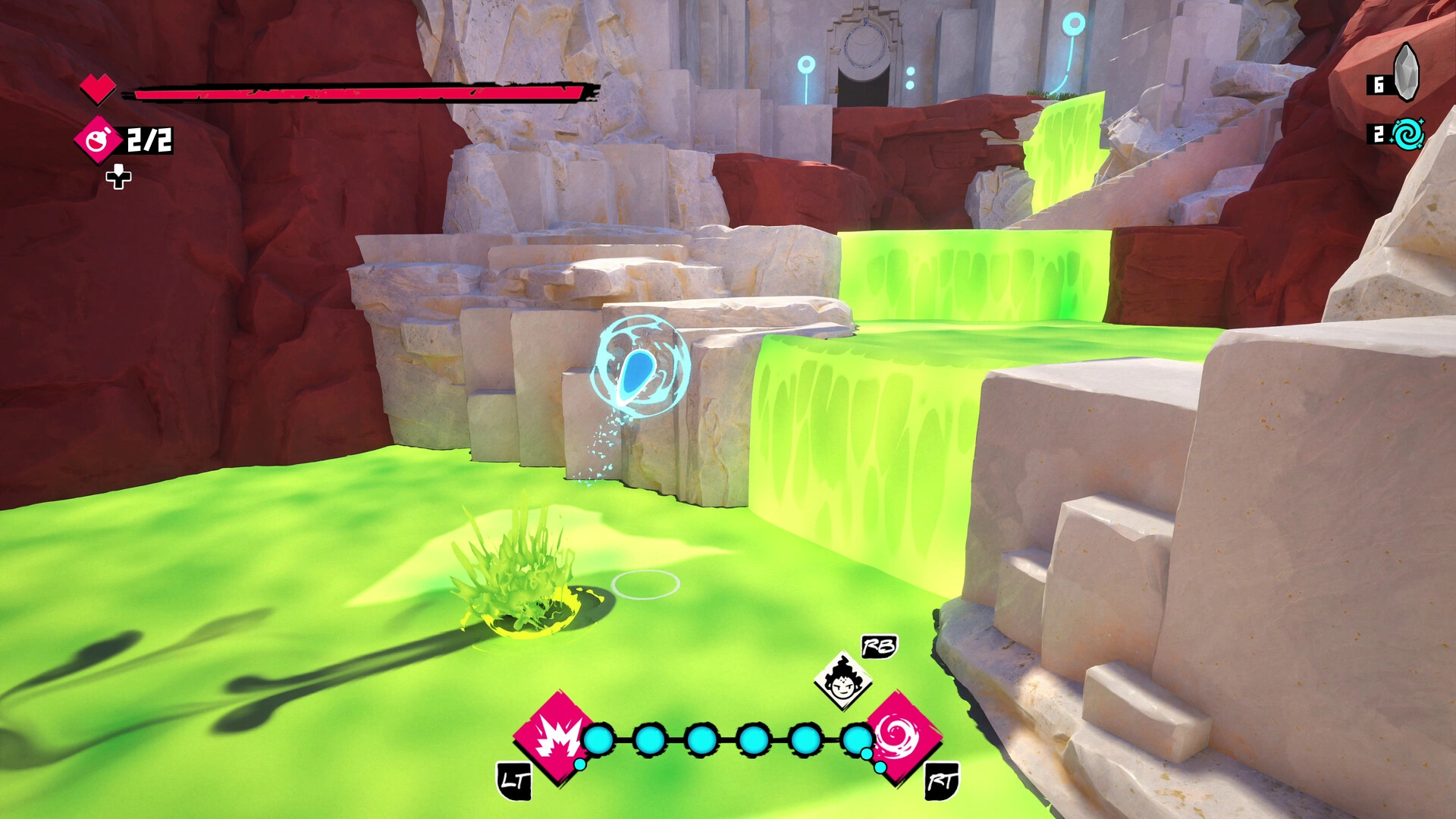
Water freezes flame-covered enemies. Toxic Waste weakens opponents. Lava applies burning damage. Paradox causes unstable enemies to explode when killed. Arena geometry matters because a cliff can settle the problem faster than any elemental counter.
The kick soon becomes Fading Echo’s defining combat move for the wrong reason. Enemies can be thrown into hazards or pushed into the void, bypassing the slower melee loop. Water can freeze tougher targets for quick follow-up attacks, while the Wave ability clears groups with little resistance. Unlimited dodging removes much of the pressure once enemy animations become familiar.
A broader roster could have carried this simplicity. Instead, the same small group returns under different elemental coatings, so encounters change color without changing behavior. Progression adds health, damage, ability charges, and mobility, yet the opening attack pattern remains intact. The puzzles keep asking for sharper understanding. The fights keep asking for another kick.
Color Before Character
Corel’s visual design carries the personality that the script leaves unfinished. Bright pools of water, lava, toxic sludge, and corruption cut through gray ruins with immediate clarity. Cel-shaded models sit against painterly textures, while One’s luminous blue hair keeps her readable during crowded effects.
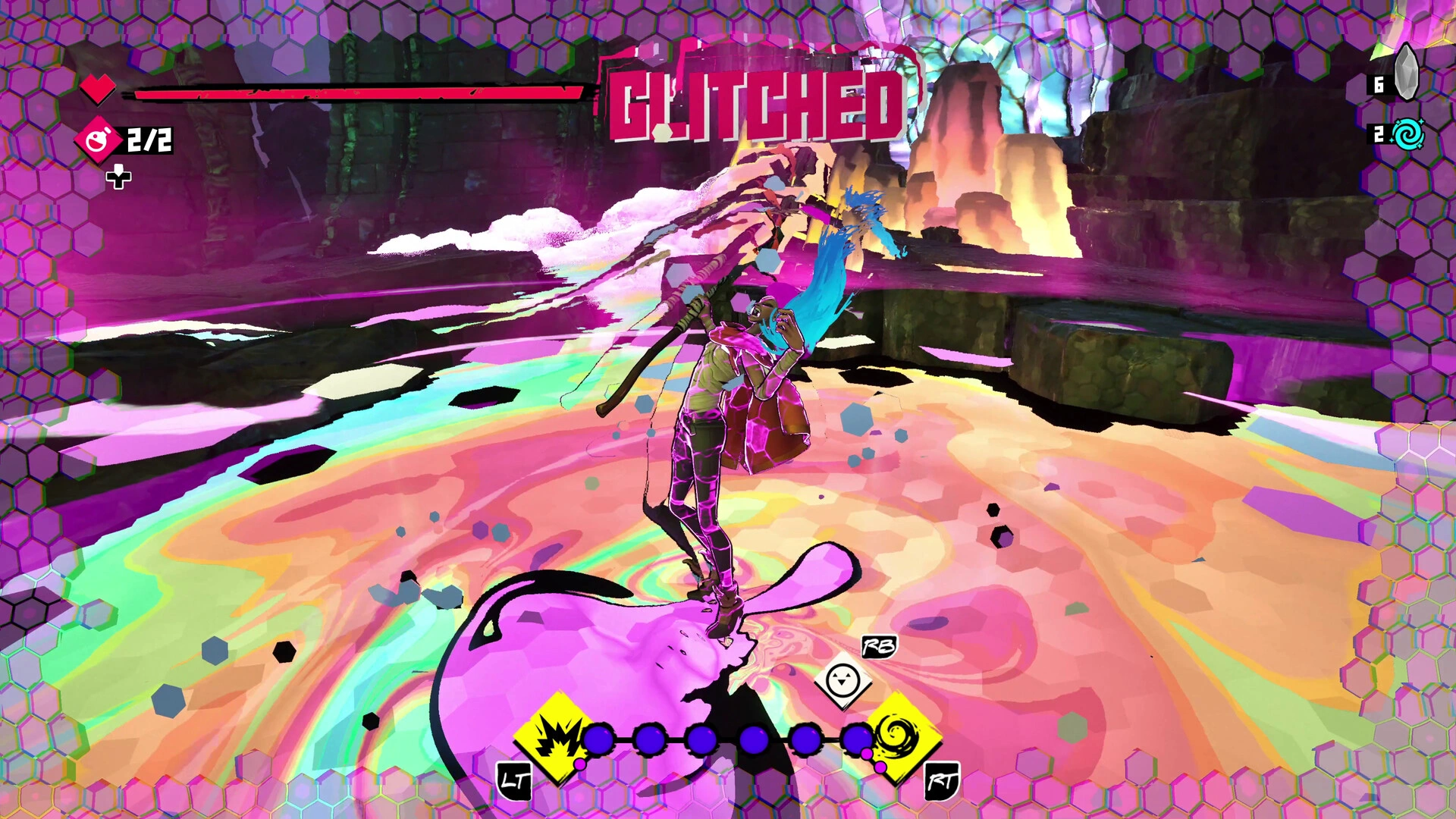
The early Echoverse sequence makes the strongest visual promise. Psychedelic waves, black-and-white drawings, fractured landscapes, and glitching realities suggest a game ready to reinvent its appearance whenever One crosses dimensions. Later regions rarely match that experimentation, though the Shadows still provide striking shifts in color and atmosphere.
Story scenes use a motion-comic format built from static or lightly animated frames. The approach suits the illustrated direction, but rapid cutting weakens emotional exchanges and major confrontations. Important lore often arrives through radio conversations that stop when One leaves the designated space, turning exposition into a temporary barrier.
Vellum fares best. Laura Bailey gives the artificial construct a calm, measured voice that becomes sharper when different Shadows alter its personality. The changing dynamic with One creates the game’s funniest exchanges. Rahne, the supporting cast, and the antagonist receive less attention, while One’s constant self-talk can clash with the destruction surrounding her.
Sound effects give each transformation a convincing physical texture. Water splashes, toxic liquid sputters, and steam hisses with playful precision. Camera collisions near walls, rare clipping, uneven voice levels, and performance drops during effects-heavy encounters expose a rougher edge, yet the art direction keeps Corel inviting after the enemy roster has stopped surprising.
The Review
Fading Echo
Fading Echo feels like a forgotten action-platformer from the PS2 and Xbox 360 era, rebuilt around a smart elemental system. Turning water into steam, toxic propulsion, or a Paradox tether gives its puzzles genuine momentum, especially once multiple realities enter the equation. Combat never grows at the same rate; a basic combo, limited enemy roster, and cliff-clearing kick flatten encounters long before the final region. The thin supporting cast and awkward exposition leave the world carrying the story, yet Emeteria’s debut still earns attention through mechanical confidence and striking color.
PROS
- Inventive elemental transformations
- Strong environmental puzzles
- Flexible exploration routes
- Distinct comic-book art direction
- Excellent voice performances
CONS
- Repetitive enemy encounters
- Shallow melee progression
- Uneven narrative delivery
- Confusing navigation
- Limited character development