














The rooms in Ferine do not shelter Irene. They appraise her. Andrea Corsini places the grieving art collector inside a monumental home of polished stone, severe angles, and long pockets of negative space. Its brutalist geometry first suggests wealth disciplined into taste.
After the death of the infant she hoped to raise, the same walls begin to resemble the enclosure at Dama’s exotic-animal compound. One woman owns art, the other owns predators, and the film keeps narrowing the moral distance between those habits.
Corsini’s feature debut grows from an act of cruelty that arrives early and leaves no clean route back. Irene, scarred by miscarriages, enters a covert adoption arrangement through maternity specialist Rosa. The birth mother hesitates. Irene flees into the night with the newborn.
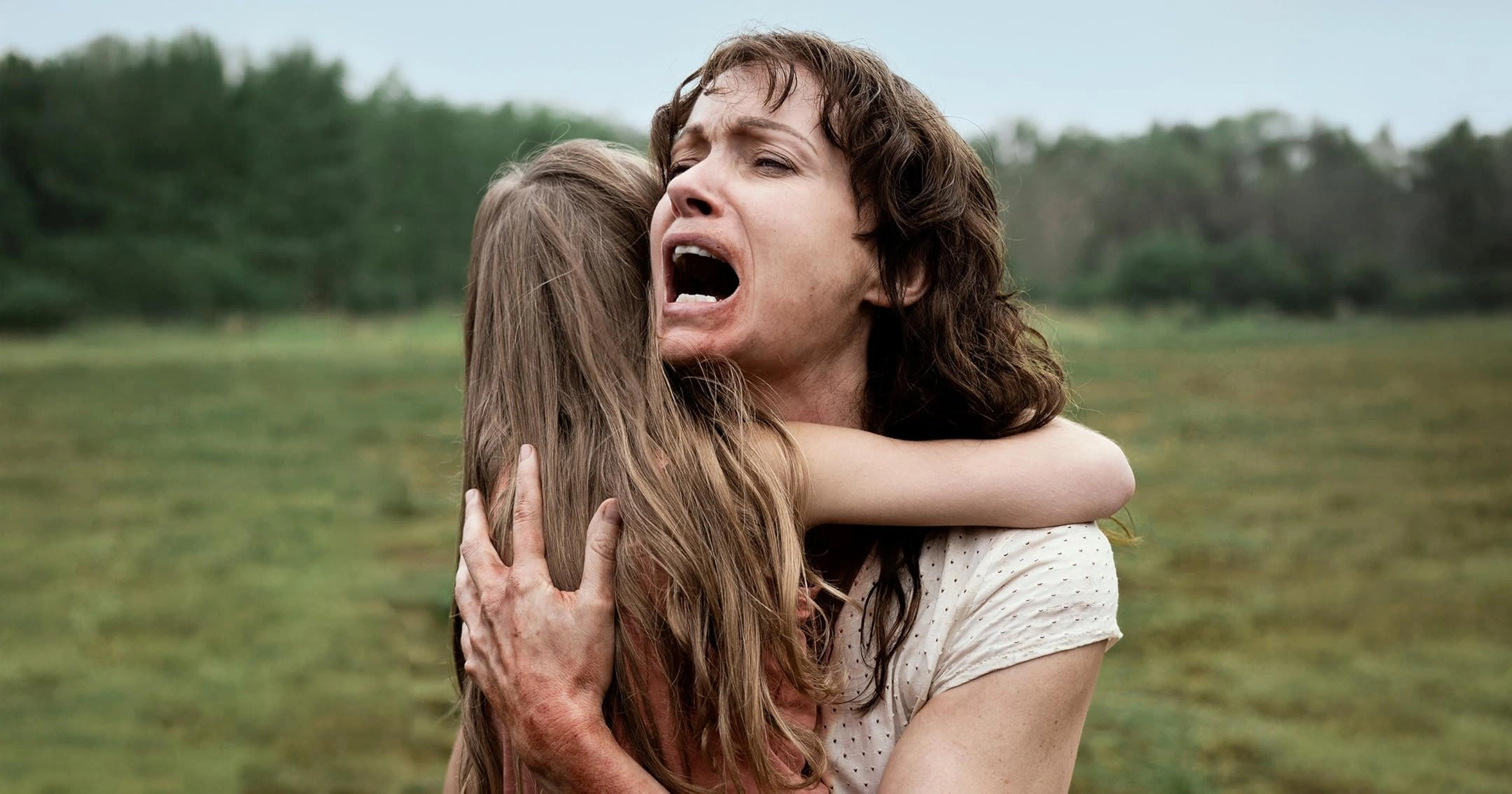
An escaped big cat crosses the road, and the collision between these separate acts of possession ends with a death so grotesque that the delayed title card feels like a door slamming shut. From that point, grief ceases to be an emotion the camera can observe from a polite distance. It becomes appetite.
Grief Under Hard Light
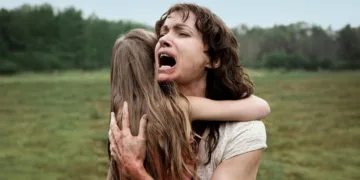
Carolyn Bracken gives Irene a physical logic that the screenplay cannot always supply. Before the transformation is visible, Bracken tightens the space around her body. Her shoulders settle, her gaze holds a fraction too long, and each movement carries the warning of a coiled animal. Corsini often frames her against hard stone or empty glass, flattening the home’s elegance into a kind of clinical hostility.
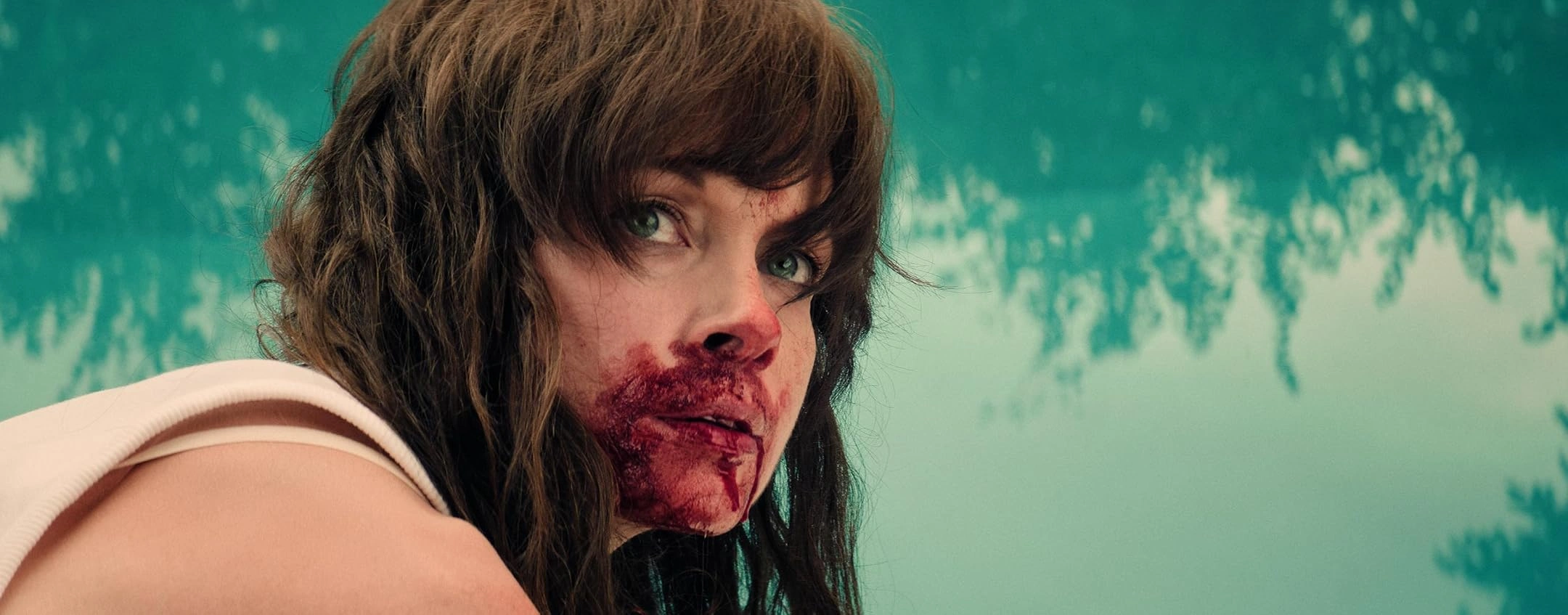
The raw rabbit scene is the bluntest example. Irene does not bite into the skinned carcass with theatrical frenzy. Bracken approaches it with concentration, almost ceremony, which makes the act harder to dismiss as simple madness. The film’s idea is written across her jaw: mourning has crossed into biology.
A later jump cut reveals Irene bloodied and draped across a wall in the garden. The composition turns her into a wounded creature resting inside claimed territory, yet the frame never grants her innocence. This is where Corsini’s visual grammar carries the moral burden. Irene is victim, trespasser, mother, and threat at once. The camera refuses to choose a single label. Sensible of it.
The early catastrophe places a limit on the performance. There is little time with Irene before loss consumes her, so Bracken cannot build a wide emotional contrast between the woman she was and the figure she becomes. She answers that structural problem through posture, breath, and silence. The script shortens the arc. Her body lengthens it.
The Keeper and the Captive
Caroline Goodall’s Dama moves through her compound with the confidence of someone who mistakes control for order. Safari decor, cages, weapons, and ornamental wealth give the location a colonial aftertaste. The design is immaculate. So is the cruelty.
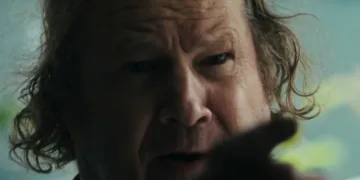
Goodall plays Dama without decorative villainy. A clipped line such as “Are you dumb?” lands with the casual contempt of a handler correcting an animal. She carries a cattle prod or gun through much of the film, yet the menace comes from her certainty that every living thing has an owner. Irene’s violence is chaotic. Dama’s is administrative.
Their eventual collision works because Corsini has already paired them through space. Irene’s home and Dama’s compound differ in style, though both are built around containment. One cages beasts openly. The other hides the cage beneath architecture and art. When the two women occupy the same dramatic field, the question is not which one is civilized. The word has already lost its usefulness.
Rosa and the young Giulia extend this pattern through the maternity clinic and custody struggle. Parents, social workers, collectors, and patrons all speak the language of care while reaching for possession. These threads sharpen the film’s central idea, but their emotional weight remains uneven. Giulia’s presence carries symbolic pressure that her limited development cannot fully support. The cage is carefully drawn. Some of its occupants remain sketches.
Blood in the Geometry
Fabrizio La Palombara’s cinematography gives Ferine its most precise argument. Pastoral calm repeatedly sits beside sudden brutality, and the compositions make violence look like a stain spreading across a painting. The blood is bright, artificial, proudly Italian in its theatricality. Corsini knows the giallo lineage, yet he uses its colors less as nostalgia than accusation.
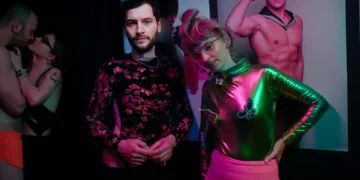
The performance-art sequence captures this balance at its strangest. Its spectacle is ridiculous, lavish, and faintly obscene, placing cultivated taste beside bodily horror until both seem like forms of consumption. The scene also exposes one of the film’s weaker habits. A second-act monologue about art lingers after the image has already made the point. The camera is eloquent. The dialogue occasionally arrives to explain the painting.
Pino Donaggio’s score enters with operatic confidence and keeps pressing against the images rather than hiding beneath them. The music treats Irene’s transformation as tragedy, threat, and dark pageant. Corsini’s editing follows the same unstable rhythm, moving from blunt shocks to deadpan visual jokes, then back to dread before the audience can settle.
Some visual clues pass too quickly, and the supporting arcs do not receive the same exacting attention as Irene’s physical descent. Still, the film’s architecture, light, music, and flesh remain locked in a rare conversation. Every corridor suggests a trap. Every open field looks temporary.
Ferine world premiered at the Fantasia International Film Festival on July 23, 2026, and is available through festival screenings and international distribution. The psychological horror film follows a wealthy art collector whose life shatters after a tragic loss, awakening a primitive, animalistic nature that drives her to violently reshape her world.
Full Credits
Title: Ferine
Distributor: EDI Effetti Digitali Italiani, Berta Film
Release date: July 23, 2026
Running time: 105 minutes
Director: Andrea Corsini
Writers: Andrea Corsini, Massimo Vavassori
Producers and Executive Producers: Francesco Grisi, Giorgia Priolo
Cast: Carolyn Bracken, Caroline Goodall, Paola Lavini, Elisabetta Caccamo, Marco Gambino, Fabrizio Odetto
Director of Photography (Cinematographer): Fabrizio La Palombara
Editors: Matteo Mossi
Composer: Pino Donaggio
The Review
Ferine
Ferine turns maternal grief into a predator and traps it inside rooms designed like moral cages. Andrea Corsini’s command of brutalist space, saturated violence, and Pino Donaggio’s operatic score gives the film a visual authority its thinner supporting arcs cannot always match. Carolyn Bracken makes Irene’s transformation physical, while Caroline Goodall supplies a colder species of menace. Some clues vanish too quickly and the art-world monologue overstays its welcome, yet the film’s most savage images retain their ethical unease long after the blood dries.
PROS
- Carolyn Bracken’s ferocious physical performance
- Brutalist spaces charged with moral tension
- Pino Donaggio’s commanding score
- Caroline Goodall’s controlled menace
- Macabre, carefully composed imagery
CONS
- Underdeveloped supporting relationships
- Several visual clues pass too quickly
- Second-act art monologue slows the hunt