





























The strangest thing about Steve Johnson is how clearly he can explain the birth of a monster and how little he can say about the ruin surrounding its maker. Nick Taylor’s Rubberhead: The Life & Monsters of Steve Johnson lives inside that distance.
Johnson, an Emmy-winning practical-effects artist whose work touched An American Werewolf in London, Fright Night, Poltergeist II, Species, and Return of the Living Dead III, speaks with the ease of a man who has rehearsed his memories until catastrophe sounds like dinner-table comedy.
Taylor signals his intent with an opening dictionary gag. “Rubberhead” can mean an incompetent worker, an irritating person, or a makeup-effects artist. The joke is sharp because the film refuses to decide which definition owns Johnson. It lets all three breathe.
Hands That Made Nightmares
Johnson’s childhood fascination with Universal monsters becomes a calling rather than a hobby. He leaves Texas for Los Angeles, studies the work of Dick Smith, assists Rick Baker, and enters an industry where latex, foam, paint, cables, and patience could give flesh to the impossible.
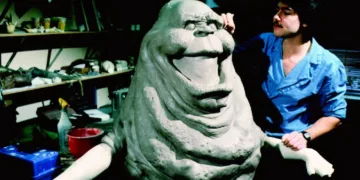
Taylor’s archive is generous here. Workshop footage and production photographs show faces being sculpted, molds broken open, prosthetics fitted, mechanisms tested, and crews trying to solve problems before a camera starts rolling.
These images give the documentary its pulse. A creature such as Slimer does not arrive as a finished icon. It begins as labor, mess, argument, and invention. Johnson’s account of working under the influence of cocaine during that period stains the triumph without erasing it. The creature remains funny. The memory becomes colder.
His career stories carry the same double charge. The failed original suit for Predator becomes a tale of pressure and misjudgment. James Cameron making him cry during The Abyss reveals the humiliation packed inside high-level studio work.
His claimed firing from Beetlejuice, after trying to replace Tim Burton’s drawings with designs he considered better, captures the arrogance that helped him lead and helped him fall. Johnson could look at a blank workshop table and see a body waiting to exist. He could look at another artist’s vision and see an error requiring correction.
A Man Who Keeps Escaping Himself
Johnson is magnetic on camera. He is funny, self-effacing, shameless, and gifted with the rhythm of confession. Alcohol, cocaine, methamphetamine, lavish parties, broken partnerships, and burned bridges enter his stories without hesitation. Yet candor and self-knowledge are not the same substance.
He insists that addiction never damaged his work. Former colleagues describe a harder reality: a talented leader who could become unreliable, extravagant, stubborn, and punishing to work beside. Taylor does not force a verdict through narration. He places Johnson’s certainty beside the testimony of those who survived his certainty.
Linnea Quigley’s interview gives that contradiction a human face. She recalls meeting Johnson on Night of the Demons, their fast romance, and the affection that remains after divorce. Her warmth does not soften the damage. It makes the damage visible. Somewhere between the sweetness of their beginning and the collapse of their marriage sits the cost Johnson can name only in fragments.
When Taylor presses toward the roots of his dependency, Johnson refuses the language of therapy and rejects the idea of blaming other people for his mistakes. The refusal sounds principled for a moment. Then it starts to resemble another locked workshop door. Responsibility without examination can become its own disguise.
The Industry Leaves the Workshop
The film’s sadness widens as Hollywood turns toward digital effects. Johnson built his company during a period when horror and fantasy depended on physical craft, then watched studios pursue computer-generated imagery that promised speed, flexibility, and lower costs. The shift after Jurassic Park did not merely change tools. It changed which kinds of workers could still imagine a future inside the industry.
Taylor avoids granting technology full responsibility for Johnson’s decline. The parties were expensive. The business decisions were poor. The addictions were real. The relationships frayed. CGI arrived at the worst possible time for a man already spending his talent faster than he could preserve it.
The editing keeps the film moving through outrageous anecdotes, archival footage, and compact career chapters, yet a quiet grief gathers beneath the pace. The monsters survive in reruns, posters, fan conventions, and childhood memory. The hands that formed them grow older. The workshops empty. Johnson can still describe where every seam was hidden, how every mechanism moved, which material failed under heat. Ask him what the damage meant, and the language disappears.
Rubberhead: The Life & Monsters of Steve Johnson world premiered at the Fantasia International Film Festival on July 23, 2026, with screenings scheduled at festival events. The documentary explores the life and career of legendary special effects makeup artist Steve Johnson, tracing his creation of iconic cinematic creatures alongside his personal highs and struggles.
Full Credits
Title: Rubberhead: The Life & Monsters of Steve Johnson
Distributor: Fantasia International Film Festival, American Nightmare Studios
Release date: July 23, 2026
Running time: 105 minutes
Director: Nick Taylor
Writers: Joseph Krings, Nick Taylor
Producers and Executive Producers: Joseph Krings, Alex Euting, Aaron B. Koontz
Cast: Steve Johnson, John Landis, Linnea Quigley, Tom Holland, Bill Corso, Rick Baker, Greg Cannom, Richard Edlund
Director of Photography (Cinematographer): Mike Testin
Editors: Joseph Krings
Composer: Jonas Wikstrand
The Review
Rubberhead: The Life & Monsters of Steve Johnson
Rubberhead: The Life & Monsters of Steve Johnson finds its deepest sadness in the distance between the creatures Johnson understands completely and the man he still refuses to examine. Nick Taylor preserves the exhilaration of practical-effects work through workshop footage, career stories, and Johnson’s unruly humor, while colleagues and former wife Linnea Quigley reveal the wreckage left outside the frame. The psychological portrait remains unfinished because Johnson keeps its darkest door closed. The monsters endure. Their maker remains harder to hold.
PROS
- Johnson’s candid, magnetic storytelling
- Rich practical-effects archives
- Honest testimony from colleagues
- Strong account of Hollywood’s digital shift
- Tender interview with Linnea Quigley
CONS
- Limited psychological examination
- Johnson minimizes addiction’s professional damage
- Several career chapters receive brief treatment