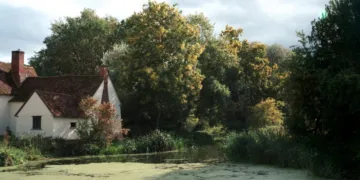

























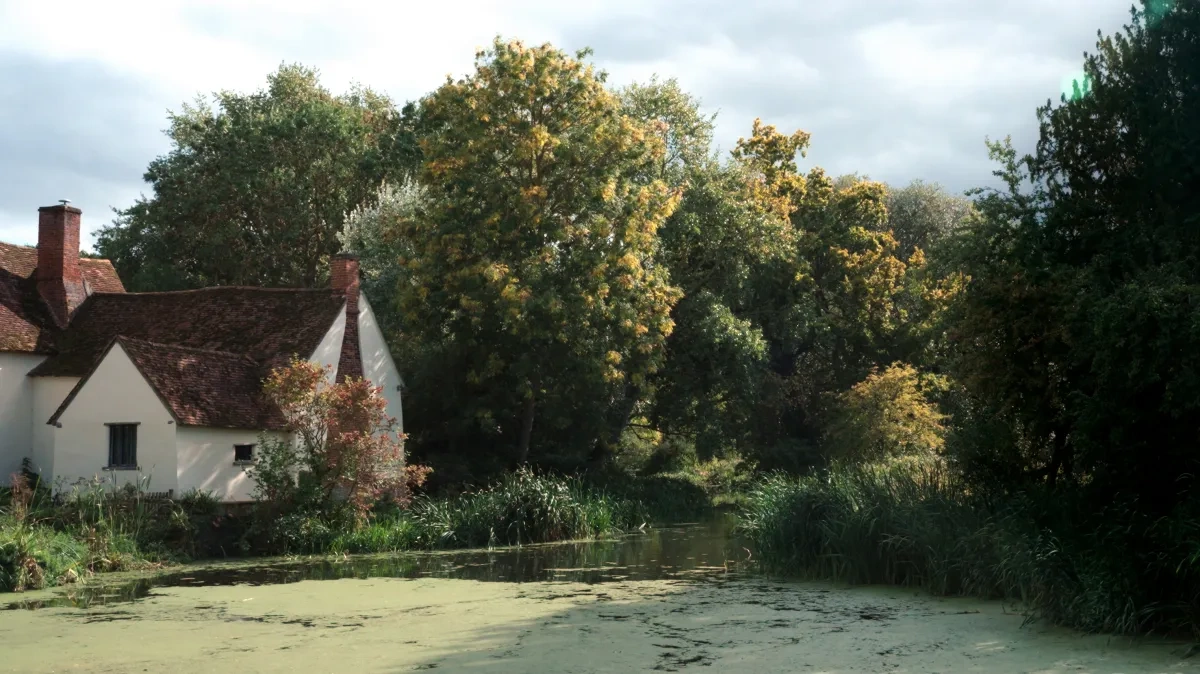

Yellow enters Turner’s skies like a wound that refuses to close. Across the water, Constable’s whites break apart over hedges, clouds, and riverbanks, small flashes of weather held for a second before the world moves on. David Bickerstaff’s Turner & Constable understands that both painters were chasing the same impossible subject: time made visible.
Built around Tate Britain’s “Rivals and Originals” exhibition, the film places J.M.W. Turner and John Constable beside one another, then waits for the old opposition between them to weaken. Turner, born in 1775, became the prodigy of Covent Garden, entering the Royal Academy at fourteen.
Constable, born a year later, arrived from Suffolk with a slower career and a quieter public image. One seems to paint storms remembered from a dream. The other watches a field until labour, weather, and memory become inseparable. The rivalry is useful because it gives the film tension. It is also inadequate. Their differences are real, but the shared hunger matters most.
A Country Looking Inward
The Napoleonic Wars closed Europe to British travellers and disrupted the Grand Tour, leaving painters to look inward at a country they had often treated as a waiting room before Italy. The documentary traces how this enforced isolation helped form a British landscape tradition. Turner imagined foreign vistas before he could visit them. Constable returned again and again to Suffolk, treating familiarity as a discipline rather than a limitation.
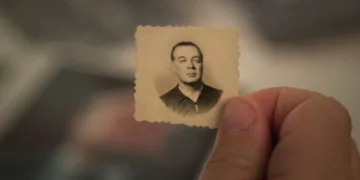
The exhibition opens with two youthful self-portraits. Turner looks rakish and alert; Constable appears formal, his face touched with the delicacy of an earlier century. Their placement on the same wall quietly resists the myth of enemies advancing toward opposite futures. Both studied Claude Lorrain. Both absorbed James Thomson’s The Seasons. Both understood that landscape painting could carry history, class, work, fear, and desire without placing a heroic body in the foreground.
Their 1831 Royal Academy pairing sharpens the distinction. Turner’s Caligula’s Palace and Bridge offers imagined antiquity under theatrical light. Constable’s Salisbury Cathedral from the Meadows turns contemporary England into something equally unstable. One looks backward through myth. The other looks outward through rain.
Pigment, Weather, Flesh
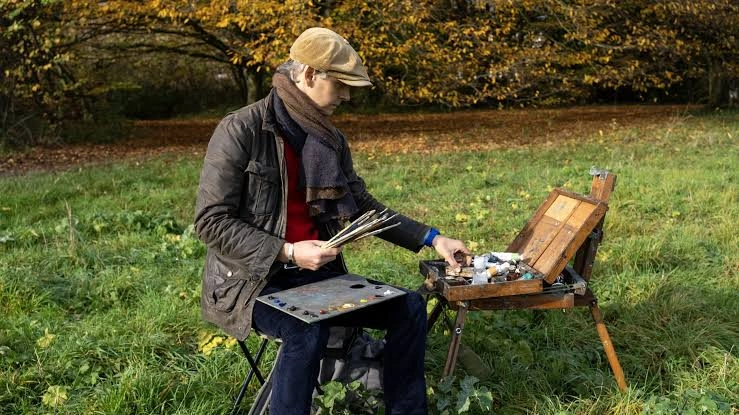
Lachlan Goudie’s demonstrations give the film its tactile life. He shows how oil paint travelled in pig bladders, punctured with pins, and how cumbersome it was for Constable to carry chair, palette, canvas, and wet material into the open air. The inconvenience matters. Constable’s clouds are not decorative ceilings. They are records of exposure, of a body standing beneath weather long enough to notice its changes.
Turner’s experiments with chrome yellow and cobalt blue are shown as acts of appetite. In Fishermen at Sea, light does not rescue the boat from darkness. It makes the danger visible. The sea gathers around the figures like a vast intelligence, indifferent and awake. Later Italian scenes, including The Bay of Baiae, reveal how travel altered his sense of luminosity. Yellow becomes heat, distance, memory.
The camera moves through Turner’s sketchbooks page by page, finding mathematics, science, fragments of landscape, and passing light. Constable’s loose whites and blues receive equal care. Critics of the period mocked Turner’s yellows and Constable’s splashes, mistaking the refusal of polish for failure. Yet both painters were trying to catch what polish kills: movement before it settles.
The Gallery After the Crowd
Amy Concannon and Nicola Moorby speak with clarity, never forcing modern psychology onto men separated from us by two centuries. Their commentary gives the paintings history without sealing them inside it. Robert Lindsay’s reading from Thomson adds a pulse of poetry, though the strongest passages belong to silence, when the camera crosses cracked paint and worn canvas at a pace slow enough to feel almost intimate.
One tracking shot eases backward through adjoining rooms, restoring depth to an exhibition that cinema could easily flatten. Elsewhere, Salisbury Cathedral from the Meadows and Caligula’s Palace and Bridge face each other across gallery space. The arrangement becomes an argument made with walls.
A screen cannot reproduce the scale of these canvases or the physical unease of standing before a storm painted larger than the body. The film finds another kind of proximity. It lingers on surfaces visitors might pass too quickly, opens sketchbooks that would remain fixed to a single page, and ends near unfinished paintings where light arrives before completion. The painters are gone. The weather is still moving.
Turner & Constable is a documentary feature film that premiered in cinemas in early 2026. The film explores the intertwined lives, profound legacies, and artistic rivalry of two of Britain’s greatest painters against the backdrop of Tate Britain’s special exhibition. Viewers can watch the film through special event cinema screenings and select digital streaming platforms.
Full Credits
Title: Turner & Constable
Distributor: Seventh Art Productions, Exhibition on Screen
Release date: March 10, 2026
Running time: 91 minutes
Director: David Bickerstaff
Writers: David Bickerstaff
Producers and Executive Producers: Phil Grabsky
Cast: J. M. W. Turner, John Constable
Director of Photography (Cinematographer): David Bickerstaff
Editors: Phil Grabsky
Composer: Asa Bennett
The Review
Turner & Constable
Turner & Constable moves at the pace of a patient gallery walk, allowing pigment, cracked canvas, and gathering clouds to speak before the experts intervene. Its polished method occasionally feels too safe, while the loose chronology leaves parts of both lives in shadow. Still, the close studies of Fishermen at Sea, The Hay Wain, the sketchbooks, and those unfinished meditations on light reveal two painters forever reaching toward what the eye cannot hold. The rivalry fades. Their restless attention remains.
PROS
- Glowing close-ups of the paintings
- Clear, historically grounded commentary
- Fascinating demonstrations of period materials
- Thoughtful reframing of Constable
- Patient, spacious pacing
CONS
- Chronology remains somewhat fragmented
- Formal approach rarely surprises
- Cannot convey the canvases’ physical scale