






















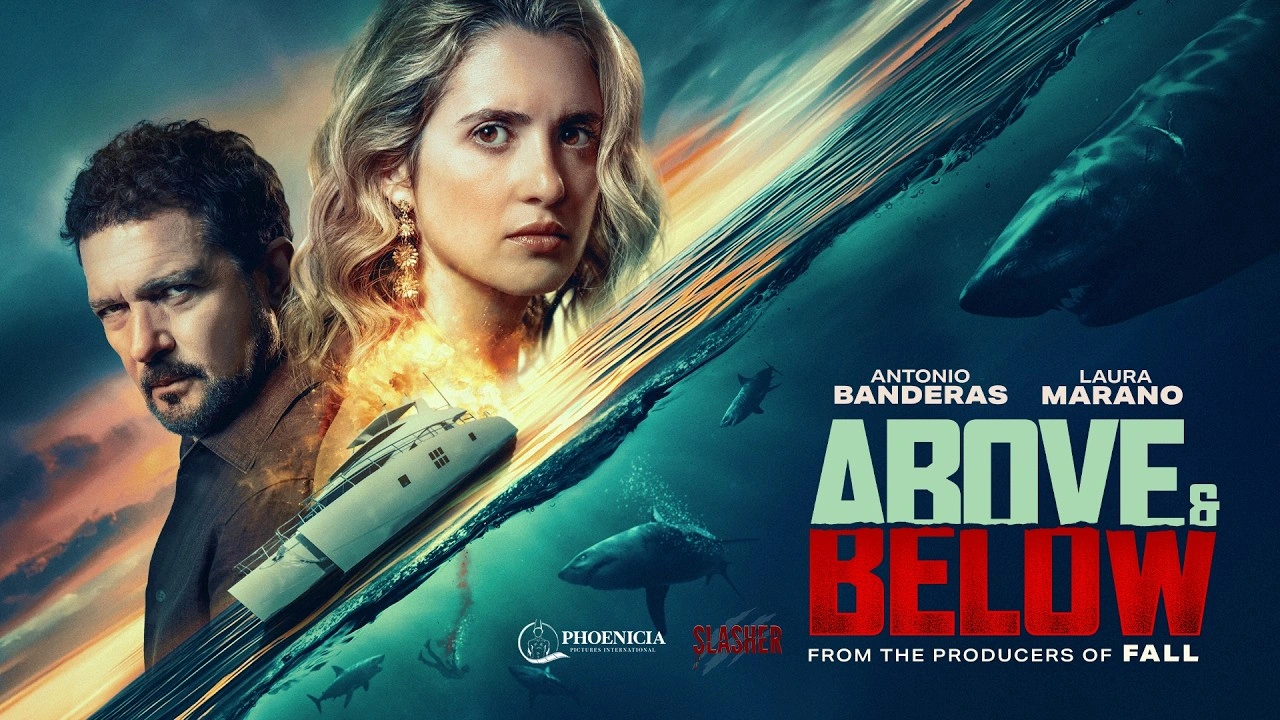

Kyle loses his savings across a poker table while Burns watches with the patience of a man who already owns the room. Antonio Banderas barely moves during their early exchange, letting the surrounding darkness and low, warm light create the authority that the screenplay has not yet earned for him. Then he offers Kyle a free shark-diving excursion. Charity from a cartel figure should cast a longer shadow.
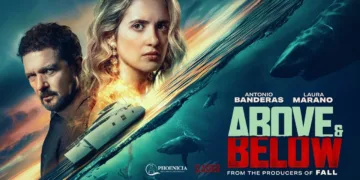
Written by Anthony Steven Giordano and directed by Jesse V. Johnson, Above and Below divides its danger across two planes. Tatiana and Kayle become trapped in a cage beneath the sea, surrounded by sharks and dwindling oxygen. Above them, Burns and his armed men search Captain Logan’s catamaran for a missing bag of cocaine. The architecture is clean: teeth below, bullets above, panic caught between them.
The route to that trap is less disciplined. Tatiana is vacationing with her boyfriend TJ, her friend Kayle, Kayle’s partner Danny, and her gambling-addicted brother Kyle. A possible breakup between Tatiana and TJ receives brief attention, then vanishes once the group boards the boat. Kyle’s addiction fares little better. His poker loss supplies the plot, yet the character remains a device with a nervous face attached.
Everyone accepts the excursion with remarkable ease. Kyle has lost his money to a stranger and returned with an expensive aquatic gift. Questions would be reasonable. The group chooses swimwear.
Waiting for the Water to Darken
Johnson spends too long arranging a crisis that is visible from the moment Martin and Garrison step aboard. Martin, played by Louis Mandylor, watches Tatiana and Kayle with open hostility, while Garrison remains silent beside him. Captain Logan introduces them as additional passengers, and the younger guests suppress their discomfort because the sea is bright, the drinks are cold, and bad decisions often arrive disguised as hospitality.
The first dive offers a false alarm involving a lost phone and one diver leaving the cage to retrieve it. The scene should tighten the relationship between human carelessness and animal threat. Instead, it delays the actual conflict without changing anyone. The sharks pass through the blue like visual punctuation marks, briefly appearing to remind the film which genre paid for the boat.
Also Read





The hidden cocaine finally supplies momentum. Once the bag is discovered, Martin pulls a gun and begins creating problems faster than Burns can solve them. Bodies fall, the drugs sink, and Tatiana and Kayle remain trapped underwater as blood and chum draw sharks toward the cage. Burns arrives at the thirty-minute mark to survey the damage with the expression of a manager discovering that his staff has set fire to the office.
Banderas understands the tonal opportunity. Burns is threatening because his anger does not follow a stable rhythm. He moves from quiet instruction to theatrical disgust, then back to calculation before anyone around him can adjust. The performance lends unpredictability to scenes whose outcomes are often easy to anticipate.
Two Kinds of Predation
The title gives Johnson a useful spatial grammar. Underwater scenes rely on negative space, limited visibility, and the rigid bars of the shark cage. On deck, gunmen move through narrow passages where every doorway can conceal a weapon. Maxime Alexandre’s cinematography keeps both arenas legible, distinguishing the exposed brightness of the catamaran from the cooler, less certain depths below.
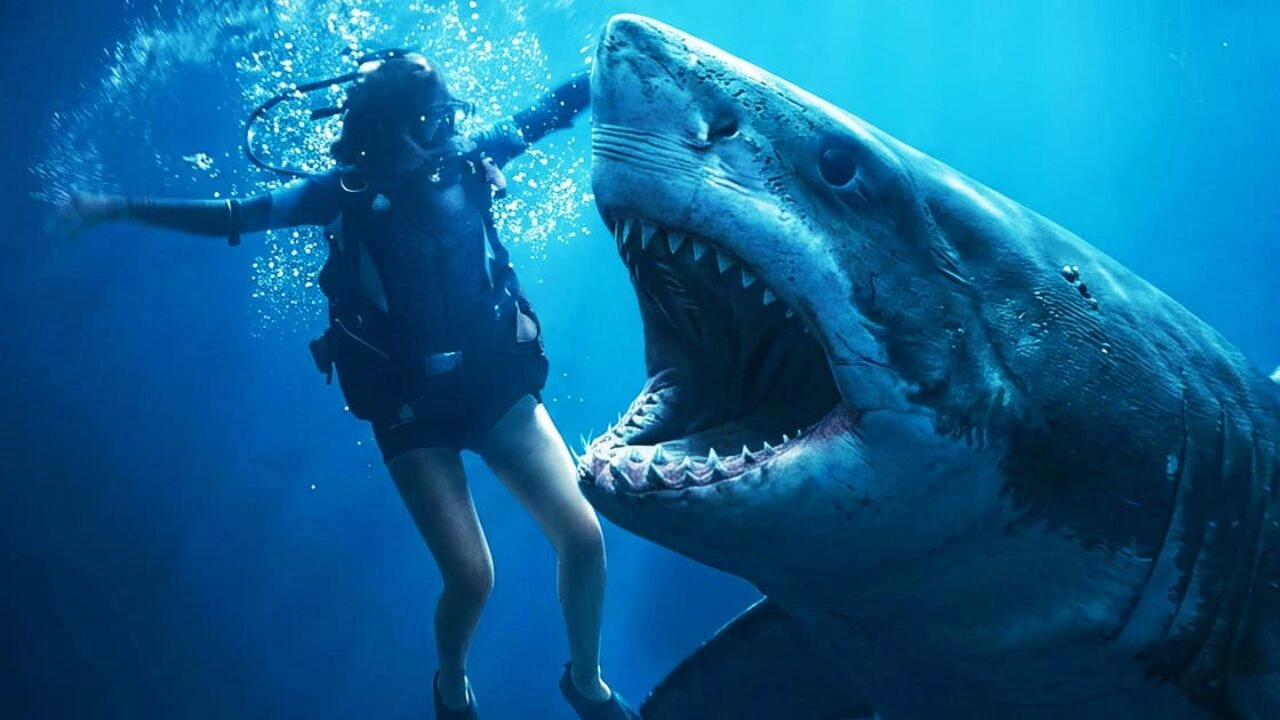
The underwater compositions carry the stronger psychological idea. Tatiana and Kayle can see open water in every direction, yet the cage converts that apparent freedom into confinement. Their masks isolate their eyes, and the frame often leaves empty blue beside them, waiting for a shape to enter. Suspense lives in that vacancy.
The sharks rarely justify it. One attack catches a character’s leg in a full bite, then leaves scratches and modest bleeding. The violence contradicts the image. A predator capable of filling the frame with its mouth should leave a clearer argument on the body.
Tatiana’s late knife attack commits to the carnage that earlier encounters avoid. She cuts into a shark and unleashes an absurd flood of gore, a grisly flourish that arrives from a different, livelier version of the film. Johnson’s confidence is stronger aboard the boat, where gunfire moves cleanly through confined spaces and a flare gun gives one confrontation a suitably incendiary finish. A pursuing police vessel meets a long-range rifle with brutal efficiency. Human beings remain the better monsters, which may be thematically useful and commercially awkward for a shark thriller.
Light, Shadow, and Empty Space
Matthew Lorentz’s editing provides the film with its most reliable structure. Cuts between the cage, the sinking drugs, Burns’ men, and the panicking passengers establish clear geography. The viewer knows who occupies each level of danger and how those spaces may collide. The problem lies in the intervals. Momentum rises during a shooting or shark appearance, then drains away during stretches of negotiation and indecision.
The younger cast struggles against characters drawn in broad strokes. Diego Llinas gives Kyle a credible layer of shame, particularly when Tatiana confronts him, yet the screenplay keeps returning him to selfishness without developing the addiction beneath it. Laura Marano fares better as Tatiana. Her eyes register fear effectively through the dive mask, and she supplies physical urgency once the cage becomes a prison. Her transformation into the group’s calmest survivor comes too quickly, with little preparation beyond being less foolish than her companions.
Timothy V. Murphy brings welcome steadiness to Captain Logan. His explanation that sharks are apex predators rather than mindless killers introduces a distinction the film almost explores: animal violence has instinctive clarity, while Burns and Martin choose cruelty through greed, pride, and panic. Mandylor makes Martin a volatile irritant from his first crude comments, and Jess Liaudin gives Garrison’s silence enough weight to keep his loyalties uncertain.
Above and Below contains strong visual premises that its writing cannot fully occupy. The cage is photographed as a submerged cell. The catamaran becomes a sunlit crime scene. Banderas casts a long shadow across both. The sharks, curiously, remain somewhere at the edge of the frame.
Above and Below is an action thriller film released on July 29, 2026. The film follows a group of friends whose dream vacation involving parties and diving takes a terrifying turn when they are attacked at sea by criminals. Viewers can watch the movie in theaters and via video-on-demand platforms.
Where to Watch Above and Below (2026) Online
Full Credits
Title: Above and Below
Distributor: Capstone Pictures, Aura Entertainment
Release date: July 29, 2026
Rating: R
Running time: 96 minutes
Director: Jesse V. Johnson
Writers: Anthony Steven Giordano
Producers and Executive Producers: Carmen Aguado, Frank Ariza, Mark Boot, David Hillary, Manu Vega
Cast: Laura Marano, Antonio Banderas, Christina Ochoa, Timothy V. Murphy, Louis Mandylor, Jess Liaudin, Ryan Bertroche, Ramiro Alonso, Diego Llinás, Rodrigo Poisón, Mario Tardón, Donncha Tynan
Director of Photography (Cinematographer): Maxime Alexandre
Editors: Matthew Lorentz
Composer: Maria Vertiz
The Review
Above and Below
Above and Below places its clearest threat on the boat, where Antonio Banderas’ volatile Burns gives the sunlit catamaran a faint noir charge. Beneath the surface, the sharks circle without enough force, and the cage rarely becomes the prison the photography promises. Jesse V. Johnson stages gunfire with clean spatial logic, while Matthew Lorentz’s cross-cutting keeps the two arenas legible. Thin characters and delayed escalation leave too much empty water between attacks, yet Banderas supplies menace whenever the film begins to drift.
PROS
- Banderas’ theatrical menace
- Clear catamaran action staging
- Strong underwater compositions
- Effective cross-cutting
- Readable spatial geography
CONS
- Weak shark attacks
- Thin supporting characters
- Overextended setup
- Predictable survival outcomes
- Uneven tension