

























![Kingdom Hearts Collection [I-III] Review](https://gazettely.com/wp-content/uploads/2026/10/Kingdom-Hearts-Collection-I-III-1-360x180.webp "Kingdom Hearts Collection [I-III] Review: KHII Holds Steady as Newer Entries Fluctuate 37")



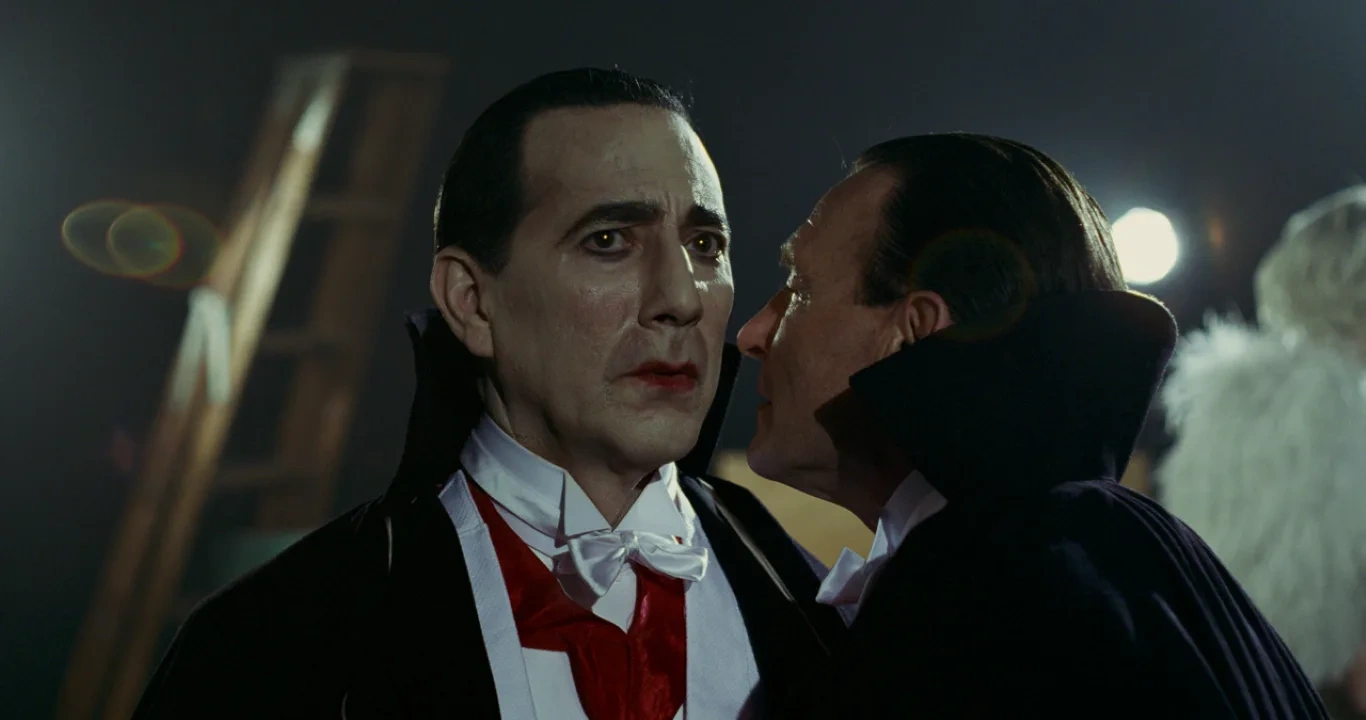

Hollywood’s cruelty in Los Vampires arrives as a practical instruction: watch another man perform during the day, then repeat him at night. Luis de Ossario, a fading Spanish star hired to play Count Vlad, hears that order as an erasure disguised as employment. The studio needs his language, his face, and his labor. His interpretation is surplus equipment.
Craig Mitchell builds the film around the historical curiosity of Universal producing English and Spanish versions of Dracula on the same sets, then replaces the real participants with fictional counterparts. This choice frees the story from historical bookkeeping and lets it become stranger.
Henry Ian Cusick’s Luis enters the soundstage carrying the wounded dignity of a man who once believed fame had made him permanent. Thomas Kretschmann’s Kürt Orlov, the daytime Dracula, regards imitation as theft, which is amusing given that both men are already borrowing a centuries-old monster.
The early scenes play their rivalry with comic irritation. Luis brings custom fangs and refuses to copy Orlov’s gestures. Orlov treats every cape movement as intellectual property. Their vanity looks ridiculous until the studio’s arrangement reveals its logic: one actor will be remembered, the other will work while the city sleeps.
One Role, Two Men
Cusick gives Luis a performance built from instability. His posture insists on authority, while his eyes keep calculating how little leverage remains. When he argues that he was once known as the “Spanish Sheik,” the boast lands as biography and obituary at once. He is still speaking from inside a publicity campaign that has already ended.
Kretschmann answers with colder insecurity. Orlov’s contempt for Luis conceals a fear that the Spanish production may expose how little of his Dracula belongs to him. Place another actor on the same staircase, inside the same coffin, wearing the same cape, and stardom starts to resemble a lighting setup. The men threaten each other, study each other, and gradually become collaborators in a contest neither can win.
Vianca, played by Daniela Couso, first appears to fit the studio’s preferred category of young actress: beautiful, inexperienced, and supervised. Sister Aubrey’s presence suggests protection, though it also resembles custody. Couso keeps Vianca composed while the men project innocence, danger, and desire onto her. Her stillness becomes a form of control. Luis and Orlov think they are competing for her attention. She appears to be watching them audition for something else.
The Studio Eats Time
The production design turns limitation into psychology. Corridors repeat, crypts lead back toward dressing rooms, and painted moons loom over artificial graveyards. Actors sleep inside prop coffins between scenes, a gag with the efficiency of a labor report. The studio has found a way to house its workers inside the image they are manufacturing.
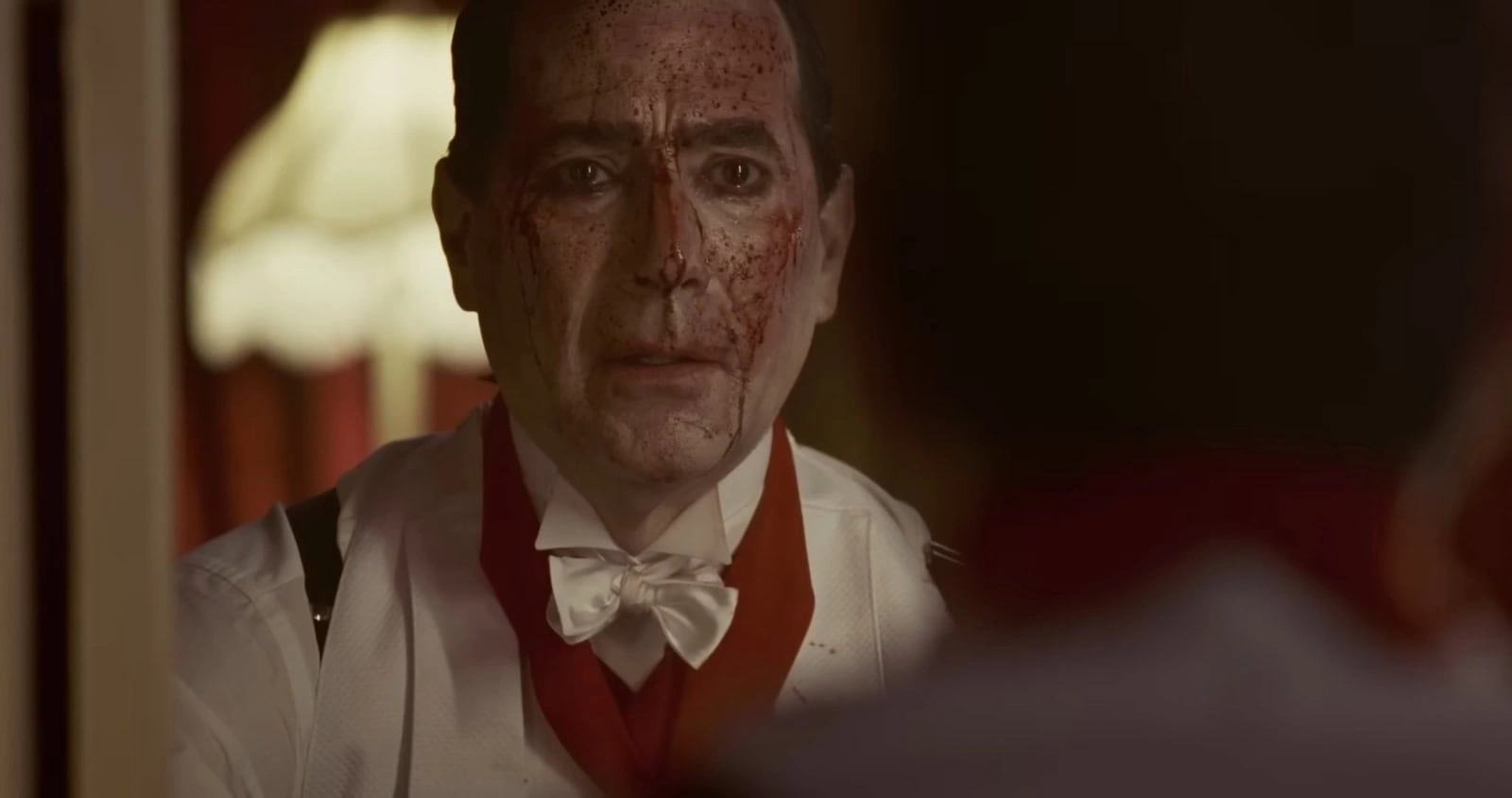
Simon Coull’s cinematography separates the black-and-white footage of the film being shot from the color world around it. That division seems stable at first. Then Luis begins losing time. Red light gathers around Vianca’s rooms, fabric interrupts his view of her, and familiar routes stop connecting in sensible ways. The backstage world starts behaving like the horror film everyone claims is pretend.
Evan Millard’s editing is strongest when it withholds the intervals Luis cannot remember. Sleep deprivation, pain from a lost tooth, and honey supplied as medicine leave him suspended between intoxication and exhaustion. Cuts deposit him after missing hours or days, and the film refuses to offer a reliable position outside his confusion. Some fades to black carry the blunt rhythm of television act breaks, and the English-language sound occasionally makes the period illusion wobble. The soundstage survives. The spell sometimes does not.
Josh Mancell’s score helps the transition by introducing a low vibration beneath comic exchanges. It feels less like music than structural distress, as though the studio itself has developed a pulse. By the time bodies appear drained of blood, the bass has already taught us to distrust the floor.
Immortality, Incorporated
Mitchell’s script crowds the studio with ideas: immigrant labor, censorship, sexual blackmail, predatory men, artistic ownership, and the conversion of performers into marketable silhouettes. Some threads barely receive a scene before another mystery replaces them. The footage Luis discovers, apparently created for blackmail, points toward a system of exploitation that the film cannot fully examine. The murders create urgency, though they also pull attention from the quieter violence already taking place under contract.
Vianca’s connection to a modified Cihuateteo tradition gives the supernatural turn a cultural lineage beyond European vampirism. After Sister Aubrey dies, Vianca crosses the studio’s physical and moral partitions with new confidence. The movie being filmed no longer imitates life. Life begins taking direction from the movie.
Luis’s temptation works because vampirism offers exactly what Hollywood withholds: authorship, permanence, and a body that cannot age out of demand. I first read his desire as another expression of ego. That seemed too easy. Cusick plays the decision with enough fear to reveal something sadder. Luis knows the offer may destroy him. He also knows obscurity already has.
The later epilogue shifts the film from gothic intrigue toward historical melancholy. One Dracula enters cultural memory; another survives as a footnote waiting to be rediscovered. Cinema preserves faces with great tenderness and distributes remembrance with the ethics of a payroll office. Luis wants to escape that system. His mistake is believing the monster stands outside it.
Los Vampires is a period horror-thriller film that made its world premiere at the Fantasia International Film Festival on July 21, 2026. Set in 1930 Hollywood, the story follows a Spanish actor cast in the night shoot of a vampire film who enters a fierce rivalry with the English-speaking star performing the role by day, all while mysterious murders occur on the soundstage. Viewers can watch the film through festival screenings and upcoming independent distribution channels.
Full Credits
Title: Los Vampires
Distributor: Fantasia International Film Festival
Release date: July 21, 2026
Director: Craig Mitchell
Writers: Craig Mitchell
Producers and Executive Producers: Ty Donaldson, Scott Bridges, Paul W., Craig Mitchell
Cast: Henry Ian Cusick, Thomas Kretschmann, Daniela Couso, Jefferson Mays, Oscar Nuñez, Jorge Diaz, Carol Abney
Director of Photography (Cinematographer): Simon Coull
Editors: Evan Millard
Composer: Josh Mancell
The Review
Los Vampires
Los Vampires turns a curious production footnote into a gothic argument about artistic ownership. Luis’s terror is rooted less in bloodshed than in the possibility that cinema will preserve another man’s gestures while erasing his own. Henry Ian Cusick gives that fear vanity, humor, and genuine pathos, while the shared sets gradually become a maze built from imitation. Craig Mitchell cannot keep every subplot under control, and the tonal shifts sometimes expose the machinery. Still, the film understands Hollywood’s oldest bargain: immortality is available, provided the studio owns your face.
PROS
- Cusick’s volatile lead performance
- Strong rivalry between the two actors
- Effective soundstage atmosphere
- Sharp ideas about cinematic ownership
- Graceful time-jumping epilogue
CONS
- Uneven tonal shifts
- Several thinly developed subplots
- Inconsistent period illusion
- Distracting sound limitations







