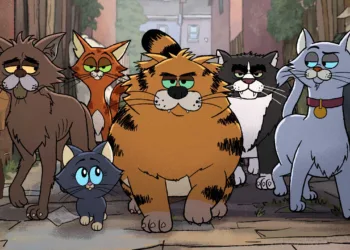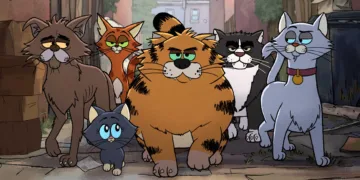




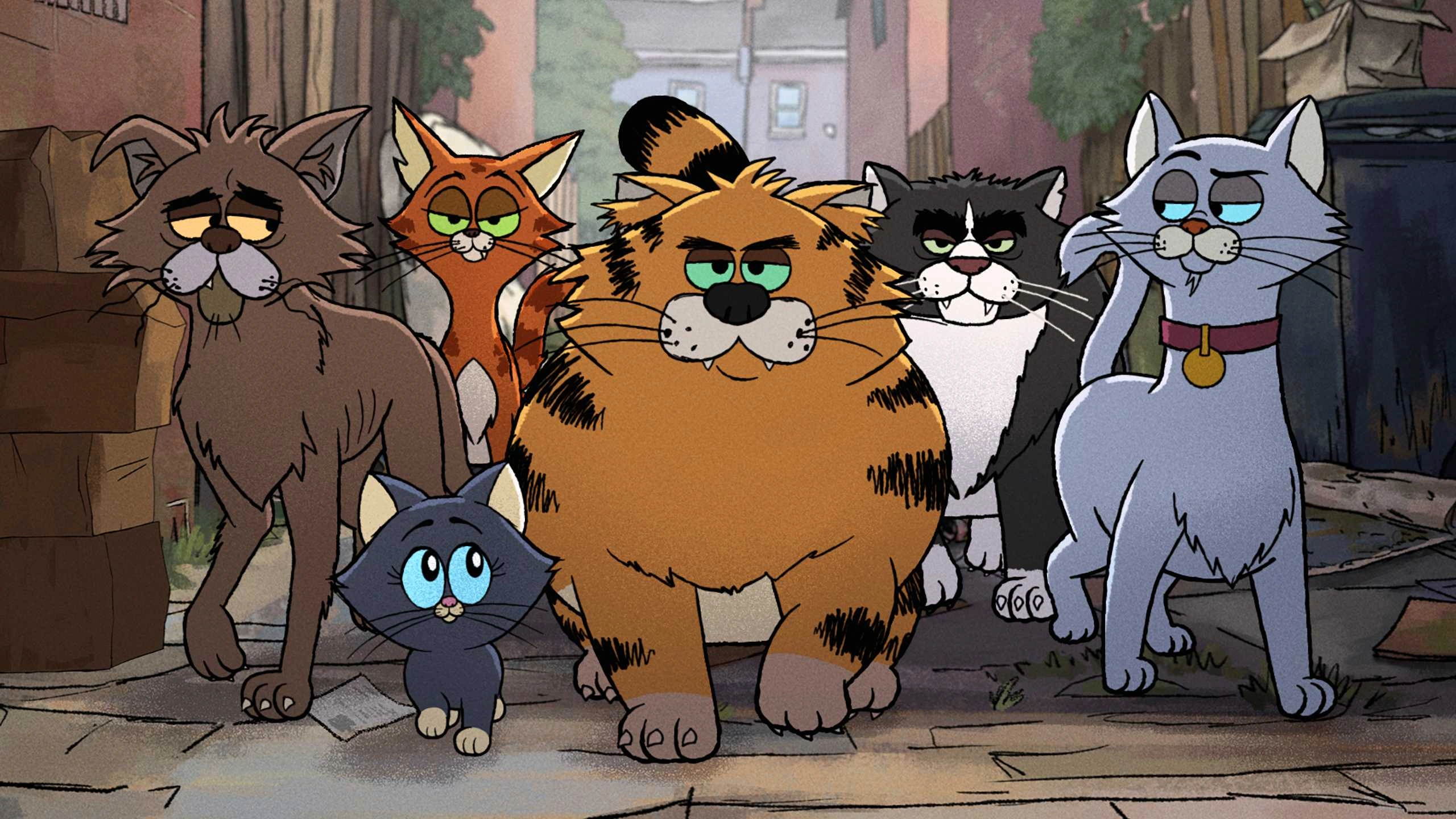

Six episodes of Alley Cats contain enough obscenity to exhaust a pub after closing time, yet very little of it feels dangerous. Ricky Gervais has built his Netflix animated comedy around creatures supposedly liberated from human etiquette, then given them conversations shaped by some of comedy’s most familiar taboos. Gus, an overweight orange stray voiced by Gervais, presides over this miniature society of insults, scavenging, sex and fatalism from an abandoned London rowhouse.
His companions arrive as deliberately crude archetypes. Fang (Andrew Brooke) is the bruiser, forever ready to turn disagreement into violence. Puke (David Earl) recounts sexual exploits grotesque enough to function as their own biological warning labels. Olive (Diane Morgan) initially wants kittens and is treated as the dim member of the gang. Ponce, whose real name is Rupert, receives the most sustained mockery because Tom Basden voices him as a cultured housecat blessed with regular meals, a comfortable home and the serenity of having been neutered.
Then the group finds Kitten, voiced by Jo Hartley, lost and frightened away from home. Gus promises to help her return, giving a series built around aimless animals its first actual objective. Her presence exposes the gentleness Gus keeps hidden beneath his declarations of contempt for people and life itself.
This collision between vulgarity and tenderness could have given Alley Cats its identity. Instead, the series repeatedly treats the two as separate programming modes, switching between them whenever one has run out of material.
A Sitcom Built Around Sitting Around
The funniest description of the show’s structure comes from Gus himself. Early in Episode 3, he proposes an agenda that involves pursuing a simple goal, becoming immediately distracted, doing pointless things, making everything worse, killing something, eating pieces of it, abandoning the mission and returning home to sleep.
That is practically the production bible. Most episodes begin with the cats watching television inside their squat. A dating show, a news report or a nature documentary prompts an argument. Soon they wander outside to find food, hunt, look for mates or nominally continue Kitten’s search for home. Another distraction appears. The cats argue again.
Also Read





Some exchanges find a pleasant comic rhythm precisely because nothing matters. Gus insists that “Bitches be trippin’” was Gandhi’s wisdom while Ponce calmly disagrees. Elsewhere the group debates if bees are frightening, if they can be eaten, and if four cats could successfully kill a human child. Ponce responds to Gus and Fang boasting about graduating from the “university of life” by politely asking where the institution sits in the league tables. The joke works because Basden refuses the aggression surrounding him. Ponce speaks like a man requesting clarification at a council meeting while everyone else behaves as if civilization ended overnight.
The cast recorded together before Blink Industries built the animation around their dialogue, and the process gives certain conversations the looseness of real friends talking past each other. It can also reveal the problem with recording friends talking past each other: they remain considerably easier to entertain than strangers listening in.
Scenes linger after their comic premise has expired. Pauses that might feel natural in live action become strangely vacant when accompanied by cats barely moving. The animation rarely supplies a secondary joke through gesture, composition or background action. Characters sit, speak and occasionally change expression. A hangout sitcom can survive without much plot. It cannot survive without the pleasure of hanging out.
Shock Comedy Running on Old Fuel
Gus and his friends behave as if every taboo remains forbidden fruit, which gives Alley Cats the curious sensation of watching characters rebel against rules that disappeared from television comedy years ago. Puke supplies descriptions of damaged genitalia and improbable sexual encounters.

His explanation for what happened after an encounter with a hedgehog is typical of the character’s function: present something grotesque, wait for disgust, escalate. Another riff imagines sexual violence involving monkeys and AIDS. Ponce is repeatedly humiliated for having been neutered. His sexuality, masculinity and body become recurring targets, alongside jokes about disability, race and sexual assault. Provocation has a legitimate place in comedy. The problem here is craftsmanship. The taboo itself is too often treated as the punchline.
That distinction matters because Alley Cats occasionally demonstrates how much better its comedy becomes once personality takes control. Asked about losing his testicles, Ponce serenely explains that they “cloud the judgment.” His response reverses the expected humiliation. He does not defend his masculinity because he sees no reason to accept the gang’s definition of it. Basden’s mild delivery transforms Ponce from designated victim into the only cat who occasionally understands how absurd his friends are.
Gus’ encounters with Lara, voiced by Kerry Godliman, work through another recognizable weakness. His swagger becomes fragile when attraction places him in a situation he cannot dominate. There is actual comic information in the change. His behavior reveals insecurity. The joke belongs to the character rather than the prohibited subject surrounding him.
Those moments also expose how strangely dated the rest can feel. Streaming platforms once marketed adult animation partly through freedoms unavailable to broadcast television: sex, language, violence, political irreverence. That freedom has existed for long enough that profanity by itself carries little cultural charge. Saying the unsayable loses its force once thousands of television characters have already said it. Alley Cats has the freedom to say almost anything. It frequently chooses things audiences have heard for decades.
Kitten Finds the Missing Story
Kitten alters the social arrangement because she does something none of Gus’ friends can manage: she asks sincere questions. Her fear of death becomes particularly important. She tells Gus that she does not want to stop existing and wants to live forever. Gus, suddenly required to comfort rather than provoke, explains that someone can continue through the memories carried by friends and family. Kitten decides this means Gus will survive through everything he teaches her.
The exchange risks becoming syrupy, yet it identifies the idea around which the series might have been built. Gus performs nihilism because emotional detachment looks useful when existence is precarious. Cats around him can disappear instantly. One acquaintance is struck by a vehicle shortly after appearing. An older animal is taken away for euthanasia. Gus must face his mother’s failing health and death. The strays casually describe themselves as future roadkill. Kitten has not yet learned the emotional etiquette required to pretend this is normal.
Episode 5 benefits enormously from letting that friction stay present. Gus’ protectiveness gains room to develop, while Kitten feels like a participant rather than an adorable parcel the gang occasionally remembers it is delivering. Hartley’s performance helps. Her voice moves easily between fear, excitement, curiosity and grief, giving the character an expressive range absent from much of the deliberately lethargic ensemble. The episode also reveals something awkward about the series’ preferred cynicism. Its most persuasive material arrives once the writing stops trying so hard to offend.
The finale retains pieces of this emotional clarity, including the bittersweet movement of Kitten’s story, yet side plots and comic digressions continue interfering with it. Gus’ mother suffers most from the compressed structure. The story requests grief before spending enough time establishing the relationship carrying that grief.
There is a richer series somewhere inside the idea of feral animals using cruelty as armor because their lives can end beneath a car tire tomorrow. Episode 5 comes close enough to make its absence elsewhere conspicuous.
Static Cats, Sudden Feelings
Blink Industries gives the cast colorful designs, and Kitten’s enormous eyes make her vulnerability instantly legible. The problem is what happens after the character models have been established.
Movement frequently feels secondary to dialogue. Cats stand or sit through long exchanges while familiar facial expressions cycle back into use. Backgrounds can appear flattened against the characters, and perspective sometimes lacks enough depth to give their world physical presence. A sequence in the finale set to Van Halen suddenly displays greater visual energy, which raises an unfortunate question: why has so much of the preceding series looked content to accompany its soundtrack rather than interact with it?
Even one song sequence turns lyrics into literal animated imagery, reducing animation to illustration. The words say something. The picture repeats it. There is a production logic behind this approach. Dialogue came first, with the actors recording together, and animation followed. That method preserves overlapping rhythms and conversational looseness, yet it can make the visual medium feel subordinate to an audio performance. When the voices themselves adopt the series’ slow, dry cadence, very little remains to generate momentum.
The tonal shifts expose the same imbalance. A vulgar argument can run for several minutes before a death or vulnerable confession abruptly asks for complete sincerity. Gus might be describing humanity with contempt in one scene and comforting Kitten about mortality soon afterward. Those impulses could belong to the same character. Humans have built entire cultures around behaving cruelly because tenderness terrifies them. Cats can probably manage it too. The missing ingredient is transition. The series often announces feeling rather than allowing behavior to carry characters toward it.
That leaves Alley Cats in a peculiar cultural position. Its obscenity belongs to an older fantasy of adult animation, one where removing censorship was treated as artistic liberation. Its strongest scenes belong to a gentler contemporary tradition interested in loneliness, care, vulnerability and the unstable families people create around themselves. Gus sitting beside Kitten has far greater disruptive power than another sexual insult shouted across the squat. For a series obsessed with creatures that supposedly refuse domestication, Alley Cats spends an extraordinary amount of time trapped inside its creator’s safest habits.
Alley Cats premiered globally on Netflix on August 7, 2026. The adult animated comedy series follows a diverse group of feral British cats navigating friendship, survival, and the absurdities of everyday life.
Full Credits
Title: Alley Cats
Distributor: Netflix
Release date: August 7, 2026
Rating: TV-MA
Running time: 15 minutes
Director: Ricky Gervais, Elliot Dear
Writers: Ricky Gervais
Producers and Executive Producers: Ricky Gervais, Steven Shaw, James Stevenson Bretton, Ben Lole
Cast: Ricky Gervais, Diane Morgan, Kerry Godliman, Tom Basden, Tony Way, David Earl, Andrew Brooke, Jo Hartley
The Review
Alley Cats
Alley Cats mistakes permission for profanity with comic freedom. Its endless sexual insults, homophobic digs, and calculated provocations rarely reveal anything about the cats exchanging them, leaving shock value to perform work the writing has neglected. Kitten briefly changes the equation, drawing genuine tenderness from Gus and giving Episode 5 an emotional clarity missing elsewhere. Ponce’s dry responses offer another glimpse of sharper comedy. Yet cramped animation, repetitive banter, and abrupt swings toward mortality keep those better instincts stranded inside a series far less perceptive than it believes itself to be.
PROS
- Kitten gives Gus emotional depth
- Stronger, gentler Episode 5
- Tom Basden’s understated Ponce
- Occasional believable ensemble chemistry
CONS
- Repetitive shock humor
- Homophobic and sexual jokes lack wit
- Static, limited animation
- Unearned sentimental turns
- Side plots weaken the Kitten story