
























![Kingdom Hearts Collection [I-III] Review](https://gazettely.com/wp-content/uploads/2026/10/Kingdom-Hearts-Collection-I-III-1-360x180.webp "Kingdom Hearts Collection [I-III] Review: KHII Holds Steady as Newer Entries Fluctuate 37")




Go Ji-won wakes from a near-fatal attack with no memory, damaged fingerprints, no identification, and nobody available to tell her who she is. Then Jang Tae-ha walks into her hospital room and supplies an entire biography. Her name is supposedly Go Eun-sae. They have dated for two years. They plan to marry. She works at his grandmother’s taffy shop in Gujin. His evidence consists of one Polaroid and considerable confidence.
Netflix’s Our Sticky Love, directed by Kim Jang-han and written by Mo Ji-hye, uses an amnesia premise familiar enough to feel inherited from an earlier generation of Korean television. Yet the series finds a useful modern wrinkle in Ji-won’s response to it. Memory loss does not erase her professional instincts.
Before the accident, she was an anti-corruption prosecutor investigating businessman Baek Sang-gil. Afterward, she remains the sort of woman who notices when somebody’s story makes no sense. That distinction saves the premise from turning her into cargo for Tae-ha to transport through the plot.
Romance Under Cross-Examination
Ha Young’s funniest scenes come from treating Tae-ha less like a fiancé than an unreliable witness. Ji-won questions why nobody in Gujin recognizes her, why an engaged couple sleeps in separate rooms, and why two years of romance apparently produced a photographic archive consisting of one Polaroid. Tae-ha’s account of their first meeting, in which he supposedly saved her from a toad before she pursued him romantically, collapses beautifully when she later sits holding one herself.
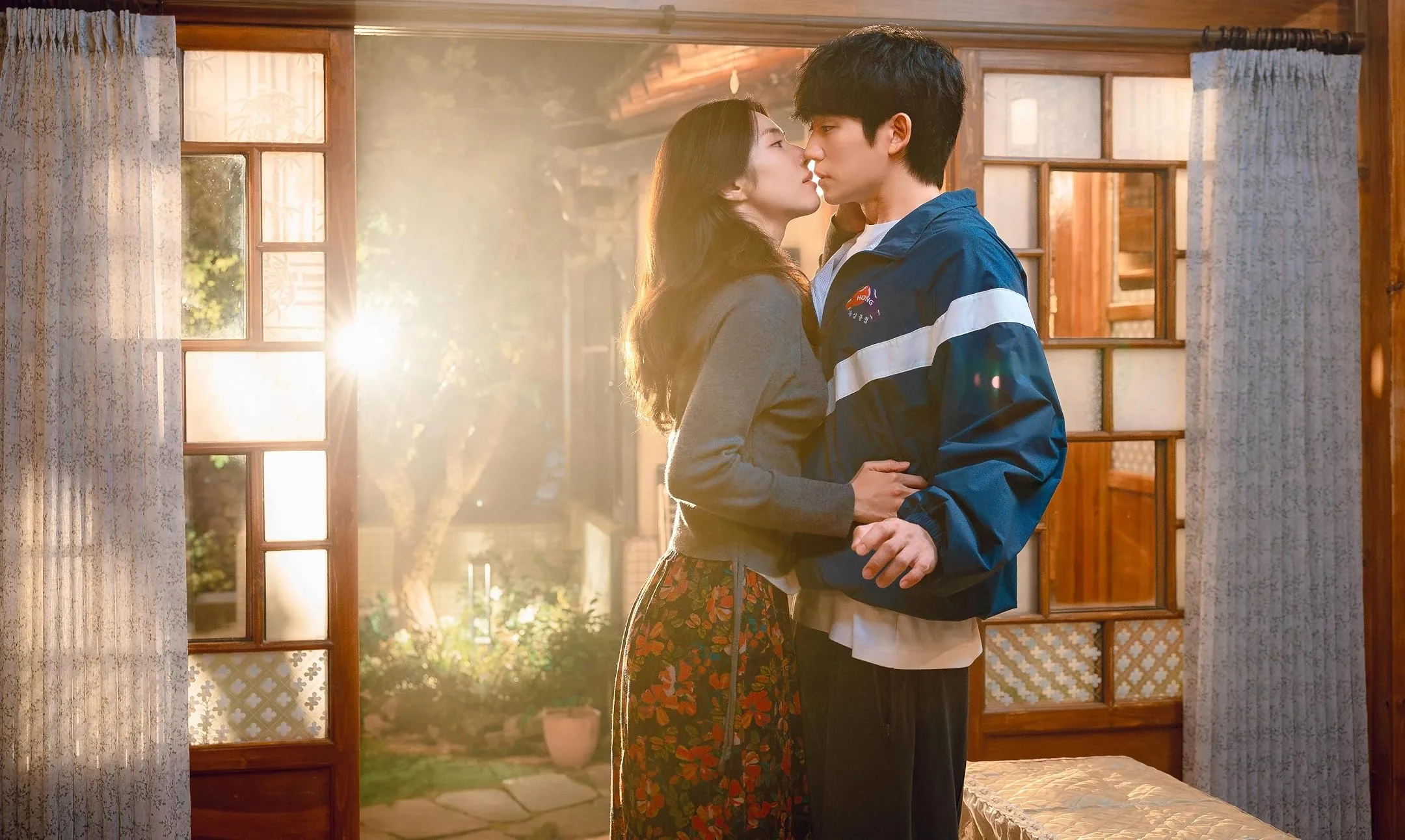
The episode-one kiss follows the same logic. Ji-won does not suddenly surrender to attraction. She kisses Tae-ha to test the claim that they already share intimacy. It is romance conducted like evidence gathering, and Ha Young plays the beat with enough certainty that the joke never requires Ji-won to become foolish.
Jung Hae-in has the harder assignment because Tae-ha’s tenderness exists inside a serious violation of trust. He knows who Ji-won is. He knows why she was attacked. He has helped construct a false identity around a woman unable to consent to that arrangement.
The script avoids making his deception entirely cute by showing the anxiety behind it. Each new question from Ji-won forces him to invent another piece of their imaginary history, while his quieter gestures, preparing food or sitting with her after painful flashes of memory, begin creating the relationship he once fabricated.
Korean romance has spent decades turning proximity, obligation, fake dating, and selective disclosure into courtship machinery. Our Sticky Love understands the machinery perfectly. Its smarter choice is letting Ji-won keep inspecting the machine while she is trapped inside it.
Gujin and the Comfort Economy
The move from Seoul to Gujin gives the series its clearest identity. Ji-won cannot believe that the sophisticated woman she imagines herself to be voluntarily traded city life for a small house, a taffy shop, and neighbours who know everybody’s business except, suspiciously, hers. Her disbelief provides comedy, then gradually becomes a way of testing what television means when it sells rural community as emotional repair.

The Gujin material works because the place is built through specific interactions rather than scenic postcards alone. Tae-ha’s grandmother greets Ji-won with hostility instead of instant affection. Coach Hong becomes part accomplice, part emotional support.
The villagers must keep improvising explanations whenever Ji-won discovers another hole in Tae-ha’s invented history. Their participation turns one man’s lie into a community production, which is ethically questionable and frequently hilarious.
Visually, the series gives the split between Ji-won’s lives an obvious grammar. Her Seoul existence contains expensive cars, political deals, corporate spaces, surveillance, and Sang-gil’s men closing in around her. Gujin offers small shops, domestic rooms, quiet roads, and repeated communal encounters.
Streaming dramas have become very efficient at manufacturing this particular kind of restorative village, often as an antidote to professional urban exhaustion. Here, the formula gains some bite because Ji-won never chose the escape. Her supposed fresh start was assigned to her.
Two Shows Sharing One Subscription
The premiere makes a strong structural decision by revealing Ji-won’s real identity early. A lesser version could have spent six episodes teasing information the audience had already guessed. Instead, the flashback shows her recording Sang-gil threatening the mayor, being discovered, and eventually landing in Tae-ha’s custody after his boss orders him to kill her.
Tae-ha’s response clarifies his moral position quickly. He recognizes Ji-won, sends her to the hospital with Coach Hong, burns her empty car, and uses the footage to convince Sang-gil she is dead. He saves her by lying to a gangster, then continues saving her by lying to her. The symmetry is tidy enough to hurt.
Heo Sung-tae gives Sang-gil immediate menace during the order to dispose of Ji-won, yet the criminal storyline rarely receives the patience granted to the romance. Once the series settles into Gujin, Mirae Eden can vanish for long stretches before danger suddenly returns. The switch from village comedy to criminal threat sometimes feels like changing channels without leaving the episode.
That imbalance says something about the television Our Sticky Love really wants to be. The conspiracy supplies pressure, but Ji-won interrogating an absurd engagement story, Tae-ha failing to lie convincingly, and a village collectively protecting their fragile fiction provide its strongest material. The show may keep a gangster waiting outside the frame, but its attention has already chosen where it wants to live.
Our Sticky Love premiered globally on Netflix on August 7, 2026. The romantic comedy series follows an ambitious prosecutor with amnesia who goes into hiding with a former boxer after he falsely claims to be her boyfriend.
Where to Watch Our Sticky Love Online


Full Credits
Title: Our Sticky Love
Distributor: Netflix
Release date: August 7, 2026
Rating: 15+
Running time: 51-67 minutes
Director: Kim Jang-han
Writers: Mo Ji-hye
Producers and Executive Producers: Studio S
Cast: Jung Hae-in, Ha Young, Heo Sung-tae, Kim Young-ok, Jeon Bae-soo, Seo Jung-yeon
The Review
Our Sticky Love
Our Sticky Love turns a pile of familiar K-drama devices into warm, persuasive television by giving Go Ji-won agency inside an amnesia plot that could easily have reduced her to someone waiting for answers. Her interrogation of Tae-ha’s paper-thin cover story, followed by that wonderfully clinical kiss to test their supposed chemistry, keeps the romance playful without making her passive. The Gujin material understands the pleasures of community-driven romantic television far better than the sluggish Mirae Eden conspiracy understands crime drama. Jung Hae-in and Ha Young make the imbalance easy to forgive.
PROS
- Ha Young’s sharp comic timing
- Strong lead chemistry
- Ji-won retains her agency
- Charming Gujin ensemble
- Effective identity premise
CONS
- Underdeveloped crime storyline
- Uneven tonal transitions
- Familiar amnesia mechanics
- Sang-gil fades too often







