
























![Kingdom Hearts Collection [I-III] Review](https://gazettely.com/wp-content/uploads/2026/10/Kingdom-Hearts-Collection-I-III-1-360x180.webp "Kingdom Hearts Collection [I-III] Review: KHII Holds Steady as Newer Entries Fluctuate 37")



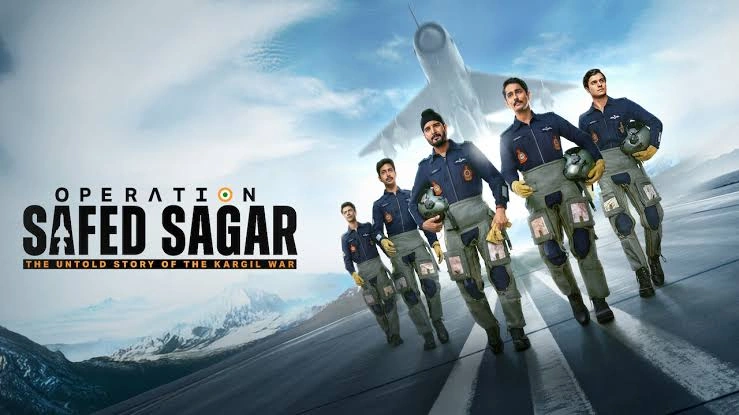

Tony Dhanoa asks his pilots what they think about the peace summit with Pakistan, lets them offer their opinions, then closes the discussion with a reminder that politics is outside the Air Force’s job. It is an efficient piece of characterization, and a useful warning about the limits Operation Safed Sagar places on itself.
Created by Abhijeet Singh Parmar and Kushal Srivastava, the six-episode Netflix drama returns to the 1999 Kargil War through the Indian Air Force’s Golden Arrows Squadron. While Prime Minister Atal Bihari Vajpayee travels to Pakistan seeking peace, Army chief Pervez Musharraf prepares to occupy vacated Indian positions along the Line of Control. Back at the base, Wing Commander Tony Dhanoa brings in Squadron Leader Ajay Ahuja to sharpen a talented group of young pilots.
The setup borrows the familiar grammar of fighter-pilot dramas: cocky rookies, a composed mentor, dangerous training, grudging respect. The surprise is how comfortably television suits that grammar. There is time for the pilots to become a unit before the war asks them to prove it.
Learning the Formation
Ajay establishes his authority without a speech. Dhali takes his wingman through a storm cloud during an exercise, disappears from radar, and returns expecting the usual mixture of relief and admiration. Ajay grounds him. The issue is not courage. Dhali chose a risk that served no tactical purpose.
Siddharth plays that distinction beautifully. His Ajay rarely needs to dominate a room because the performance is built around small decisions, measured pauses, and the sense that he has already considered the mistake before anyone else has finished defending it. Abhay Verma gives Dhali enough swagger to make the punishment sting, then gradually lets embarrassment harden into discipline.
The rivalry with Bal Reddy helps the training episodes avoid becoming an extended military orientation video. Reddy explains how Dhali could have avoided the cloud, earning instant hostility from a pilot who would rather survive turbulence than criticism. Their friction gives the exercises a human rhythm: mistake, resentment, adjustment, trust.
Life away from the runway matters too. Gatherings at Ajay and Alka’s home make the squadron feel like people who know where the beer is kept. Alka’s advice to Madhavi about never starting a fight before a sortie lands because it is practical rather than ceremonial. These scenes give the later missions something action scenes cannot manufacture on command: people worth worrying about.
The War Becomes a Procedure
The political material operates in a colder register. Manu Rishi Chadha plays Musharraf as a bureaucrat who has discovered that calm delivery can make terrible plans sound administrative. Vinay Pathak’s Nawaz Sharif is increasingly boxed out as soldiers disguised as mujahideen move into mountain positions. Their meetings give the series a second arena, one built from offices, maps, phone calls, and shifting control.

Once the Golden Arrows enter combat, director Oni Sen wisely resists turning every sortie into an airborne music video. Missions are structured around clear problems: altitude, dated equipment, targeting restrictions, poor visibility, new intelligence. The camera and editing usually keep the objective legible, so a change in flight path or targeting method carries dramatic weight without needing someone to shout about destiny.
The CGI occasionally announces itself, especially during wider aerial shots, yet the sequences survive because the tension comes from process. A pilot has a target, a limitation, and very little time.
That same process becomes a structural trap in the final stretch. A setback appears, the mission is restricted, Tony proposes a workaround, permission is sought, and another sortie begins. The first few repetitions feel like escalation. Later ones feel like the show has discovered a reliable episode generator and become understandably fond of it.
Heroism With Guardrails
The narrowness becomes clearest when grief and frustration enter the squadron. Losses leave pilots angry, and diplomatic restrictions threaten to keep them from responding as they want. Those moments briefly suggest a messier drama about soldiers trapped between emotion, command, and policy. The series quickly channels that anger back into duty.
Jimmy Shergill is particularly good when Tony has to absorb those pressures. His face carries the fatigue of someone sending men into danger while still sounding certain in front of them. Speeches near the end are less helpful. The performance has already shown the burden; the dialogue occasionally arrives afterward carrying a highlighter.
Mihir Ahuja gives Reddy a quieter presence beside Dhali’s volatility, while Verma makes Dhali’s movement from bravado to guilt feel tied to specific failures rather than a scheduled character arc. The ensemble is strongest when behavior does the work.
Operation Safed Sagar clearly wants to honor the Golden Arrows, and its Indian officers are rarely permitted ideological uncertainty. The Pakistani political scenes have greater internal conflict because Musharraf and Sharif can manipulate, disagree, and miscalculate. That imbalance reduces some of the historical drama to predetermined moral lanes. Then a sortie begins, an aircraft struggles against altitude and equipment, and the series becomes sharp again. It trusts procedure, pressure, and performance. Whenever it trusts those things, the show flies straight.
Operation Safed Sagar premiered globally on Netflix on August 7, 2026. The military drama series recounts the Indian Air Force’s high-altitude operations and strategic missions during the 1999 Kargil War.
Where to Watch Operation Safed Sagar Online


Full Credits
Title: Operation Safed Sagar
Distributor: Netflix
Release date: August 7, 2026
Rating: TV-MA
Running time: 45-60 minutes
Director: Oni Sen
Writers: Mehboob Pal Singh Brar, Abhijeet Singh Parmar
Producers and Executive Producers: Karishma Panvelkar
Cast: Jimmy Shergill, Siddharth, Dia Mirza, Abhay Verma, Mihir Ahuja, Taaruk Raina, Prajakta Koli, Adil Hussain
The Review
Operation Safed Sagar
Operation Safed Sagar knows exactly where its engines are strongest. The training drills, high-altitude sorties, and quietly authoritative work from Siddharth and Jimmy Shergill give the series real momentum, while Abhay Verma makes Dhali’s shift from swagger to guilt feel earned. The trouble arrives once the tactical cycle starts repeating and political certainty replaces dramatic friction. Oni Sen keeps the aerial action clean and purposeful, CGI seams included. It may rarely question the mission, but it understands how to stage one. Sometimes the flight plan really is enough.
PROS
- Siddharth’s restrained leadership
- Clear, tense aerial sequences
- Strong squadron chemistry
- Effective training-to-combat progression
CONS
- Repetitive later missions
- Limited political complexity
- Narrow battlefield perspective
- Occasional visible CGI







