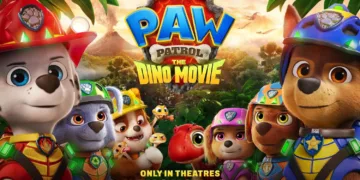










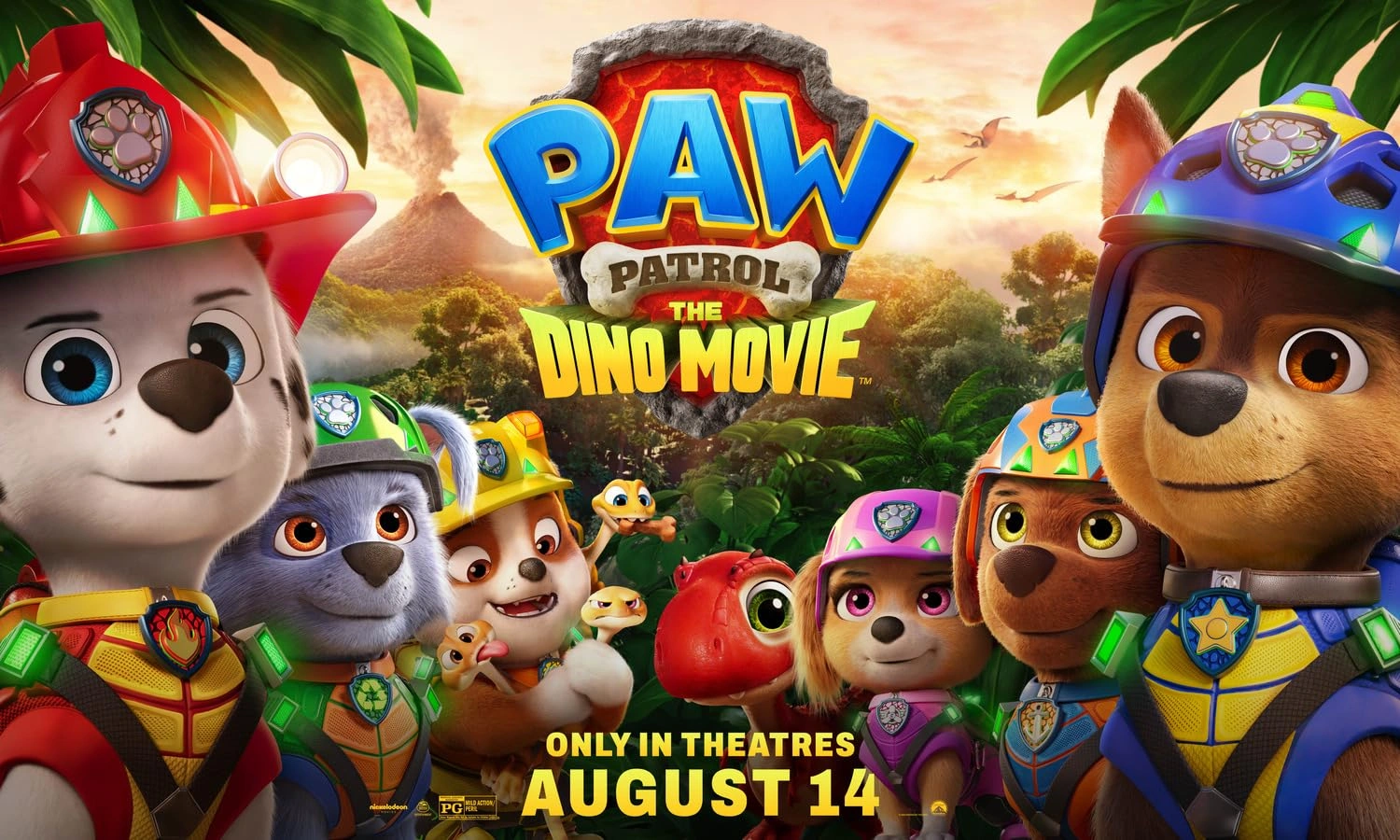

Three theatrical films into its life, PAW Patrol has developed a reliable method for making television-sized characters feel temporarily cinematic: take one pup, give them a personal problem, then construct a disaster large enough to force that problem into the open. PAW Patrol: The Mighty Movie did this with Skye. PAW Patrol: The Dino Movie hands the responsibility to Marshall, then surrounds him with dinosaurs, volcanic eruptions, and enough specialized rescue equipment to keep Adventure Bay’s procurement department awake at night.
Cal Brunker returns to direct, working from a screenplay co-written with Bob Barlen. The basic language of the franchise remains intact. Ryder commands Chase, Marshall, Skye, Rocky, Rubble, and Zuma, each pup still identified by profession, color, vehicle, and cheerful readiness to intervene whenever somebody makes a terrible decision.
The first terrible decision belongs to a wealthy family whose yacht catches fire. The pups extinguish the blaze, complete the rescue, and continue across the ocean before a violent storm drives their ship toward an uncharted tropical island populated by dinosaurs. There they meet Rex, a dog who uses wheels to compensate for limited movement in his hind legs and has spent years learning to live among the island’s prehistoric residents. It is a premise assembled from extremely recognizable pieces. What matters is how efficiently the film rearranges them.
Marshall Gets His Turn
Marshall has always been an easy character to reduce to slapstick. He falls over, misjudges his movements, then springs back up with enough enthusiasm to make embarrassment look temporary. The Dino Movie takes that comic pattern and gives it dramatic function.
The yacht rescue establishes the idea early. Marshall wants responsibility, yet his eagerness routinely gets ahead of his coordination. Previous PAW Patrol stories could reset that joke after each mission. A feature film needs progression, so his mistakes begin to affect how he sees himself. He knows he wants to help. He is less certain that wanting it is enough.
This is the same character-focused architecture Brunker used with Skye in The Mighty Movie, though Marshall makes for a different lead. Skye’s story pushed against physical smallness and the feeling of being underestimated. Marshall’s problem is internalized incompetence. Every stumble confirms something he already fears.
Also Read




His friendship with the baby dinosaur Rhubarb gives the screenplay a useful way to move him outside Ryder’s command structure. Protecting Rhubarb requires instinct rather than simply executing another carefully assigned rescue task. Marshall starts making decisions because another creature depends on him, which gives his later actions during the volcanic crisis a clearer emotional basis.
The film keeps this development appropriately legible for a very young audience. Marshall does not suddenly become a different dog, nor does clumsiness disappear as if confidence were a software update. He learns that failure and usefulness can occupy the same body.
That is a modest idea, yet it suits a franchise built around competence. The PAW Patrol usually arrives with the correct vehicle, the correct gadget, and the correct pup for the problem. Marshall introduces the possibility that being useful may involve uncertainty first.
Adventure Bay Goes Jurassic
Moving the pups onto Dino Island changes the scale immediately. The television series has always treated geography with considerable flexibility, but the island allows Brunker to borrow openly from dinosaur adventure cinema.
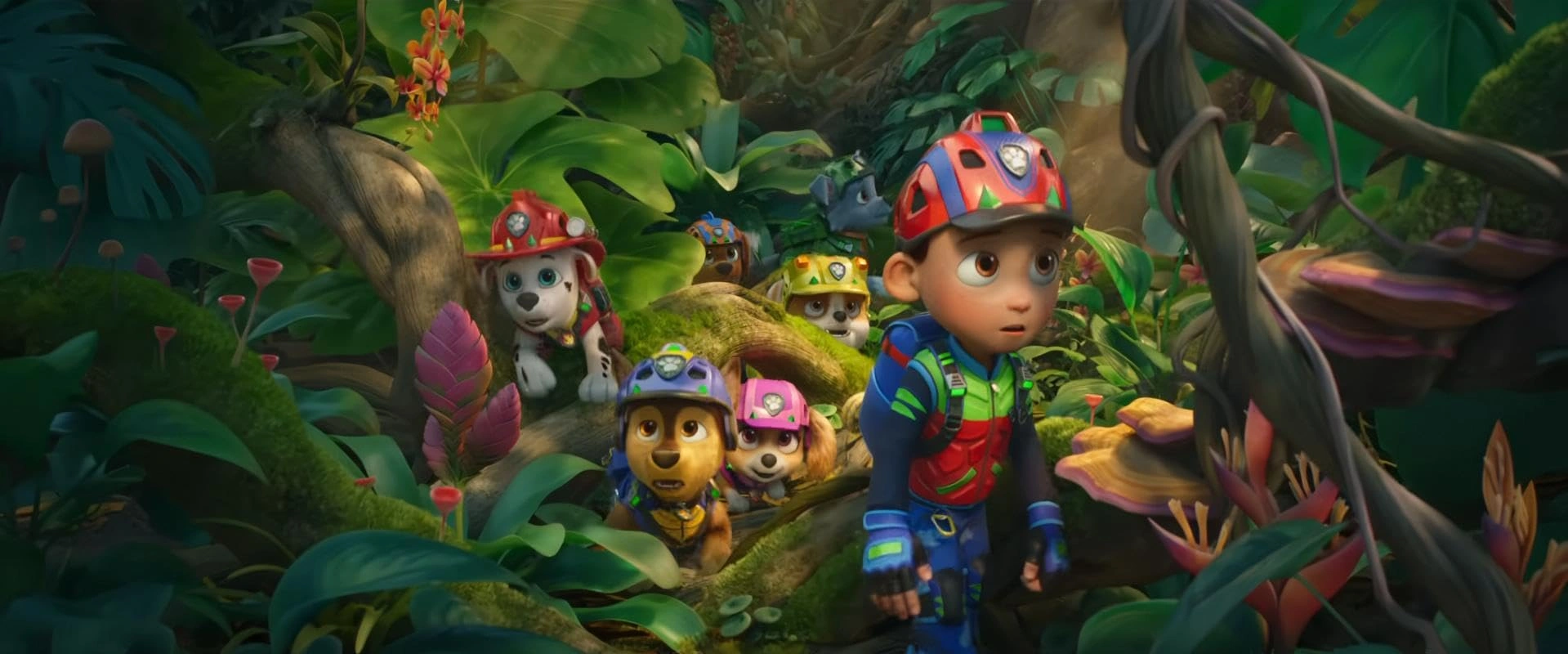
The influence of Jurassic Park and its descendants is easy to spot. Towering herbivores move through dense vegetation. A T. rex provides instant danger through size alone. Smaller Compy-like dinosaurs become comic creatures rather than the unpleasant little predators associated with the live-action films. A dinosaur confrontation recalls the T. rex and Spinosaurus clash from Jurassic Park III, translated into a register where young viewers can enjoy the spectacle without worrying about seeing a prehistoric animal torn apart.
That translation matters. American dinosaur cinema has spent decades turning extinct creatures into objects of awe, terror, commercial branding, or some combination of the three. PAW Patrol absorbs the iconography and removes most of the fear. The dinosaurs become neighbors requiring emergency services.
Rex makes that shift easier. Having lived on the island for roughly two years, he understands its animals and has constructed a treehouse filled with handmade mechanisms. His wheeled mobility is presented practically. He moves differently from the other pups, yet the story positions him as the person with knowledge everyone else lacks. Once Ryder’s team arrives, Rex is the local expert. His home also introduces the film’s most interesting contradiction.
Rex has built a life around adaptation. His treehouse uses improvised systems, he has learned the rhythms of the dinosaurs, and he proudly exists without Wi-Fi. The PAW Patrol arrives from a world where every inconvenience has a motorized solution.
The contrast could have produced a sharper story about two ideas of progress. Instead, the film mostly assumes that new technology is good whenever the heroes own it.
That assumption becomes harder to ignore after the pups publicize the island’s existence. Scientists and outsiders arrive, and Mayor Humdinger soon learns that Dino Island contains valuable diamonds. Suddenly, a place that survived in isolation is exposed to extraction. Humdinger is clearly responsible for what follows. The story gives him the dynamite. Still, the pups opened the door.
When the Rescue Mission Erupts
Mayor Humdinger remains one of those villains whose continued access to heavy machinery raises questions no municipal government seems interested in answering. Ron Pardo plays him with the broad vanity the character requires, and the film wastes little time pretending his interest in Dino Island is scientific. He discovers diamonds, brings equipment onto the island, and uses explosives with the confidence of a man who has apparently never encountered the concept of geological consequences.
Placing dynamite near a dormant volcano goes badly. The eruption supplies the film with its strongest stretch of action. Lava, collapsing ground, frightened dinosaurs, stranded visitors, rescue vehicles, and multiple simultaneous emergencies allow the PAW Patrol formula to operate at feature scale. Every pup can be assigned a practical function while Marshall’s personal problem becomes inseparable from the physical crisis.
This is where Brunker’s experience with the franchise helps. The rescues remain easy to follow. Vehicles enter scenes with clear purposes. Geography is simple enough for children to understand who is trapped, what threatens them, and which pup needs to act. The action rarely becomes visual noise.
The volcano also gives Marshall nowhere to hide from his insecurity. Earlier mistakes could be shrugged off because another rescue would arrive shortly. Here, Rhubarb and the other dinosaurs are facing immediate danger. Marshall has to act while still being the same pup who gets things wrong.
The film’s roughly 88-minute running time supports that directness. It moves from yacht rescue to storm, from storm to island discovery, then from Humdinger’s arrival to volcanic catastrophe with little empty space.
There is limited comic material written specifically for accompanying adults. Modern studio animation often treats parental attention as a second audience that must constantly be serviced with references, irony, or jokes children will miss. The Dino Movie mostly declines that arrangement. The Backstreet Boys song “Bottle Up,” written by Ed Sheeran, feels like the clearest glance toward adults who grew up with a different strain of pop culture. The rest belongs to the children in the room.
Prehistoric Beauty, Plastic Pups
Dino Island gives the animation team opportunities Adventure Bay cannot. The storm sequence has weight in its water and lighting, while the island shifts through humid daylight, dense foliage, shadowed jungle interiors, and the orange violence of the eruption.
Marshall’s nighttime movement through the jungle is especially effective. Darkness narrows the world around him, vegetation layers the frame, and the polished brightness associated with PAW Patrol briefly gives way to something closer to storybook danger. It is one of the rare moments where the franchise’s visual language feels transformed by location rather than enlarged for a cinema screen. The pups themselves remain stranger objects.
Their enormous eyes, spotless uniforms, smooth fur, bright helmets, and perfectly coordinated vehicles create a synthetic finish that becomes especially visible against the more carefully textured jungle. The environment suggests mud, humidity, age, and biological mess. The heroes look ready to be returned to molded plastic trays.
That clash also mirrors the story’s uncertain environmental politics. Humdinger’s rusting machinery and destructive mining are coded as ugly forms of technology. The PAW Patrol’s jets, trucks, gadgets, and newly supplied equipment are celebrated because benevolent characters control them.
Rex complicates that distinction. His handmade systems suggest a form of life shaped by local conditions rather than imposed upon them. Once the wider world discovers the island, that fragile arrangement begins to disappear beneath visitors, infrastructure, extraction, and rescue hardware.
Children’s films do not need fully developed political theories. They do benefit from recognizing the implications of their own stories. The Dino Movie comes surprisingly close to asking what happens when a protected place becomes valuable to outsiders, then retreats into the safer moral equation of good machines against bad machines. Its most persuasive answer arrives without dialogue. Rex had already found a way to live beside the dinosaurs before anyone came to save them.
PAW Patrol: The Dino Movie is scheduled for theatrical release on August 14, 2026, by Paramount Pictures. The story follows the team as they crash-land on an uncharted island inhabited by dinosaurs and must team up with a stranded pup named Rex to stop their rival, Humdinger, from causing a volcanic catastrophe.
Full Credits
Title: PAW Patrol: The Dino Movie
Distributor: Paramount Pictures
Release date: August 14, 2026
Rating: G
Director: Cal Brunker
Writers: Cal Brunker, Bob Barlen
Producers and Executive Producers: Jennifer Dodge, Laura Clunie, Toni Stevens
Cast: Jameela Jamil, Terry Crews, Snoop Dogg, Bill Nye, Paris Hilton, Jennifer Hudson, Fortune Feimster
Composer: Pinar Toprak
The Review
PAW Patrol: The Dino Movie
PAW Patrol: The Dino Movie borrows the visual language of Jurassic Park while keeping every tooth safely inside preschool entertainment. Dino Island gives Cal Brunker richer environments to play with, and Marshall earns his spotlight through the yacht rescue, his bond with Rhubarb, and the volcanic finale. The ecological message is shakier. Rex’s handmade refuge celebrates coexistence with nature, then the story floods his world with visitors, machinery, and shiny technology without examining the contradiction. Still, the brisk 88 minutes and clear rescue stakes make this a solid third outing.
PROS
- Strong Marshall character focus
- Detailed Dino Island environments
- Effective volcanic rescue sequences
- Rex is a capable new addition
- Brisk, child-friendly pacing
CONS
- Muddy environmental message
- Glossy pup designs clash with scenery
- Limited material for adult viewers
- Humdinger remains mechanically familiar