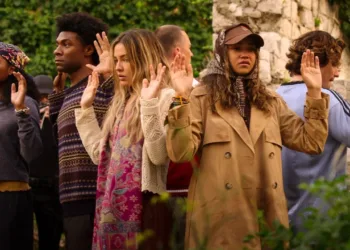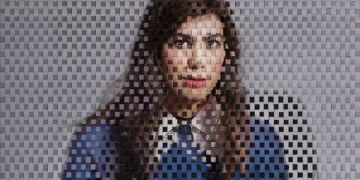


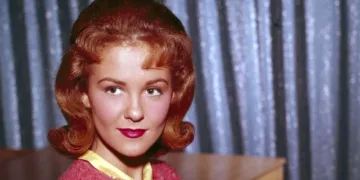





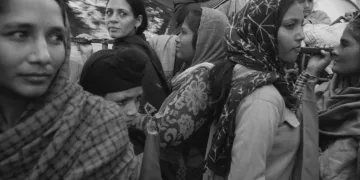

















Pamplona gives Adela almost no empty space. Her mother watches, religion supplies the rules, furniture crowds the interiors, and mirrors repeatedly return her own image without offering much recognition. Fernando González Molina uses those cramped late-1990s rooms to turn repression into architecture. Before Adela has language for being intersex, the house has already told us that somebody else has been arranging her life.
My Dearest Señorita, written by Alana S. Portero as a reinterpretation of Jaime de Armiñán’s 1972 film, relocates the earlier story’s questions from Franco-era secrecy to a period when those questions could finally be spoken aloud. Elisabeth Martínez plays Adela, raised as a woman under the severe protection of her conservative mother. A gynecological examination uncovers the truth her family concealed since childhood: Adela was born intersex.
The diagnosis gives the film its first clean break in visual rhythm. What had been confinement becomes movement. Adela leaves Pamplona for Madrid, carrying the unease of someone who has discovered that the people closest to her edited her biography before she could read it.
Mirrors, Rooms, and Martínez
Martínez understands that Adela’s most interesting conflict happens before speech. During the medical revelation, her face barely reorganizes itself. Small hesitations, lowered eyes, and the stiffness of her posture carry the shock. Beside experienced performers, her relative lack of polish occasionally registers, yet it also keeps these moments from acquiring theatrical varnish.
Molina repeatedly places Adela near mirrors or inside frames that divide the image. It is an obvious visual strategy, yet an appropriate one. A mirror offers factual reflection without identity, which is exactly Adela’s predicament. She has spent years seeing a body while receiving somebody else’s explanation for it.
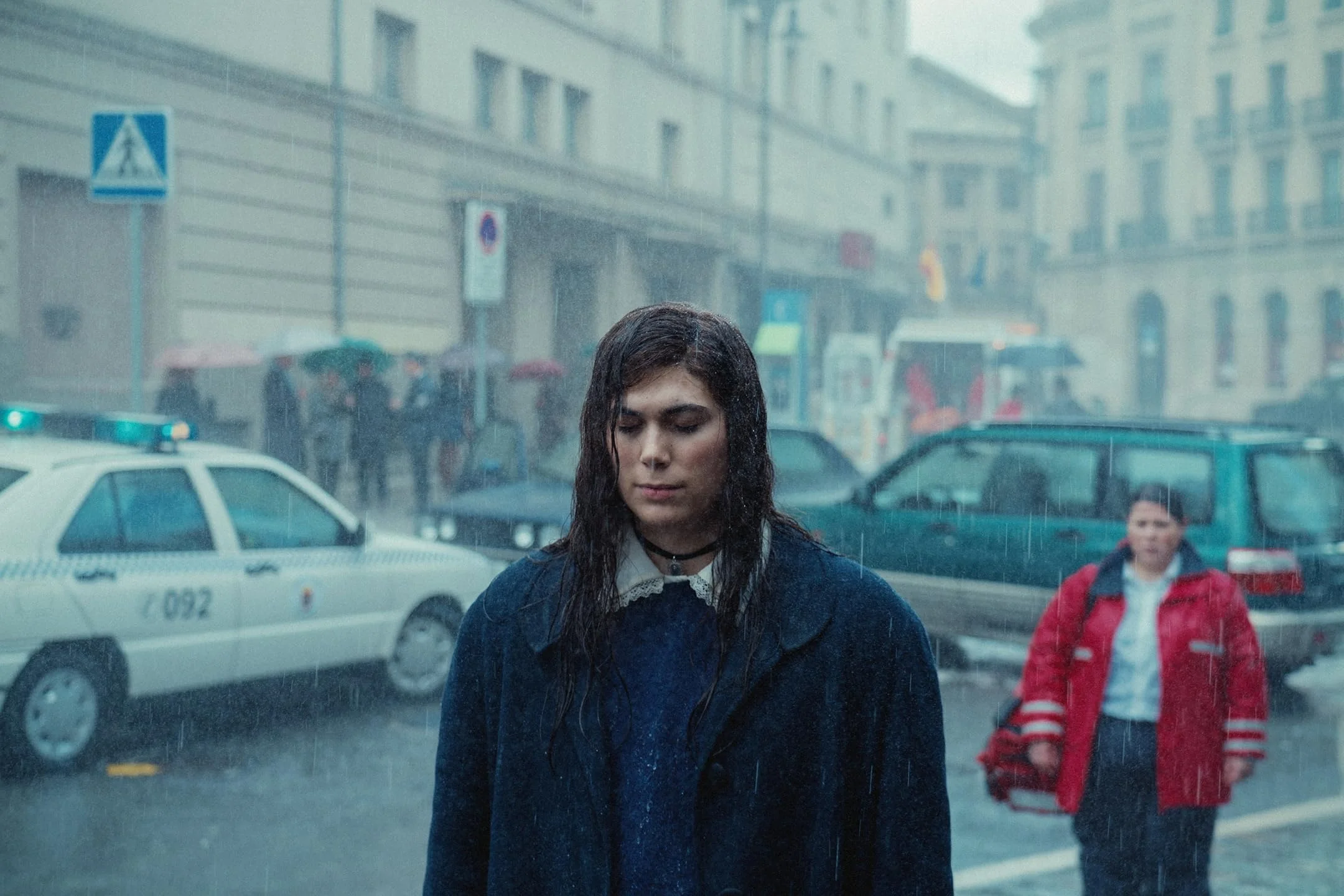
Pamplona is photographed with muted interiors and a rain-heavy atmosphere that squeezes the frame inward. Madrid loosens it. Rooms become places of conversation rather than surveillance, and bodies occupy space with less ceremony. That visual transition risks simplicity, but the film earns much of it through Adela’s tentative behavior. Freedom does not arrive as a triumphant transformation sequence. She watches first. Then she participates.
Also Read




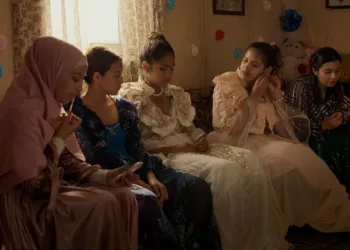

Anna Castillo’s Isabel accelerates that change whenever she enters. Her restless energy disturbs the film’s carefully controlled solemnity, especially after Adela reconnects with her in Madrid. Castillo moves through scenes as though she has arrived from a picture with a faster shutter speed.
The Trouble With Saying Everything
Portero’s screenplay is far less comfortable with silence than Martínez is. The film explicitly discusses intersexuality, medical language, discrimination, faith, self-definition, and the social violence of forcing bodies into convenient categories. Clarity has an obvious purpose here, especially in a story built around information deliberately withheld from its protagonist. Yet several conversations explain an emotion seconds after the camera has already shown it.
Paco León’s queer priest makes that problem particularly visible. His presence creates an interesting contradiction inside Adela’s religious world. He listens without reproducing the judgment she expects, and details such as his affection for Mónica Naranjo give the character a welcome streak of irreverence. Then the screenplay repeatedly turns him into an interpreter, supplying Adela and the audience with the thematic reading of scenes that needed no interpreter.
The Madrid household has a related weakness. Gato, Adela, and the people surrounding the protagonist provide warmth and practical acceptance, yet several are constructed around what they can teach or offer her. They resemble points of light positioned along Adela’s route. Pleasant light, certainly, but lighting equipment remains lighting equipment.
Isabel escapes that fate because Castillo introduces friction. Her reference to Fucking Åmål and the pain that representation might have spared someone growing up in the 1990s makes the film’s cultural argument concrete. A movie seen at the right age can alter the vocabulary available for understanding oneself. Here, cinema becomes evidence.
Speaking Where the Original Whispered
The 1972 My Dear Miss worked inside Francoist Spain, where ambiguity carried political danger. Its inability to name certain realities became part of its cinematic grammar. Asking Molina’s film to reproduce that silence would misunderstand the historical difference separating the two works. This version faces another problem: what happens once the forbidden word can be spoken?
Its answer is visibility. Adela is played by an intersex performer, her condition is named directly, and the narrative grants her access to community rather than leaving identity trapped inside private bewilderment. That change replaces much of the earlier film’s destabilizing uncertainty with tenderness and self-recognition.
Molina sometimes protects that tenderness too carefully. The polished compositions, controlled lighting, and quickly resolved tensions can keep discomfort at a tasteful distance. The film becomes sharper whenever the frame contradicts that safety, especially in Pamplona, where doorways, mirrors, and crowded interiors make family protection resemble custody. Madrid changes the geometry. Adela begins occupying the frame rather than being placed inside it. The distinction may sound small. Cinematically, it is everything.
My Dearest Señorita premiered globally on Netflix on May 1, 2026. Directed by Fernando González Molina, the Spanish drama film follows a young individual from a traditional background who discovers they are intersex, sparking a poignant journey of self-discovery, identity, and unexpected love.
Where to Watch My Dearest Señorita (2026) Online


Full Credits
Title: My Dearest Señorita
Distributor: Netflix
Release date: May 1, 2026
Rating: TV-MA
Running time: 1 hour 52 minutes
Director: Fernando González Molina
Writers: Alana S. Portero
Producers and Executive Producers: Javier Ambrossi, Javier Calvo
Cast: Elisabeth Martínez, Anna Castillo, Paco León, Nagore Aranburu, Manu Ríos, Eneko Sagardoy, Lola Rodríguez, María Galiana
Director of Photography (Cinematographer): Carlos Rigo
The Review
My Dearest Señorita
My Dearest Señorita finds its sharpest language in mirrors, cramped Pamplona rooms, and Elisabeth Martínez’s guarded silences, where identity becomes something the frame can imprison before Adela learns to define it herself. Fernando González Molina loses some of that precision whenever the screenplay translates those images into speeches, and several supporting characters become ideological signposts. Madrid brings light, movement, and welcome relief. The remake lacks the dangerous ambiguity of its 1972 ancestor, yet its gentler visual grammar gives Adela something the earlier film could barely imagine: room to exist.
PROS
- Martínez’s restrained central performance
- Strong Pamplona-Madrid visual contrast
- Effective mirrors and confined framing
- Warm, credible chosen-family scenes
- Thoughtful reinterpretation of the 1972 film
CONS
- Frequently over-explanatory dialogue
- Supporting characters can feel schematic
- Visual polish sometimes softens discomfort
- Less ambiguity than the original