

























Ridley Scott has spent much of his career imagining worlds where institutions collapse before the people trapped inside them do. Alien turned a commercial spaceship into a corporate death trap. Blade Runner made identity a commodity. Here, civilization has already vanished by the time Hig begins flying his battered Cessna over Colorado, so the remaining question is smaller and harder: what obligations survive when society does not?
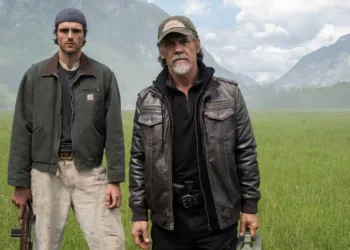
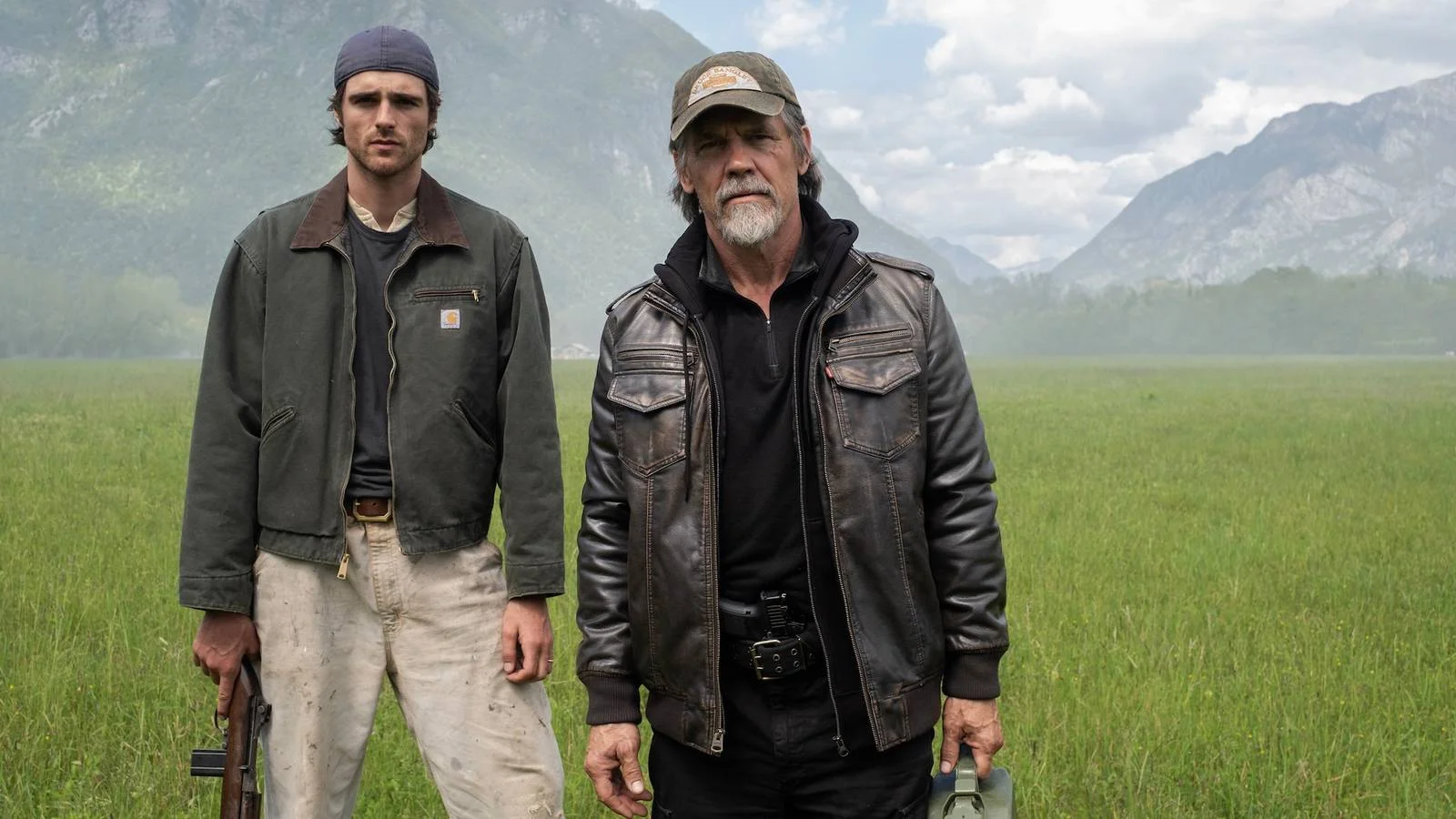
The Dog Stars, adapted by Mark L. Smith from Peter Heller’s 2012 novel, takes place in 2035 after an influenza pandemic has killed most of the population. Hig, played by Jacob Elordi, lives at an abandoned airfield with Jasper, his dog, and Bangley, a heavily armed veteran played by Josh Brolin. Hig scavenges fuel, medicine, and food from ruined Denver.
Bangley watches the perimeter through a rifle scope and shoots strangers before they can become problems. Both men have survived. They disagree about what survival permits. Scott makes that disagreement the movie’s most useful idea, then spends much of the running time testing how far it can bend before fear snaps it.
The Perimeter
Bangley has adapted almost perfectly to the apocalypse. He stores weapons, fortifies the airfield, recycles spent casings, studies approaching strangers from a distance, and burns bodies after attacks. Brolin plays him with the weary satisfaction of a man whose darkest assumptions about humanity have finally received supporting evidence. The end of civilization has made him terrible company and an excellent neighbor. Hig remains less efficient.
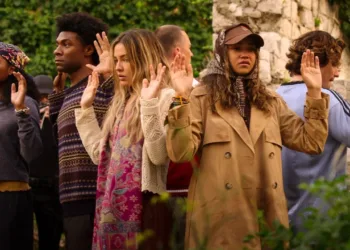
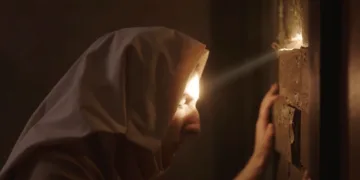
He flies medicine to a secluded Mennonite community led by Aaron, played by Benedict Wong, despite Bangley warning him about the infection risk. Children there gather around Jasper. Hig talks to them. He keeps a garden. He sleeps outdoors. These gestures are small enough to look foolish beside Bangley’s ammunition stockpile, which is precisely why they matter. Hig keeps behaving as though other people retain moral value after the structures that once enforced such thinking have disappeared.
The film occasionally seems ready to turn this into an argument about isolationism. Bangley calls outsiders roaches. Hig keeps looking for communities. Yet Smith’s screenplay repeatedly gives Bangley extremely convenient evidence. Two strangers approach the perimeter. They are dangerous. Rumors spread about Reapers attacking survivors. The Reapers are dangerous. People descend on the compound. Also dangerous.
Also Read






This produces an odd philosophical imbalance. Hig argues that fear cannot become a social philosophy, while the movie surrounds him with murderous strangers who make Bangley’s paranoia look statistically prudent. Call it the apocalypse credibility problem: a film condemns distrust while arranging the world so that distrust keeps working. Scott never entirely resolves it.
Grief With Nowhere to Go
Hig’s resistance to Bangley comes partly from grief. His wife Melissa died during the pandemic after the couple had already lost the child she was carrying, and his trips into Denver include visits to their preserved former home. He sits on the bed. Memories return. Melissa appears pregnant, affectionate, alive. The scenes explain Hig’s pain without giving the marriage enough texture to make that pain particular.
We learn surprisingly little about how Hig and Melissa behaved together, what made her funny or difficult, or which tiny domestic habit might hurt him now because nobody else will ever repeat it. She functions largely as the memory of a life rather than a fully remembered person. Elordi has to build the missing interiority himself.
He does so through withdrawal. Hig looks down when conversations get close to something painful. His body often seems slightly disconnected from wherever he happens to be standing. Elordi’s performance is quiet enough that Brolin can dominate their shared scenes simply by speaking, yet the restraint fits a man who has spent years rehearsing the same sorrow.
Jasper provides what the flashbacks sometimes cannot. Hig’s relationship with the dog is immediate, physical, and specific. Jasper flies beside him, responds to commands, detects intruders, and connects Hig to a version of himself that existed before the plague. When Jasper dies defending him, the loss has narrative force because the relationship has existed in the present tense. That distinction hurts the Melissa material.
Jasper’s death also strips away one of Hig’s last excuses for remaining inside the routine he has built with Bangley. A distant radio transmission from Grand Junction begins to sound less like information than possibility. Hig gets into the Cessna and goes looking. This is where the movie finally asks its central question through action rather than dialogue: how much safety must a person surrender before life begins to resemble living again?
A Second Valley
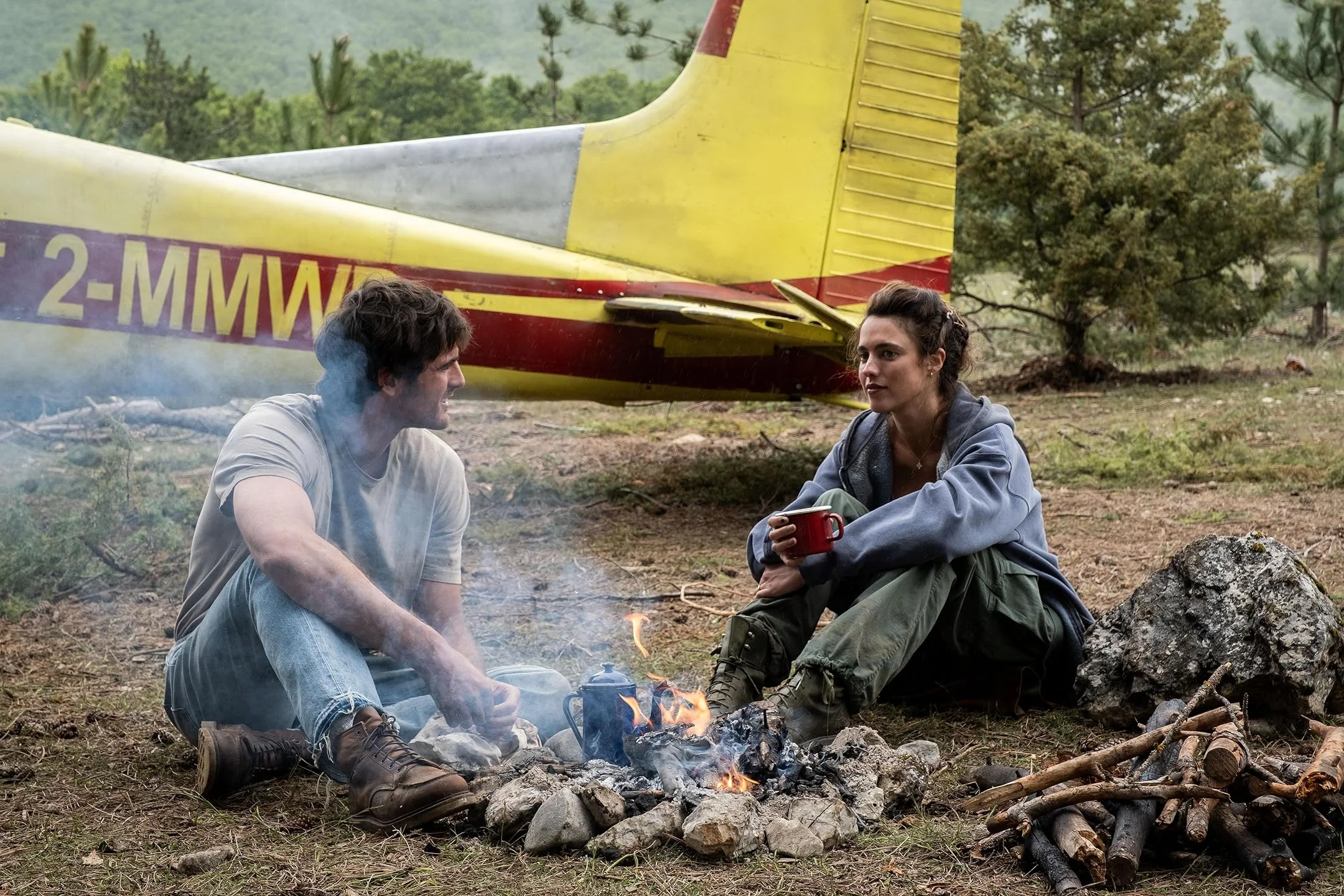
Engine trouble interrupts Hig’s flight and brings him to an isolated ranch occupied by Pops and his daughter Cima. Guy Pearce plays Pops as Bangley with slightly different scars. He watches Hig carefully, assumes danger first, and treats trust as something that must be earned through prolonged observation. Margaret Qualley’s Cima changes the temperature immediately.
She has lost a husband. Hig has lost a wife. The screenplay recognizes the symmetry with such enthusiasm that it sometimes feels tempted to laminate it. Cima’s blunt reminder that Hig does not hold exclusive rights to grief is valuable because someone finally challenges the private mythology he has constructed around suffering.
Their relationship develops while Hig repairs his plane and they clear trees for a makeshift runway. Scott is good with this kind of physical labor. People pulling branches, adjusting machinery, inspecting an engine, or preparing for departure give the romance a material environment instead of leaving Elordi and Qualley to exchange sad speeches beside picturesque mountains. The writing is less convincing when it tries to manufacture intimacy directly.
Hig and Cima talk about missing traffic and music. He produces a makeshift player and headphones. She listens. The scene announces connection before the characters have accumulated enough shared experience to make it feel inevitable.
Their dead spouses remain strangely abstract too, which leaves the romance built on the category of bereavement rather than two richly articulated histories. Qualley helps. Cima has humor and impatience where Hig tends toward solemnity, and her presence breaks the masculine stasis created by Hig, Bangley, and later Pops. Then the Reapers attack.
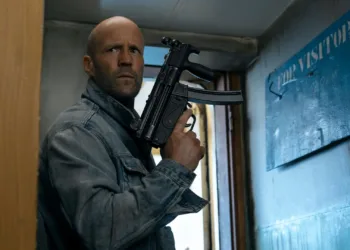
Scott can still make gunfire feel physical. Bodies move through space clearly, defensive positions matter, and violence carries weight rather than becoming visual noise. Yet the attackers themselves are barely people. Their face paint, shouting, tattoos, and collective savagery reduce them to a post-apocalyptic category marked ENEMY.
That choice damages the movie twice. It makes the action emotionally disposable, and it sabotages the story’s attempt to question fear of outsiders. Bangley keeps winning arguments from offscreen.
Civilization, With Martinis
Grand Junction is where The Dog Stars briefly becomes a stranger film. Hig, Cima, and Pops reach an airport controlled by Darlene, played by Allison Janney beneath elaborate makeup and dressed in vintage airline attire. She serves drinks. Her enclave fetishizes an older version of American order, complete with ritualized hospitality, midcentury styling, and the increasingly obvious suggestion that participation is less voluntary than advertised.
The tonal change is severe. Scott moves from mournful Western imagery toward retro-futurist grotesquerie, with touches of bodily horror and a social arrangement built around compulsory nostalgia. It is also one of the few places where the movie’s politics become properly complicated.
Bangley represents isolation. Aaron’s Mennonite settlement represents mutual dependence. Darlene offers organized society without meaningful freedom. Each system solves one post-apocalyptic problem by creating another.
Darlene’s airport is particularly revealing because it turns memory into government. People are no longer recreating the past because they miss it. They are being instructed to perform it. The uniforms, drinks, décor, and etiquette preserve the gestures of civilization after the values beneath them have rotted away. Scott has spent decades photographing institutions with suspicious grandeur, and this one fits neatly beside them.
The sequence also exposes the movie’s structural weakness. The opening stretches patiently across flights, supply runs, conversations with Bangley, and Hig’s mourning. Once Grand Junction arrives, events begin stacking up with far less breathing room. Threats appear, information arrives, escape becomes necessary, and emotional decisions follow rapidly. The movie suddenly behaves as though somebody has remembered the runtime.
Looking Down From the Cessna
Erik Messerschmidt’s cinematography is strongest when Hig is airborne. Italian mountain ranges standing in for Colorado give the flights an almost restorative scale, while the ground below tells a different story: abandoned roads, overturned vehicles, vegetation creeping into former settlements, deer occupying human spaces, packs of dogs moving through areas people once controlled. Scott avoids lengthy explanations of the pandemic. Medical equipment, deserted municipal buildings, ruined cities, and isolated compounds perform much of the world-building visually.
Some effects are noticeably weaker, particularly certain explosions and transitions, and the inconsistency is surprising from a filmmaker whose imagined worlds usually feel physically complete. Still, the landscape has presence. Civilization looks less destroyed than abandoned by history.
Harry Gregson-Williams supports that mood with acoustic guitar, Dobro, strings, and folk textures. Hozier’s “Like Real People Do” makes the emotional agenda fairly explicit. Scott is making an apocalypse about contact.
That creates an unusual late-career tension. The director famous for monsters, battles, executions, empires, and corporate cruelty seems deeply interested here in the dangerous act of allowing another person to matter.
Hig helps Aaron when Bangley tells him to stay away. He leaves the fortified perimeter. He trusts Pops enough to remain at the ranch. He lets Cima challenge his grief. He follows the Grand Junction signal even after the world has taught him that strangers frequently come carrying weapons. None of those choices guarantees safety. That is their value.
The difficulty is that The Dog Stars occasionally wants the philosophy without doing all the work required to sustain it. Its marauders remain cartoons. Melissa remains a memory sketch. Cima and Hig move toward each other faster than their conversations justify. Grand Junction raises fascinating questions shortly before the narrative rushes past them.
Yet Scott keeps returning to the Cessna, that absurdly fragile machine carrying Hig across a world built around barricades. Bangley survives by reducing the number of people he must trust to nearly zero. Hig climbs into an aging plane and flies toward voices he cannot identify. One strategy makes perfect sense. The other is human.
The Dog Stars is a post-apocalyptic science fiction drama directed by Ridley Scott that arrives in theaters nationwide on August 28, 2026. After a devastating pandemic wipes out a vast portion of humanity, a lone survivor living in an airplane hangar picks up a mysterious radio transmission that changes his existence.
Where to Watch The Dog Stars (2026) Online
Full Credits
Title: The Dog Stars
Distributor: 20th Century Studios
Release date: August 28, 2026
Rating: R
Running time: 1 hour 59 minutes
Director: Ridley Scott
Writers: Mark L. Smith
Producers and Executive Producers: Michael Pruss, Cliff Roberts, Ridley Scott, Mark L. Smith
Cast: Jacob Elordi, Margaret Qualley, Josh Brolin, Guy Pearce, Allison Janney, Benedict Wong, Alara-Star Khan, Sebastian Rokison-Woodall
Director of Photography (Cinematographer): Erik Messerschmidt
Editors: Sam Restivo, Claire Simpson
Composer: Harry Gregson-Williams
The Review
The Dog Stars
The Dog Stars is most persuasive when Ridley Scott treats survival as an ethical problem rather than an action premise. Hig flying medicine to Aaron’s community and Bangley shooting strangers from the perimeter embody two incompatible answers, yet the screenplay weakens that conflict by turning the Reapers into convenient proof that paranoia works. Jacob Elordi carries Hig’s grief with quiet restraint, while Josh Brolin gives the film its sharpest personality. Grand Junction’s retro nightmare briefly awakens a movie that can drift into torpor. Scott finds genuine tenderness here, even if the philosophy arrives with several missing pages.
PROS
- Brolin’s sardonic Bangley
- Beautiful flight photography
- Strong survival-versus-community theme
- Gregson-Williams’ acoustic score
- Strange, memorable Grand Junction sequence
CONS
- Underwritten Hig-Cima romance
- Faceless, crudely coded marauders
- Uneven final act
- Thin characterization of Melissa
- Long stretches lose momentum