

















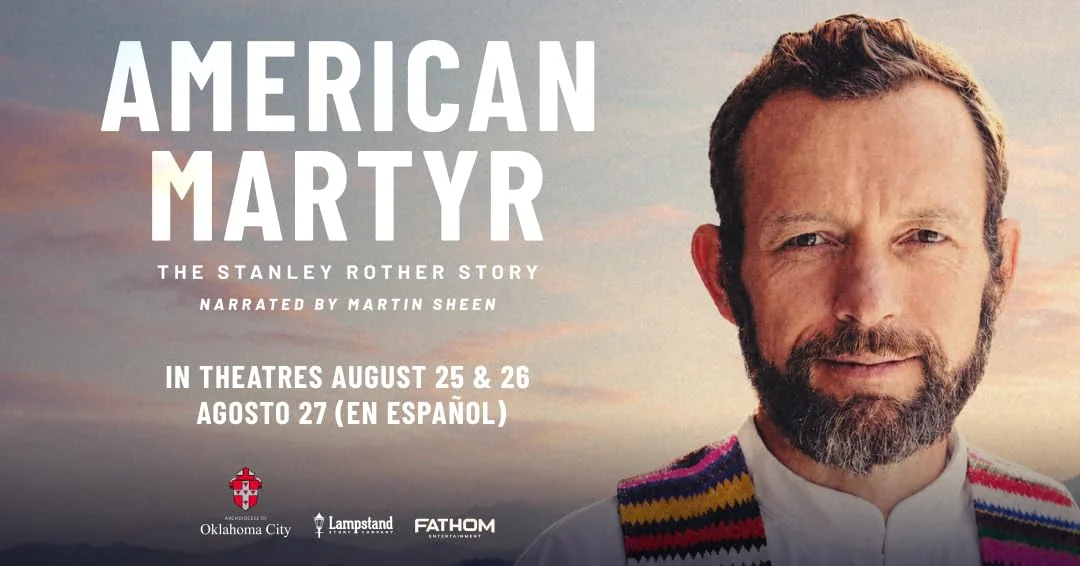
Stanley Rother’s story acquires much of its force from the distance between two farming communities. He was raised among German-Catholic farmers in Okarche, Oklahoma, then spent the defining years of his priesthood among the Indigenous Tz’utujil people of Santiago Atitlán, Guatemala. Derek Watson’s American Martyr: The Stanley Rother Story treats those places less as opposites than as parts of the same vocation.
Rother hardly looked destined for missionary legend. He struggled academically at Assumption Seminary in San Antonio, particularly with Latin, and was eventually dismissed before finding another path to ordination in 1963. Five years later, he arrived in Guatemala and learned Spanish and Tz’utujil. The irony is almost too neat: the seminarian who stumbled over Latin became the priest willing to learn the language of the people standing before him.
Watson presents that transition through family testimony, photographs, letters, and recollections rather than dramatic reconstruction. The approach suits a man whose significance came from settling into another community until the distinction between missionary and neighbor began to disappear.
Faith in the Fields
Rother’s Oklahoma upbringing becomes unexpectedly portable in Santiago Atitlán. He could preach, but he could also work with soil, machinery, and practical problems. The documentary repeatedly returns to that combination.
He helped organize a farm cooperative and introduced agricultural practices intended to improve local food production. He trained traveling catechists, supported healthcare and education, and established a radio station capable of broadcasting Mass and religious instruction beyond the immediate parish. His work on Tz’utujil religious material placed Catholic teaching inside a language historically pushed aside by dominant institutions.
That cultural exchange matters. Missionary stories can easily become accounts of an outsider arriving with answers. Watson’s interviews suggest something less comfortable for that model. Rother changed because Santiago Atitlán became home. His relatives describe him referring to the congregation as his family, while Guatemalan testimony presents a priest who worked alongside people rather than remaining ceremonially above them.
Martin Sheen’s narration is serviceable during these passages, yet the film gains texture whenever Watson steps away from scripted explanation. A relative remembering Rother’s habits or a collaborator describing his work communicates cultural intimacy that narration can only report.
The Shepherd Returns
The Guatemalan Civil War transforms ordinary parish work into a political act, regardless of Rother’s intentions. Indigenous Maya communities faced disappearance, torture, military repression, and killing. Priests and church workers became targets as violence spread into rural areas.
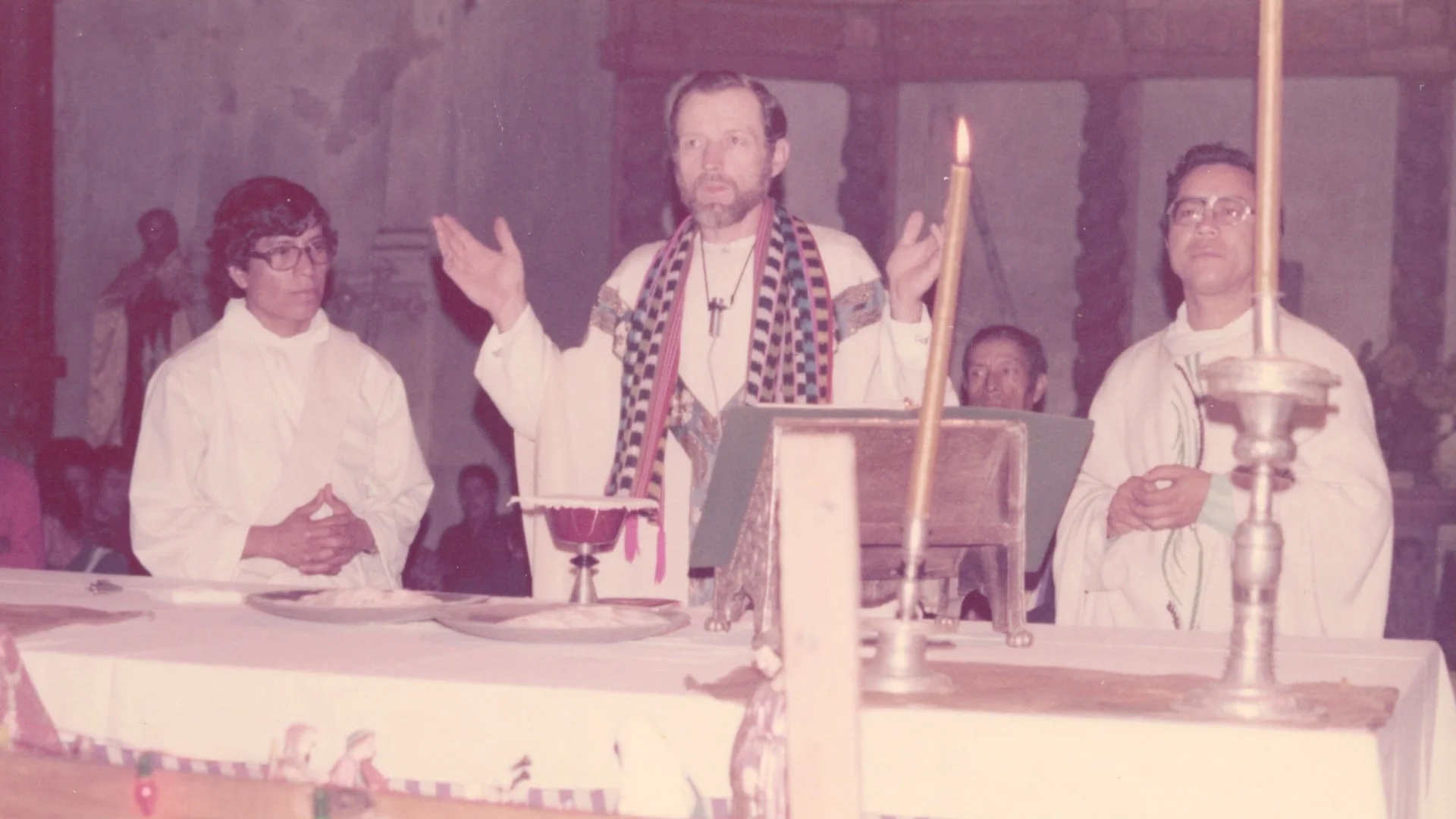
Rother did not frame himself as a revolutionary. His actions still placed him in dangerous territory. Supporting Indigenous parishioners, maintaining the radio station, and refusing to abandon people threatened by the state made neutrality impossible in practice. His name eventually appeared on a death squad list, forcing him back to Oklahoma. The film’s decisive moment comes afterward. Safety is available. He rejects it.
Rother had promised his congregation that he would return for Holy Week. His cousin, Msgr. Don Wolf, recalls that Rother seemed settled on where he belonged. Biographer María Ruiz Scaperlanda describes his stay in Oklahoma as a Garden of Gethsemane, invoking Christ confronting death without actively seeking it. Rother returned to Santiago Atitlán and was murdered by gunmen in the rectory in July 1981.
Here the documentary’s institutional perspective becomes restrictive. Its treatment of Guatemala’s political and theological climate remains narrow. Liberation Theology receives little meaningful attention, and the assassination of Archbishop Óscar Romero in neighboring El Salvador a year earlier is absent from the historical frame supplied by the reviews.
Those omissions matter because Rother’s killing occurred amid a regional struggle over the Church’s relationship to poverty, state violence, and Indigenous rights. Without that framework, political history sometimes becomes background weather rather than an active force shaping his fate.
The Man and the Martyr
Watson has relatively little moving footage of Rother, so American Martyr builds him from fragments: still photographs, brief archival material, letters, journals, restrained recreations, and memories offered decades later. The limitation produces one of the film’s better formal choices. Rother never becomes a slickly manufactured screen saint. Photographs leave gaps. Memories contradict the tidy certainty that institutional biography often prefers. The man remains partly inaccessible.
One recollection carries particular power. After Rother’s assassination, villagers reportedly collected his spilled blood in ordinary jars, already treating him as a martyr. His heart remained in Santiago Atitlán, while his body returned to Oklahoma. Few images could express his divided geographical legacy with such stark precision: one life claimed by two communities, each preserving a different part of him.
His 2017 beatification in Oklahoma City drew roughly 20,000 people, formally recognizing him as a martyr within the Catholic Church. Canonization would require recognition of a miracle, and the documentary plainly arrives from an institution invested in that possibility.
Yet its strongest material exists before sainthood enters the discussion. Rother’s defining act is painfully concrete. He knew Guatemala could kill him. He knew Oklahoma could shelter him. He went back because Santiago Atitlán had ceased to feel like somewhere he had been sent.
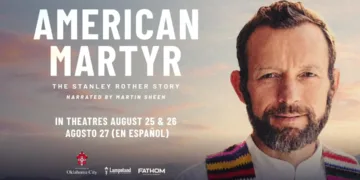
American Martyr: The Stanley Rother Story premiered in theaters nationwide on August 25, 2026, through Fathom Entertainment. Narrated by Martin Sheen, the documentary chronicles the extraordinary life, ministry, and martyrdom of Father Stanley Rother, the first U.S.-born priest recognized as a martyr by the Catholic Church.
Where to Watch American Martyr: The Stanley Rother Story (2026) Online
Full Credits
Title: American Martyr: The Stanley Rother Story
Distributor: Fathom Entertainment
Release date: August 25, 2026
Running time: 2 hours 3 minutes
Director: Derek Watson
Producers and Executive Producers: Chet Burns, Christi McGahan, Most Reverend Paul S. Coakley, Sara Susanne Orczy-Barstow Brown, Steven Paul Brown, Robyn & Chuck Duginski, Shellie & Don Greiner, Matthew & Janis Mollman, Maria Ruiz Scaperlanda, Michael A. Scaperlanda
Cast: Stanley Rother, Michael Scaperlanda, Rebekah Scaperlanda, Martin Sheen
The Review
American Martyr: The Stanley Rother Story
American Martyr: The Stanley Rother Story is strongest when Stanley Rother’s Oklahoma roots and his life among Guatemala’s Tz’utujil people are allowed to speak across cultures. Derek Watson’s restrained use of photographs, letters, archival footage, and personal testimony gives Rother’s devotion tangible human shape. The Archdiocese-backed perspective leaves the Guatemalan Civil War and Liberation Theology frustratingly underdeveloped, reducing the historical forces surrounding his murder. Still, the choice that defined Rother, returning to Santiago Atitlán after learning he was marked for death, carries enormous moral weight.
PROS
- Intimate firsthand testimony
- Restrained archival presentation
- Strong portrait of practical service
- Powerful account of Rother’s return
CONS
- Thin political context
- Liberation Theology largely absent
- Functional narration
- Institutional perspective narrows the history