














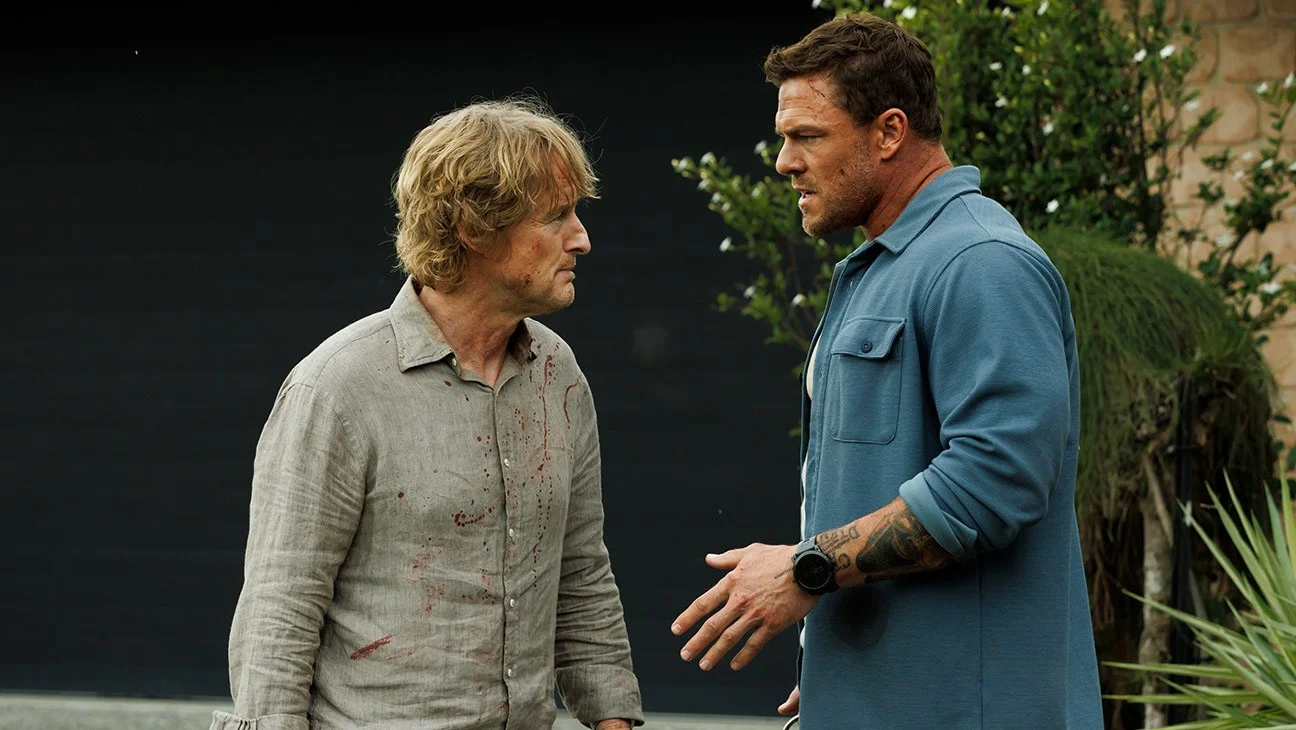

Queensland rarely gets to play itself in an American action movie. Brisbane is usually scenery for somewhere else, its streets redressed, its skyline politely erased. Scott Waugh’s Runner lets the city keep its name, then sends Alan Ritchson barreling south toward the Gold Coast with a donated liver, Owen Wilson, and a procession of armed men trying to kill him.
That geographic honesty gives a familiar genre exercise a small but useful distinction. Waugh, working from a screenplay by Miles Hubley and Tommy White, has made an American buddy-action movie that happens to remain visibly Australian. Its hero, Hank Malone, is an American military veteran living on a houseboat in Queensland, attending AA meetings, learning French through his phone, and working as a specialist courier for clients with unusual problems.
His early errands tell us almost everything about the movie’s preferred register. Hank deals with a drunken politician and gets stuck transporting an expensive parakeet nobody seems particularly eager to receive. Then comes the serious job. A liver is arriving in Brisbane for Ellie, a seven-year-old girl waiting for a transplant at a Gold Coast hospital.
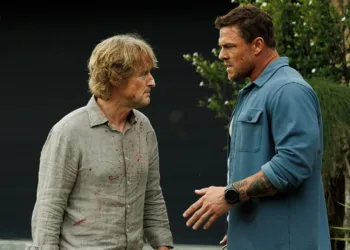
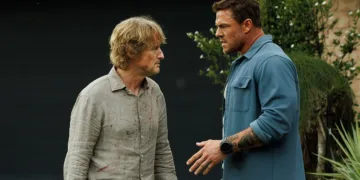
The organ arrives attached, figuratively speaking, to Ben Bishop, a relentlessly sociable courier played by Wilson. Hank drives. Ben talks. Somewhere behind them, black SUVs appear. It is an old formula crossing unfamiliar roads.
The Road to the Gold Coast
Runner understands the usefulness of a physical objective. Hank and Ben cannot simply escape their pursuers. They have to protect a fragile organ, keep moving toward a fixed destination, and beat a biological deadline. The liver converts every roadblock into something potentially fatal for a child sitting miles away.
The problem is Damian Zaldívar, played by Rodrigo Santoro. His mother needs the same liver, and Damian intends to take it. The screenplay barely tries to make the coincidence feel plausible. A rare compatible organ happens to be needed simultaneously by two people connected to opposite ends of a violent chase. Damian also possesses access to cartel gunmen, local bikers, compromised personnel, and enough Queensland infrastructure to make Ben reasonably ask what a cartel is doing there. Runner’s answer is essentially another car.
There is something revealing in the way an Australian landscape gets absorbed into imported American action grammar. Brisbane becomes a network of highways, parking areas, hospital corridors, and pursuit routes. Local bikers slot into the antagonist hierarchy with little cultural texture.
Waugh occasionally allows the skyline and Gold Coast transit system to register, and Hank even remarks fondly on Australians, yet the country functions primarily as an unusually sunny arena for a story descended from Midnight Run, The Transporter, and decades of mismatched-partner thrillers.
The location still matters because it gives the familiar mechanics fresh visual coordinates. A later chase involving a Gold Coast tram has a physical specificity that a generic backlot could never supply. The roads have turns, gradients, traffic, and recognizable civic infrastructure. For a movie built around getting one object from Brisbane to a particular hospital, geography becomes part of the suspense.
The screenplay then repeatedly sabotages its own clock. Once the liver is said to have roughly 45 minutes of viability left, Hank and Ben still manage extended fights, detours, hospital complications, and a remarkable amount of vehicular destruction. Time in Runner is less a measurable quantity than an action-film accent. The characters keep announcing urgency while the movie spends minutes freely.
Muscle Meets Motormouth
Ritchson’s physical scale makes Hank immediately legible. He looks capable of turning most rooms into crime scenes, which gives his early insistence that he no longer hurts people the quality of a countdown. The AA chip, his year of sobriety, and the photograph of his dead daughter provide the quieter side of the character before the plot gives him permission to start dismantling attackers.
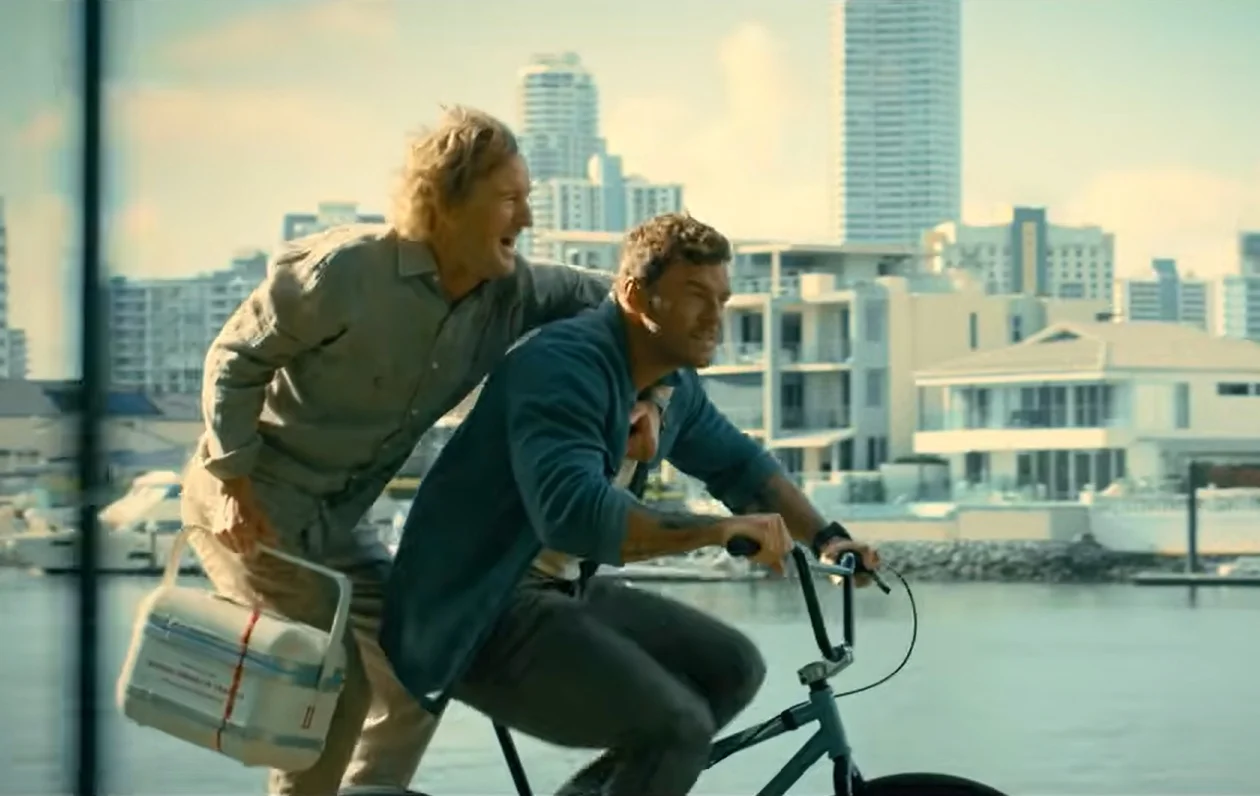
Ritchson plays those softer beats with restraint. When Hank’s habit of learning French is eventually tied to his daughter, the screenplay pushes hard for emotion, but Ritchson resists making the scene bigger than it needs to be. He is also unexpectedly good at dry comedy. Hank often seems mildly offended that reality continues producing people foolish enough to attack him.
Wilson works from the opposite direction. Ben talks compulsively, cultivates his own mythology, and even refers to himself in the third person. It is an aggressively Wilsonian construction, down to the wandering conversational rhythm that makes every sentence sound as though it has discovered a side road. The pairing should create friction. It creates functionality.
Their scenes lack the precise exchange of irritation and growing affection that powered the best American buddy movies. Rush Hour could turn a misunderstanding into choreography. Midnight Run could make two men sitting beside each other feel like ideological warfare. Hank and Ben spend much of Runner performing beside one another instead. Wilson can land a line. Ritchson can answer with a stare. The screenplay rarely lets those gestures accumulate into a relationship with its own rhythm.
Santoro has no such problem finding the movie’s frequency. Damian is furious, wounded, theatrical, and frequently appears seconds away from either murder or tears. His devotion to his dying mother supplies a distorted reflection of Hank’s commitment to Ellie. Both men are trying to save someone. One regards everyone else’s life as expendable. Santoro plays that contradiction at near-melodramatic volume, which proves exactly right for a movie involving a million-dollar liver and biker-assisted cartel warfare on the road to the Gold Coast.
Scott Waugh Speaks Stunt
Waugh’s clearest language is physical action. A former stunt performer, he understands that a fight becomes memorable through an idea rather than sheer duration. One sequence captures his instincts perfectly. Hank is dragged into the back of a blacked-out SUV. The vehicle drives away. Then it stops. The body of the car begins rocking. Windows break from inside. Hank eventually emerges alone and continues toward the next group of men waiting to discover what happens when they punch Alan Ritchson.
The scene withholds the fight itself for part of its duration, letting the battered vehicle describe what is happening inside. It is economical, funny, and far better than filming another exchange of elbows from six inches away.
Elsewhere, Waugh does crowd the camera too close to his performers. Several fights possess strong stunt concepts that become harder to appreciate because framing chops bodies into impacts instead of allowing movement to read across the space. Yet the action keeps changing its vocabulary.
Guns get larger. Vehicles become weapons. The pursuit expands from professional criminals to bikers. An overturned police car contributes a spinning wheel that sends one attacker violently into a wall. That last image tells you exactly how Runner interprets realism.
The final stretch escalates into a hospital battle destructive enough to make the building itself seem personally involved. Waugh understands escalation in the old exploitation sense: once one object has been broken, find a larger one. The result has a satisfying mechanical progression that many streaming action movies lose when every sequence uses the same digital debris and anonymous corridors.
Some of Runner’s own production limitations remain visible. Moving backgrounds outside vehicle windows can look unfinished. Familiar songs arrive through conspicuous substitutes or covers. The polish frequently sits a level below the ambition of the stunt work. Then another car crashes through something.
Sentiment in the Passenger Seat
Runner keeps trying to decide how seriously it wants its own suffering taken. Hank carries grief over his daughter. Ellie waits for surgery. Her mother Kate moves through a hospital subplot involving a suspected cartel infiltrator. Damian is killing people because his own mother is dying. These are heavy motivations attached to a movie that also uses automobile parts as improvised instruments of bodily catastrophe.
The collision can be funny when the film recognizes it. Wilson’s chatter works best when it arrives after some preposterously violent event and treats the destruction as another inconvenience on the schedule. Santoro’s performance succeeds for a related reason: Damian’s emotions are pitched at the same exaggerated scale as the plot.
The trouble comes when the movie asks its sentimental scenes to operate according to a completely different dramatic code. Hank’s history with his daughter is carefully arranged to mirror Ellie’s situation, giving his decision to protect the liver an emotional explanation the character barely needed. Kate’s hospital investigation similarly interrupts the road movie rather than deepening it. The cleanest version of Runner is already sitting in Hank’s battered vehicle: two couriers, one organ, one destination, and a growing number of people between them and the exit.
Angel Studios may be experimenting here with the language of mainstream genre cinema, but the film still carries traces of a house style that prefers its emotional meanings underlined. Waugh appears far happier once those meanings have to survive at 100 kilometers per hour.
The regional setting creates the more interesting tension. An American action formula has been exported to Queensland, populated with local roads and supporting players, then allowed to treat Australian civic infrastructure with the destructive enthusiasm Hollywood usually reserves for Los Angeles. Brisbane survives the cultural exchange. The hospital has a rougher evening.
Runner releases in theaters on September 11, 2026, distributed by Angel Studios. The action thriller follows a high-end courier who has three hours to transport a vital organ across Australia while evading ruthless mercenaries.
Where to Watch Runner (2026) Online
Full Credits
Title: Runner
Distributor: Angel Studios
Release date: September 11, 2026
Rating: 15
Running time: 1 hour 38 minutes
Director: Scott Waugh
Writers: Miles Hubley, Tommy White
Producers and Executive Producers: Alan Ritchson, Todd Garner, Mark Fasano, Jeffrey Greenstein
Cast: Alan Ritchson, Owen Wilson, Rodrigo Santoro, Leila George, Adriana Barraza, Sullivan Stapleton, Peta Sergeant, Geraldine Hakewill
Director of Photography (Cinematographer): Lorenzo Senatore
Composer: Charlie Nguyen Kim
The Review
Runner
The Brisbane-to-Gold Coast setting gives Runner a welcome regional identity, yet the film remains built from recognizably American buddy-action machinery. Scott Waugh gets the strongest mileage from physical escalation: smashed vehicles, improvised weapons, and a hospital fight that treats architecture as collateral damage. Alan Ritchson and Owen Wilson never find the easy rhythm the format demands, while Rodrigo Santoro wisely performs at the same operatic pitch as the plot. Sentiment keeps interrupting the chase, but the film moves fast enough for its sillier instincts to survive.
PROS
- Inventive stunt-driven action
- Strong Queensland locations
- Ritchson's dry physical presence
- Santoro's wild villain performance
- Efficient 98-minute runtime
CONS
- Weak buddy chemistry
- Overworked emotional backstory
- Implausible ticking clock
- Uneven comedy and violence
- Visible production shortcuts