


























A patch of black mold is a wonderfully uncinematic problem. It sits behind a cupboard, spreads quietly, and usually ends with someone making a phone call to a building manager. Gábor Reisz understands exactly how useful that ordinariness is. Ground Floor takes a maintenance complaint and keeps enlarging it until one damaged wall seems connected to an entire apartment block’s habits, compromises, and petty power structures. The movie is funniest when each expansion feels only slightly less reasonable than the one before it.
Kristóf (Ádám Tompa) discovers the mold while he and his wife Vera (Bettina Józsa) are preparing to leave for a holiday. Vera then reveals that she is pregnant, which changes the practical stakes almost immediately. This apartment is no longer simply where they happen to live.
It is supposed to become a home for their child. Kristóf starts looking for the source of the moisture and finds himself moving from neighbor to neighbor, then toward Balázs (Rodrigo Crespo), the building manager whose ability to answer a straightforward question without answering it becomes one of the film’s best recurring jokes.

Tompa gives Reisz an ideal center for the escalation. Kristóf begins as tired, anxious, and slightly withdrawn. His behavior does not leap from irritation to rebellion. Tompa lets frustration accumulate in small increments, so the increasingly bizarre encounters around him still have a believable emotional scale. By the time Kristóf looks obsessed, the movie has shown us every little dismissal that helped get him there.
That matters because Reisz keeps the audience asking a useful question about Kristóf: when does reasonable concern become fixation? He is correct that something is wrong. He is also increasingly incapable of leaving it alone. Vera’s pregnancy gives that fixation emotional weight without turning it into a sentimental explanation for everything he does. He can be right about the building and unreasonable in the way he pursues the truth. Tompa plays both sides of that tension cleanly.
Crespo’s Balázs is even better at making dysfunction seem perfectly normal. He is friendly enough to sound cooperative and slippery enough to redirect every conversation toward his own priorities. His pet project is installing an elevator, which he presents as an obvious communal good. Kristóf points out that he lives on the ground floor. That exchange is tiny, but it explains the movie’s entire comic system: the people with authority keep offering solutions to problems they prefer discussing while ignoring the problem actually sitting in front of them.
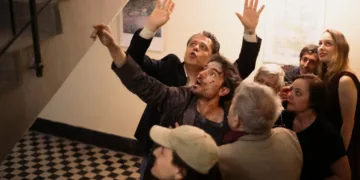
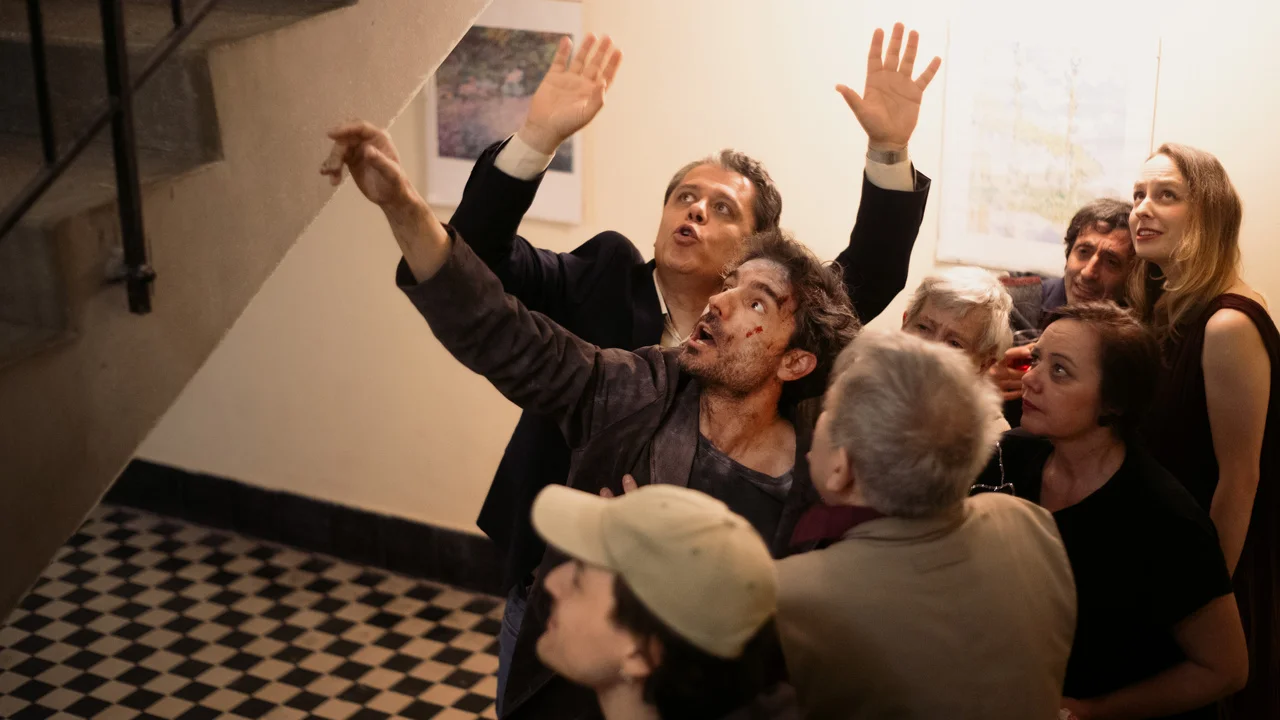
The apartment block gradually becomes the film’s most important piece of storytelling. Production designer Zsófia Tasnádi gives Reisz a space that initially feels plain and functional, then becomes stranger as Kristóf explores it. Corridors lead into apartments, damaged sections reveal concealed problems, and the building seems to keep producing another person with another version of what is happening.
Cinematographer Kristóf Becsey helps that transformation along. The camera begins from a relatively grounded visual language, then becomes increasingly restless as Kristóf loses his patience. Whip pans between characters add nervous energy to conversations that are already slipping away from common sense. A whip pan is simply a very fast camera movement from one subject to another, and here the speed creates the feeling that Kristóf is constantly trying to catch up with a situation that has already moved somewhere else.
I liked how Reisz uses that physical exploration to explain the film’s larger political idea without immediately stopping for a speech. Kristóf learns about the building by moving through it. He encounters residents who benefit from the existing arrangement, people who dislike it but have accepted it, and people who have learned that speaking up costs too much energy. The plumbing problem, questionable repairs, building politics, and Balázs’s little kingdom start to resemble parts of the same machine.
The allegory is not difficult to read. The apartment block is designed as a miniature society shaped by patronage, resignation, minor authoritarian behavior, and the strange communal bargain of knowing something is broken while hoping someone else will deal with it. Reisz’s cleverest decision is making those ideas visible through architecture. The building has layers, hidden damage, contested spaces, and problems that travel through shared walls. Kristóf cannot isolate his mold because the building itself refuses isolation.
The comedy follows a similar principle. Early scenes stay close enough to recognizable bureaucracy that the absurdity has some sting. Balázs deflects. Residents contradict each other. A drunken “House Doctor” enters the investigation. Conversations follow their own sideways logic. Kristóf keeps asking questions that should be simple and receives answers that somehow make the situation larger.
Reisz then accelerates everything. András Kálmán and Reisz’s score helps push the movie from deadpan irritation toward near-chaos, eventually reaching a manic use of Liszt’s Hungarian Rhapsody No. 2. The music starts behaving like another resident who has decided the meeting has gone on long enough.
This is also where Ground Floor begins losing some of the precision that made its first stretch so sharp. The early satire works because the behavior is ridiculous while remaining recognizable. Once the residents move toward collective confrontation and the film leans harder into outright farce, Reisz starts emphasizing ideas that the building, performances, and comic rhythm had already communicated perfectly well. Louder does not automatically mean sharper.
That shift does not erase what works. Kristóf’s personal awakening still has force because the film has spent so much time showing the exhausting mechanics of resignation. Every ignored complaint and redirected responsibility teaches him why everyone else stopped trying. His refusal to accept that arrangement starts as a practical concern, turns into obsession, and finally exposes how much effort a dysfunctional system demands from the person who simply asks it to function.
By then, the mold has almost become the simplest problem in the building. Kristóf can see it, point to it, and insist that someone deal with it. The harder problem is everything his neighbors have already learned to stop seeing.
Ground Floor world-premiered at the Venice International Film Festival in September 2026. The tragicomedy follows a man who discovers black mold behind his apartment wall on the eve of a holiday, triggering an absurd building-wide investigation that mirrors broader societal fractures.
Full Credits
Title: Ground Floor
Distributor: Films Boutique
Release date: September 2026 (Venice International Film Festival)
Running time: 1 hour 48 minutes (108 minutes)
Director: Gábor Reisz
Writers: Gábor Reisz, Éva Schulze
Producers and Executive Producers: Júlia Berkes, Andrea Romeo
Cast: Ádám Tompa, Rodrigo Crespo, Bettina Józsa, Tünde Bacskó, György Gazsó, Juli Kindl, Éva Tímár, Marcello Fonte
Director of Photography (Cinematographer): Kristóf Becsey
Editors: Gábor Reisz
Composer: András Kálmán, Gábor Reisz
The Review
Ground Floor
Ground Floor turns a patch of mold into an increasingly absurd study of bureaucracy, resignation, and petty authority. Gábor Reisz is at his sharpest when Kristóf’s investigation stays close to recognizable everyday frustration, aided by Ádám Tompa’s carefully escalating performance and an apartment block whose design carries much of the political argument. The final push into broad farce dulls some of that precision, yet the film remains funny, formally smart, and clear about how broken systems teach people to accept being ignored.
PROS
- Ádám Tompa anchors the escalating absurdity
- Strong use of the apartment block as storytelling
- Sharp early bureaucratic comedy
- Cinematography makes Kristóf’s frustration tangible
- Political ideas emerge naturally through space and behavior
CONS
- Final-act farce becomes too emphatic
- The allegory occasionally explains what the filmmaking already conveyed
- Escalation loses some of the early satire’s precision