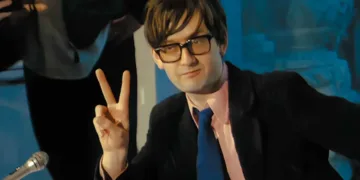















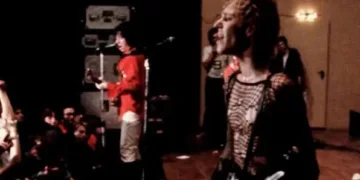








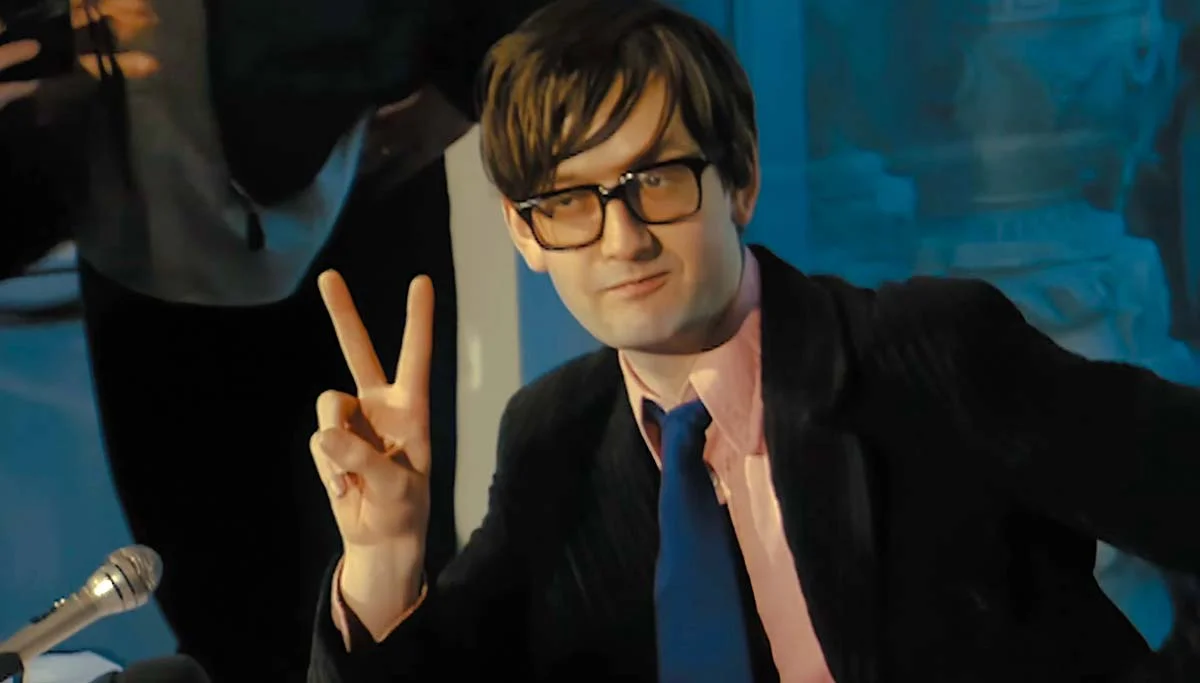

“Disco 2000” once asked its characters to imagine themselves fully grown. At Pulp’s 2025 O2 Arena show, they have had plenty of time to find out. Streamers fall, the crowd sings, and Jarvis Cocker still moves through the song with the restless precision of someone addressing a single person across the room. Yet its old disappointment has survived the years too. The spectacle gives the song a new setting without washing away the sting of being overlooked.
Garth Jennings keeps finding ways to let Pulp’s past remain audible in its present. Footage from the O2 shows sits alongside home movies, television appearances, photographs, and Cocker’s memories in Pulp: What Do You Do for an Encore? The film does not hold the concert until its history lesson is finished. It moves between them, allowing a recollection to change the weight of a performance and a performance to make an old anecdote feel less settled.
Cocker is an unusually good guide for that approach. He tells the band’s history as someone who can still recall the odd human detail inside a career milestone. His account of gathering unpopular schoolmates to form a group tells us something different from a list of early gigs. Nick Banks’s audition, during which he was occupied with finding the owner of a dog that had followed him from the bus stop, is even better. The story gives Pulp’s reputation for welcoming misfits an ordinary, funny beginning.
Jennings’ archive has a similar character. A family memory such as the replica Dalek made by Cocker’s grandfather belongs beside the old TV clips because both help explain the imagination Cocker brought to pop music. The director and singer establish their familiarity during a car journey that recalls their collaboration on the “Help the Aged” video. From there, the film’s jumps across decades feel guided by Cocker’s associations. For a viewer unfamiliar with Pulp, that looseness can be helpful: the people and their tastes come into view before the dates demand attention.
The concert gives those memories somewhere to go. “Spike Island,” from the band’s first album in 24 years, arrives early with Cocker singing about his need to perform. New material could easily feel like the admission price for hearing “Babies” and “Common People.” Here it helps establish that the musicians have brought something of their current lives to the stage. The older songs carry traces of the young people who made them, while the performers standing under the O2 lights know what came after.
Jennings knows when to bring the camera close to Cocker’s face and hands. His gestures can carry a lyric across a vast stage, and a close-up lets a home viewer follow the expression behind all that pointing. Wide shots give us the scale of the production, including its elaborate backdrop and the crowd gathered beneath it. During “Common People,” Jennings’ relatively sparing cuts to the audience make its response feel earned. We have spent enough time watching Cocker direct the song outward to understand why thousands of people answer him.
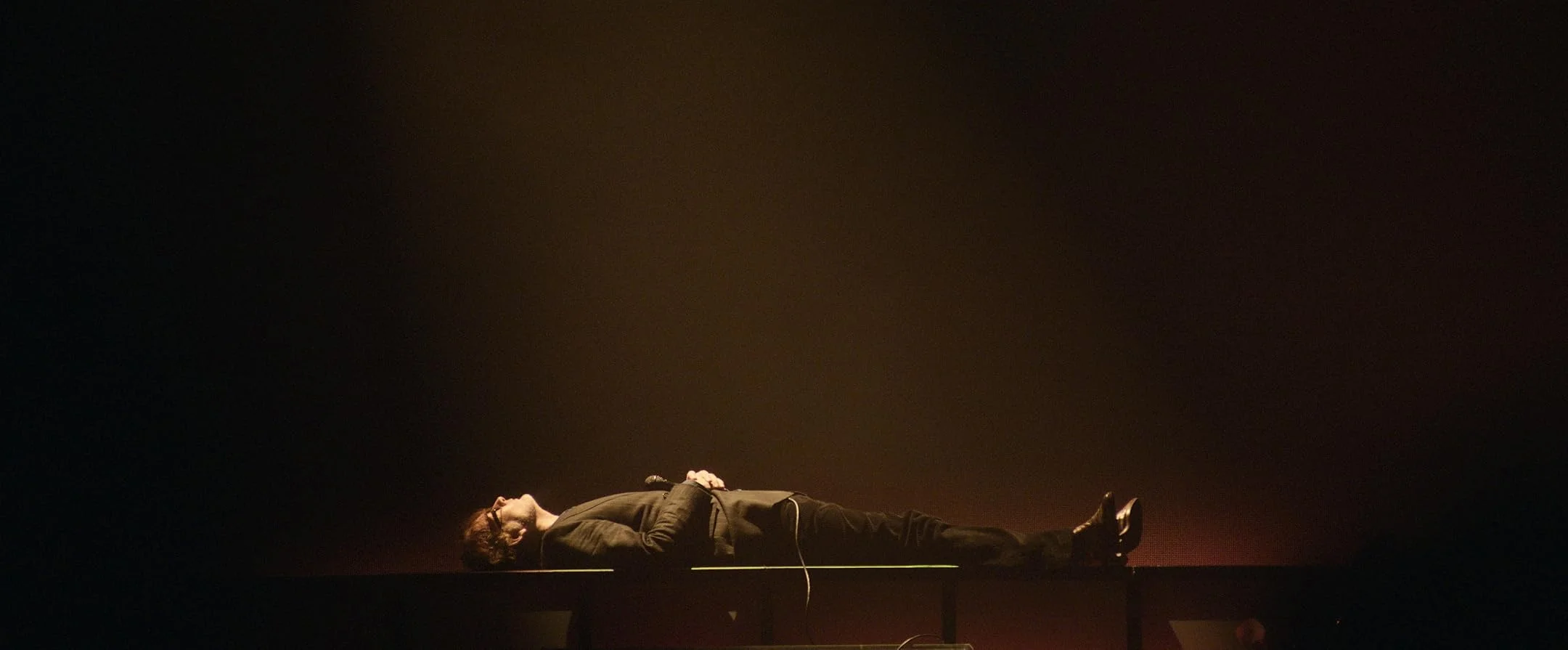
That same scale presents the film’s main difficulty. The O2 is enormous, and some of its energy remains inside the room. Long stretches of performance are a generous record for fans, though an unfamiliar viewer may have to wait for the archival material to give certain songs their full charge. I wanted to stay with a few of Cocker’s recollections longer, particularly when the film reaches the strains of fame and the darker territory surrounding This Is Hardcore. Another song sometimes arrives just as that history becomes interesting.
Cocker’s perspective also dominates the account. Candida Doyle, Banks, and Mark Webber are present, but the film offers less sense of what returning has meant to them individually. That choice makes the documentary especially vivid as a story told by Pulp’s frontman while leaving some of the band’s shared history beyond its reach. Jennings’ affection for Cocker is evident in the attention he gives both his narration and his stage performance; it also shapes the limits of what we hear.
The performance dedicated to bassist Steve Mackey, who died in 2023, needs little narration. Cocker, Doyle, Banks, and Webber play with the arena ornament stripped back. After the lights and crowd scenes, the sight of those four musicians together lets a missing bandmate register without turning him into a chapter heading. It is one of the film’s clearest demonstrations of what concert footage can express on its own.
Late in the film, Cocker asks why Pulp should keep going. Jennings has shown the pleasure of hearing the old songs again, along with the distance those songs have travelled. The closing choice of “A Sunset,” another new song, gives his question a present-tense answer. Pulp have come back to sing to the people who waited for them, and they still have songs they want those people to hear.
Pulp: What Do You Do for an Encore? premiered in September 2026 and is available to stream exclusively on MUBI. The music documentary blends electrifying concert footage with four decades of archival material to chronicle the iconic Britpop band’s journey and return to the stage.
Where to Watch Pulp: What Do You Do for an Encore? (2026) Online




Full Credits
Title: Pulp: What Do You Do for an Encore?
Distributor: MUBI
Release date: September 18, 2026 (UK Theatrical) / September 25, 2026 (MUBI Streaming)
Running time: 1 hour 38 minutes (98 minutes)
Director: Garth Jennings
- Cast: Jarvis Cocker, Nick Banks, Candida Doyle, Mark Webber, Andrew McKinney, Emma Smith, Richard Hawley
- Composer: Pulp
The Review
Pulp What Do You Do for an Encore?
Garth Jennings lets Pulp’s old songs and new performances speak to each other, with Jarvis Cocker’s funny, personal recollections giving the concert its shape. The archival material can be so absorbing that another lengthy song sometimes feels premature, and the O2’s energy does not always reach the screen. Still, the performance for Steve Mackey and the place made for songs from More give this encore a sense of purpose.
PROS
- Cocker’s warm, revealing narration
- Archival footage that enriches the songs
- Expressive concert close-ups
- Moving tribute to Steve Mackey
CONS
- Some O2 spectacle feels distant on screen
- Other band members get limited perspective
- Performances sometimes cut short a promising recollection