

















When Father Daniel and his wife May separately question a man connected to their daughter’s disappearance, Simon Rumley places their inquiries in a split screen. The division offers no comforting symmetry. They want the same child back, but Daniel’s belief in forgiveness and May’s demand for action have made the search a test of two incompatible responses. The frame lets both persist at once. It cannot settle which will survive contact with what they learn.
Christian Ferriera gives the man they question, Stanley, an increasingly strained presence. His distress complicates a scene that could have functioned as a simple step toward the next villain. Daniel, played by Steve Oram, remains comparatively mild. That restraint initially makes sense for a priest whose convictions must mean something before they can be tested; at times, though, Oram’s composure makes the strain harder to detect than Ferriera’s. Rumley has found a visual form for the parents’ division, while the performances leave its emotional force uneven.
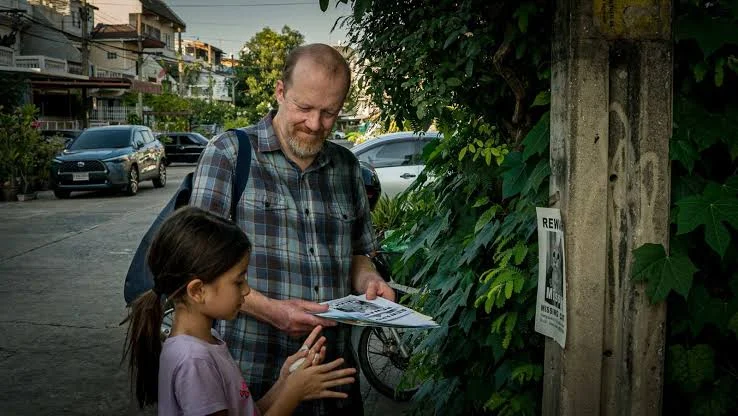
The danger enters the family’s life through an image. At a sleepover, ten-year-old Olivia (Margaux Dietrich) is shown a video of a kitten being crushed. Soon her own kitten, Missy, disappears, and Olivia becomes convinced it has met the same fate. Her fear sends her searching through Bangkok, where she is abducted.
Rumley shows fragments of the video and attends to its effect on the people watching it. In Olivia’s nightmares, the possibility of what happened to Missy becomes as invasive as anything she has seen. An ugly piece of footage has taught her how to picture the world beyond her home.
Daniel cannot talk her out of that picture. Olivia asks how God could permit such cruelty, a question his work as a priest requires him to face but his role as her father gives him reason to dread. When his acoustic hymn accompanies her search for Missy, sound and action briefly occupy different moral worlds. The song offers assurance while Olivia moves toward a danger Daniel does not recognize. Rumley does not need ominous music to announce the gap. The reassurance itself does the work.
Once Olivia is taken, the film divides its attention between her captors and her parents’ efforts to find her. The audience’s glimpses of her predicament make Daniel’s language of forgiveness harder to hear with his confidence. May refuses the comfort of treating their daughter’s disappearance as a spiritual test. Their difference is sharpened by the thriller’s control of information: we know enough to fear for Olivia, while the parents must act without knowing enough to protect her. Daniel’s faith is judged under conditions that give him little time to think.
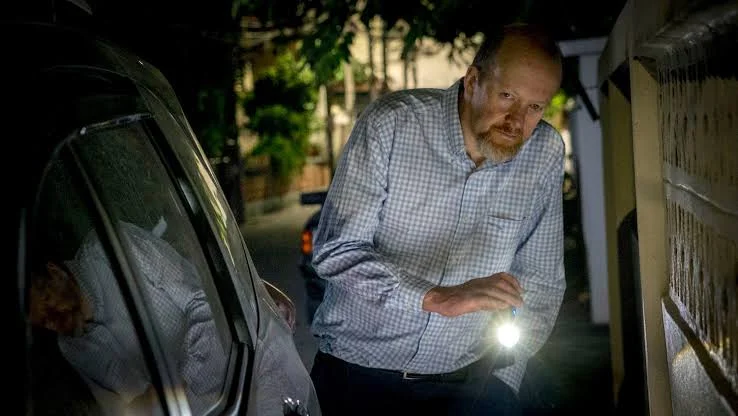
This places Crushed near the tradition of thrillers in which a search through a city becomes a descent through a parent’s moral limits. Rumley is less interested in the satisfaction of pursuit than in what the pursuit does to the person conducting it. Stanley is a father too, a parallel that makes his part in Olivia’s abduction especially sickening without making him Daniel’s moral equal. Daniel has to decide what his obligations to Olivia permit him to do to another person. The film’s best passages let that decision grow more difficult as the search closes in.
Rumley often cuts away from the worst harm threatened against Olivia, letting words, sounds, and reactions carry what the image refuses to show. At first, the restraint is devastating: the audience has already learned from Olivia how readily the mind completes a fragment.
Yet the method becomes less secure as the film moves toward its reckoning. Keeping the violence out of sight can protect Olivia from becoming a spectacle, but it can also leave her suffering insufficiently examined while Daniel’s crisis receives the dramatic attention. The split screen makes the parents’ disagreement visible; it cannot, by itself, restore Olivia’s perspective to every choice that follows.
That difficulty gives the film its force and marks its limit. Oram’s subdued Daniel is most persuasive when certainty sounds like something he is working to maintain, as in his attempts to answer Olivia before she vanishes. A brief encounter between Olivia and Missy near the end presses against the imbalance. For Daniel, the child before him is no longer an occasion to argue about forgiveness. She is the person who must live with what happened, and with what her parents chose afterward.
Crushed can make absence frightening with unusual precision: a missing kitten, an unseen act, a daughter whose parents do not know where to look. Its account of justice is less steady, partly because the film’s careful avoidance of spectacle sometimes becomes an avoidance of scrutiny. Rumley’s divided frame remains the clearest expression of what he is trying to hold together. Daniel and May cannot return to the view of the world they shared before Olivia disappeared.
Crushed arrives on digital platforms in the United Kingdom on October 5, 2026. The harrowing thriller follows an English vicar living in Thailand whose faith is pushed to its absolute limits when his young daughter is abducted.
Full Credits
Title: Crushed
Distributor: GrimmVision
Release date: October 5, 2026 (UK Digital Platforms)
Running time: 1 hour 40 minutes (100 minutes)
Director: Simon Rumley
Writers: Simon Rumley
Cast: Steve Oram, May Nattaporn Rawddon, Margaux Dietrich, Sahajak Boonthanakit, Nadech Chatwin, Kevin Lea Davies
The Review
Crushed
Crushed builds dread from fragments: a disturbing video, a reassuring hymn, and horrors kept outside the frame. Rumley’s split screen gives Daniel and May’s opposing responses a precise visual form. Yet the restraint that makes Olivia’s fear so potent sometimes keeps her experience at a distance while her father’s crisis takes over. The film poses a difficult question about forgiveness, even when it cannot give that question its full weight.
PROS
- Split screen makes the parents’ moral divide visible
- Olivia’s fear shapes how the audience sees danger
- Sound and omission build sustained dread
CONS
- Oram’s composure can obscure Daniel’s strain
- Cuts away from harm sometimes evade scrutiny
- Daniel’s crisis can overshadow Olivia’s experience