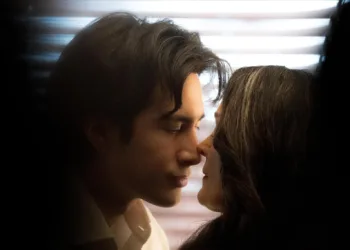



























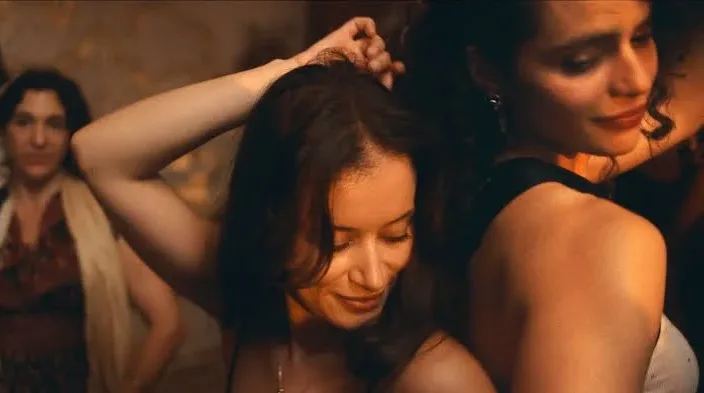

Myriam and Eva dance back-to-back, and the placement tells us something their conversations cannot quite settle. Blocking is the arrangement of performers within a scene; here, it lets two estranged friends look comfortable together without requiring them to explain themselves. Mélissa Guers and Ava Baya give the shared movement an appealing familiarity. In Hanaël El Yousfi’s feature debut, The Daughters of Abraham, that physical connection gives the friendship a history we can feel before we understand what damaged it.
The damage makes their ease interesting. Eva helped separate Myriam from one of her brothers because her family disapproved of the relationship. She has already acted on the expectations that both women now struggle against. Their reunion takes place around the Marseille wedding of Myriam’s older brother, Mohammed, whose best man is another of Eva’s brothers.
These connections give the wedding a useful dramatic function: it brings the friends together through the same family network that helped pull them apart. Their affection survives, but affection alone cannot establish that Eva will behave differently when loyalty becomes difficult.
Guers and Baya make that uncertainty readable through their changing behavior around different people. With friends, strangers, and relatives, the women adjust how much of themselves they allow into the room. Those shifts are an important part of the characterization.
A performance can suggest an entire social history through the difference between someone’s ease in one setting and their caution in another. Here, the relaxed connection between the leads becomes a point of comparison. We have seen what being together permits them; their family encounters show the adjustments that permission requires.
Myriam is Muslim, with Moroccan family roots, while Eva comes from a Jewish family with Tunisian roots. El Yousfi and co-writer Mia Grace Brown make those identities matter through specific social arrangements. Eva’s mother invites Myriam to a Shabbat dinner under the mistaken impression that she is Jewish. Elsewhere, a bachelor party falling on a Jewish holy day produces friction over attendance. The dinner invitation is especially revealing because the welcome rests on an assumption. A gesture of hospitality becomes a test of belonging before Myriam has done anything except arrive.
The earlier romance gives these smaller disputes their weight. Friendship and shared celebrations can be accommodated; choosing a partner across the same religious divide meets resistance. The screenplay locates prejudice inside relationships that also contain affection, making its consequences harder for the women to dismiss or escape.
The title points toward Judaism and Islam’s shared ancestry, while the family scenes show how that connection offers no automatic protection against exclusion. El Yousfi keeps the argument grounded in these households and their choices. The women’s faiths are part of their inheritance, not explanations for everything they do.
Eva’s relationship with her sister Shana, played by Gabrielle Cohen, adds another concrete expression of those expectations. Her mother’s judgment of Eva as less feminine places the sisters within a hierarchy of acceptable womanhood.
Conversations between Myriam, Eva, and Shana about religion and men give the friends space to discuss pressures that take different forms in their homes. Baya’s independence gains texture from this setting: Eva can resist the role assigned to her and still have participated in restricting Myriam’s romantic life. That inconsistency gives the friendship something to work through beyond a simple opposition between young women and traditional parents.
The Marrakech holiday supplies a much harsher test. During a sexual encounter, Myriam is secretly recorded, and the video later circulates without her consent. Fabien Faure’s rich colors and dynamic close-ups have already presented the nightlife as an experience she actively enjoys.
That choice matters. The film allows her pleasure to exist before the recording becomes a means of humiliation. Consent to sex grants nobody permission to film or distribute it, and the later condemnation exposes how readily people around her redirect responsibility toward the person whose privacy has been violated.
I find Guers particularly persuasive across this change because her initial confidence remains essential to understanding her vulnerability. The film has given us a woman who drinks, flirts, enjoys company, and makes choices.
When abuse makes her emotionally and physically vulnerable, we can measure what is being taken from her without treating suffering as her defining characteristic. Faure’s intimate approach supports that continuity. The close attention given to Myriam before the crisis helps the later drama remain attached to a person we know, rather than turning her into an example in an argument about gender.
The screenplay is less convincing in the coincidence that draws Eva’s family into the video crisis. The relationship already carries substantial tension through the rejected romance, Eva’s involvement in that separation, and the wedding reunion.
Adding a convenient connection to the new crisis makes the construction visible at precisely the point when the consequences need to feel unavoidable. The characters’ reactions can be emotionally credible while the route connecting their circumstances feels arranged. El Yousfi’s close observation of the women keeps the drama engaging, but it cannot entirely disguise that shortcut.
The shift into violence also changes the demands placed on the film’s earlier warmth. Golden Marseille light and the energy of the friendship have made these lives inviting to spend time with. The harsher material forces us to reconsider the security of those familiar spaces.
Because the screenplay has already shown small acts of exclusion and Eva’s earlier compliance with family wishes, the abuse does not arrive in a social vacuum. The escalation is severe, yet the groundwork allows the film to retain its concern with belonging: Myriam is hurt by people whose acceptance still matters to her.
The final dance returns to an action the film has already taught us to read. Repetition in a story can change the meaning of a scene without changing its basic activity. After Myriam’s body has been recorded and subjected to other people’s judgments, dancing carries a different claim to freedom than it did during the holiday or the friends’ reunion. The movement cannot undo those violations. It gives her an immediate way to inhabit her body on her own terms, while leaving the harder work of trust and protection beyond the dance floor.
The Daughters of Abraham made its international premiere at the Toronto International Film Festival in September 2026 before its scheduled theatrical release in France. The drama follows a young Muslim woman raised in Marseille who reunites with an estranged Jewish childhood friend during summer break, only for a sudden tragedy to test their bond.
Full Credits
Title: The Daughters of Abraham
Distributor: Les Films du Losange, CG Cinema
Release date: September 11, 2026 (Toronto International Film Festival) / December 30, 2026 (France)
Running time: 1 hour 34 minutes (94 minutes)
Director: Hanaël El Yousfi
Writers: Hanaël El Yousfi, Mia Grace Brown
Producers and Executive Producers: Charles Gillibert
Cast: Mélissa Guers, Ava Baya, Gabrielle Cohen, Bilel Chegrani, Syrus Shahidi, Jalila Talemsi, Younès Bouab, Hiba Bennani
The Review
The Daughters of Abraham
The Daughters of Abraham earns its emotional force through Guers and Baya’s expressive partnership and El Yousfi’s attention to how friendship changes inside family spaces. Shared movement, intimate photography, and everyday exclusions make its cultural tensions easy to understand without simplifying them. A convenient plot connection weakens the crisis’s construction, but Myriam remains a fully realized person throughout the harsher material. The final dance gains its power from everything her freedom has cost.
PROS
- Guers and Baya give the friendship history and complexity.
- Physical staging communicates intimacy without exposition.
- Specific family encounters sharpen the cultural argument.
- The final dance develops the meaning of earlier scenes.
CONS
- A convenient coincidence connects Eva’s family to the crisis.
- The visible plot shortcut weakens the escalation’s credibility.