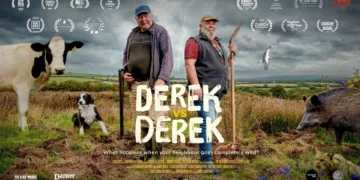














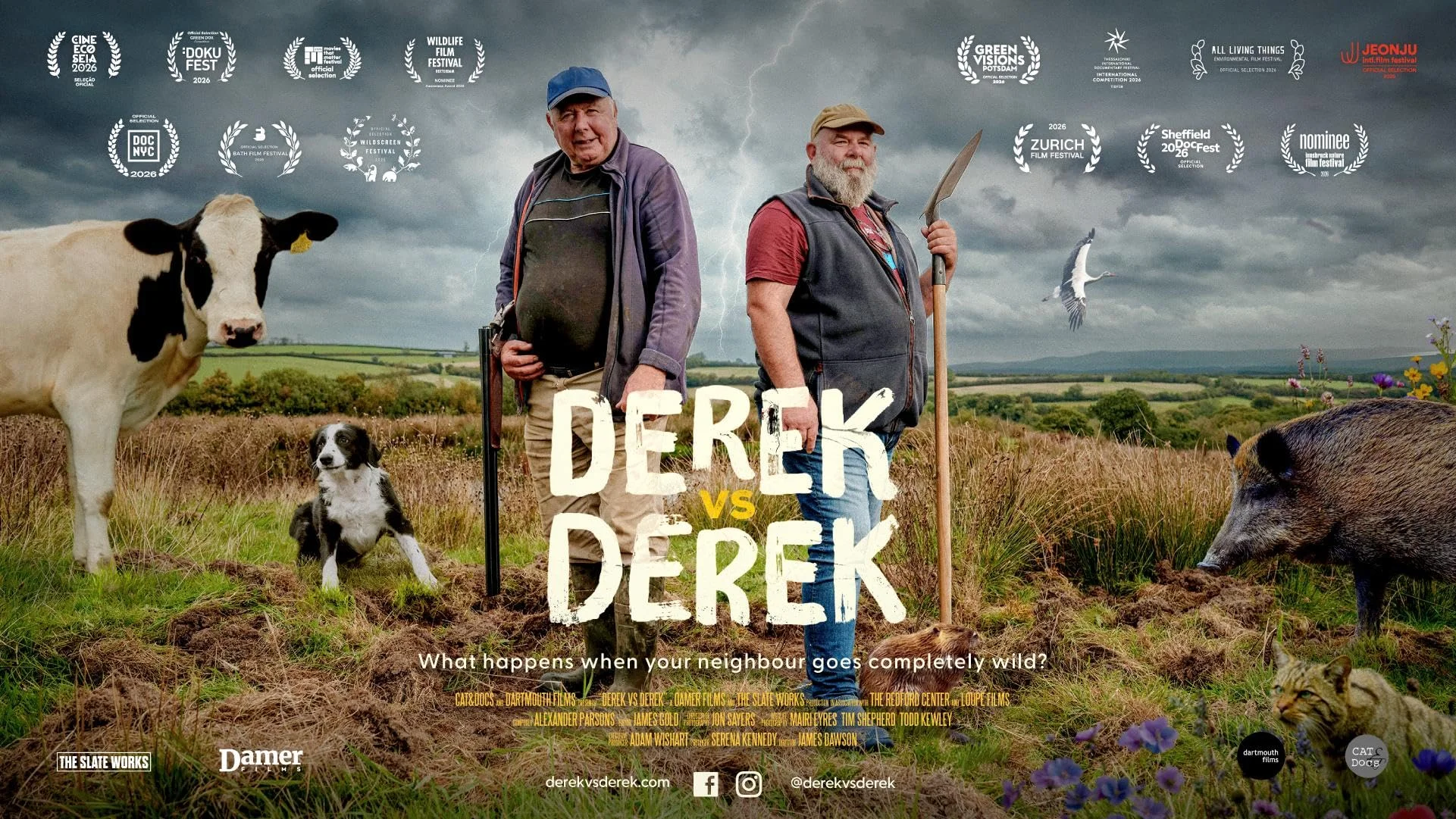

Derek Banbury smiles when he talks about how much Derek Gow annoys him. You can hear the objection and see the pleasure of having someone worth objecting to. Banbury farms dairy cattle in Devon; his neighbor has given up sheep farming to restore wildlife to his land. Their disagreements have consequences, but that smile makes it difficult to settle into the comfortable business of picking a hero and waiting for the other man to embarrass himself. There is affection here, or at least enough familiarity to leave room for it.
The feeling of being caught between two people who might eventually understand each other owes plenty to James Gold’s editing. Separately filmed remarks become exchanges, allowing each Derek’s position to answer or complicate the other’s. James Dawson’s documentary Derek vs Derek builds an experience of listening across the divide. We get to enjoy their stubbornness while retaining an interest in what might change it. The humor keeps that possibility alive: irritation can be funny without becoming evidence that someone deserves to be ignored.
Dawson also gives us reasons to like both men that have little to do with winning an argument. Each touches and talks to the animals under his care. Banbury’s attachment to his cows is visible, just as Gow’s enthusiasm for the creatures he breeds and reintroduces has a physical, everyday expression. Their hedges register the disagreement immediately: one is closely trimmed, the other allowed to flower and fruit. Yet the animal interactions make those competing ideas feel less remote. Both men understand care through work, even as they disagree about what that work should protect.
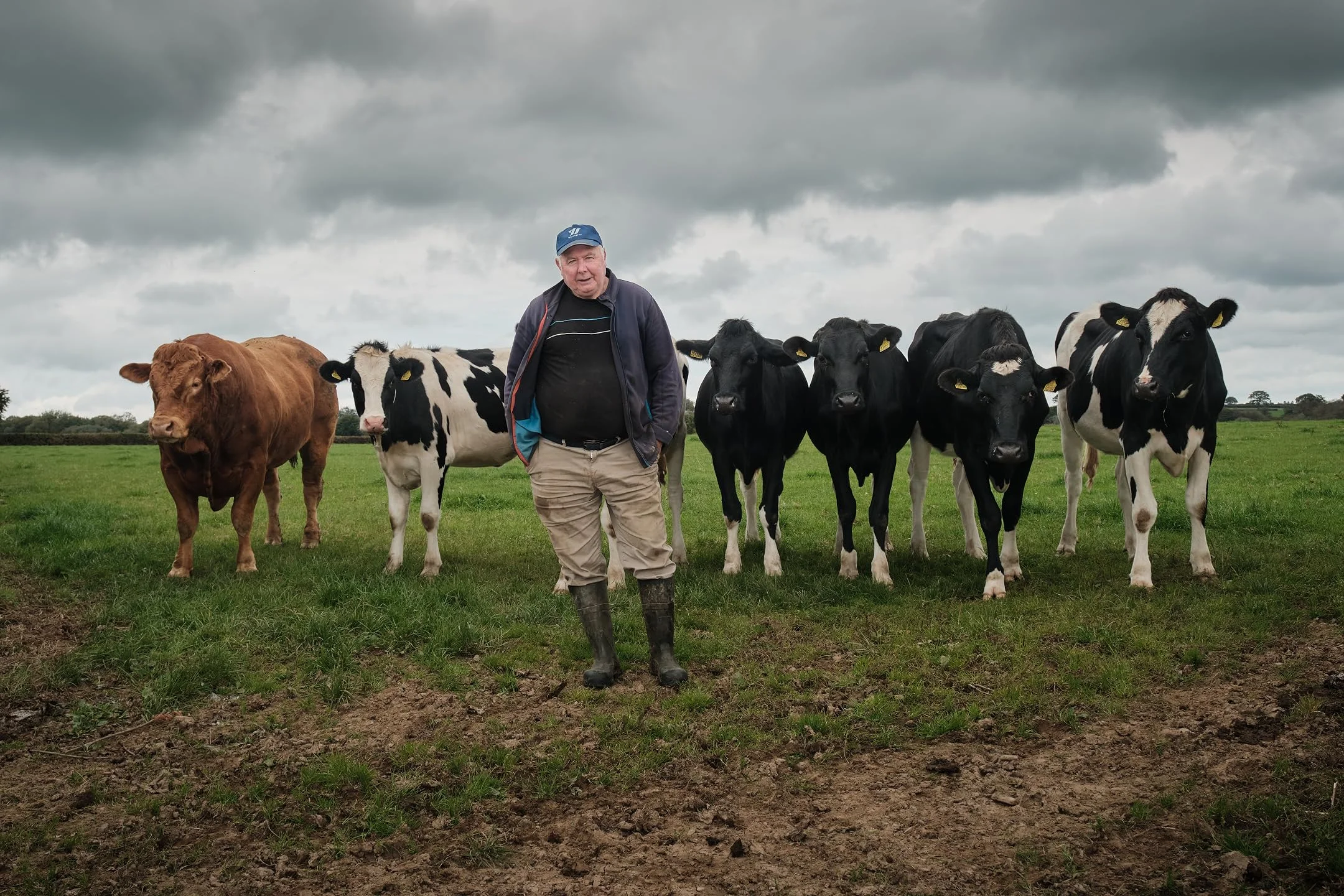
That warmth becomes valuable when the film approaches Banbury’s resistance. Supermarkets keep milk prices low, leaving him under pressure to make his farm pay. His son works beside him, and his wife Linda earns additional income through visitor accommodation. These details give his determination an emotional weight that a simple label such as “intensive farmer” cannot supply. The land carries a family’s expectations. You can disagree with his priorities and still feel the anxiety involved in changing practices when the existing ones barely sustain the household.
Gow’s boar make that anxiety harder to dismiss. Their disturbance of the soil helps his restoration project, but they escape onto neighboring property, where the same behavior becomes somebody else’s problem. The pleasure of watching animals reshape a landscape runs into the discomfort of realizing that the people next door have limited control over the experiment. Dawson lets the creatures remain entertaining without making their disruption harmless. Gow has to retrieve them, and his willingness to do so matters to how we understand his commitment.
The trail-camera footage belonging to farmer Tony Bricknell-Webb sharpens that discomfort. A boar is recorded eating a sheep; the image does not establish that it killed the animal. Gow maintains that the boar consume livestock already dead. It is an ugly enough sight to make the neighbors’ anger understandable, while the uncertainty prevents it from settling the accusation. I appreciated having to hold both reactions at once. Sympathy for Gow’s ambitions survives, but it now includes the practical obligation to keep those ambitions from damaging other people’s livelihoods.
The film’s environmental concern becomes most affecting through a much quieter encounter. Gow turns the pages of a Ladybird wildlife book and identifies species now endangered. A familiar kind of childhood book becomes a record whose contents can no longer be taken for granted. The sadness comes through the act of recognition, species by species. Dawson’s images of water voles, beavers, storks, and dragonflies give that recognition something living to attach to. Their appeal helps us feel what is threatened, rather than leaving ecological decline as a number we acknowledge and quickly forget.
For Banbury, the possibility of changing his mind arrives through something useful: pollinating insects. He and other farmers recognize that insects have become scarcer, giving Gow an argument connected to their own experience. This is where the documentary’s patient attention pays off. Filmed over three years, it has room for resistance to become less absolute without requiring a dramatic conversion. Concern for wildlife finds a point of contact with concern for the farm. The emotional movement feels credible because Banbury has something to recognize, rather than simply a lecture to accept.
The intimacy does leave the larger questions less developed. Milk prices explain some of Banbury’s pressure, and the escaped boar demonstrate a problem of responsibility, but the film offers less help in thinking through how food production and restoration might coexist across a much larger area. Its emphasis on two approachable personalities makes the debate easy to enter while limiting how far we can follow it. I wanted a firmer sense of the arrangements that could support the cooperation it makes us hope for. Affection between neighbors is valuable; maintaining both livelihoods and restored habitats requires decisions beyond their relationship.
Linda’s involvement supplies a modest, tangible example of what cooperation can already look like. Gow’s activities bring business to her accommodation, and she caters a conference held on his land. An enterprise that irritates her husband can also contribute to their household income.
That connection complicates the apparent separation between the farms without dissolving their disagreements. Linda is doing useful work with the people gathered next door, including at a conference where the possible return of wolves is discussed. The practical relationship is already functioning while another difficult conversation about sharing the countryside waits to be had.
Derek vs Derek released in UK cinemas on October 2, 2026. The documentary captures an entertaining rural feud between a passionate rewilding conservationist and a traditional intensive farmer as they clash over land use in the English countryside.
Full Credits
Title: Derek vs Derek
Distributor: Independent Cinema Releases
Release date: October 2, 2026 (United Kingdom)
Rating: 15
Running time: 1 hour 28 minutes (88 minutes)
Director: James Dawson
Writers: James Dawson
Producers and Executive Producers: Adam Wishart, James Dawson
Cast: Derek Gow, Derek Banbury
Director of Photography (Cinematographer): James Dawson
Editors: James Dawson
The Review
Derek vs Derek
Derek vs Derek leaves you fond of two men whose disagreements remain consequential. Its humor and patient observation make environmental concern feel personal, while escaped boar keep the practical costs in view. The editing encourages listening, and the wildlife footage gives ecological loss a living presence. Larger questions about farming and restoration receive less attention, but the neighbors’ gradual accommodation offers hope without demanding a tidy conversion.
PROS
- Affectionate humor preserves both men’s dignity.
- Editing turns separate interviews into meaningful exchanges.
- Wildlife imagery gives ecological loss emotional weight.
- Practical conflicts keep the optimism credible.
CONS
- Limited exploration of food-production economics.
- Few details on coordinating restoration across larger areas.