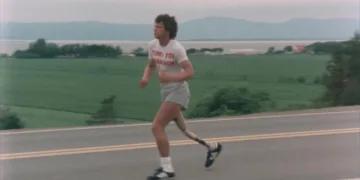









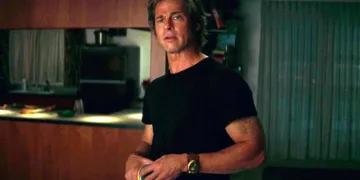



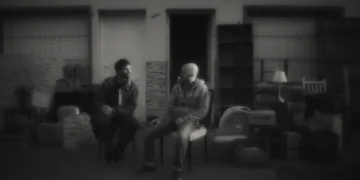















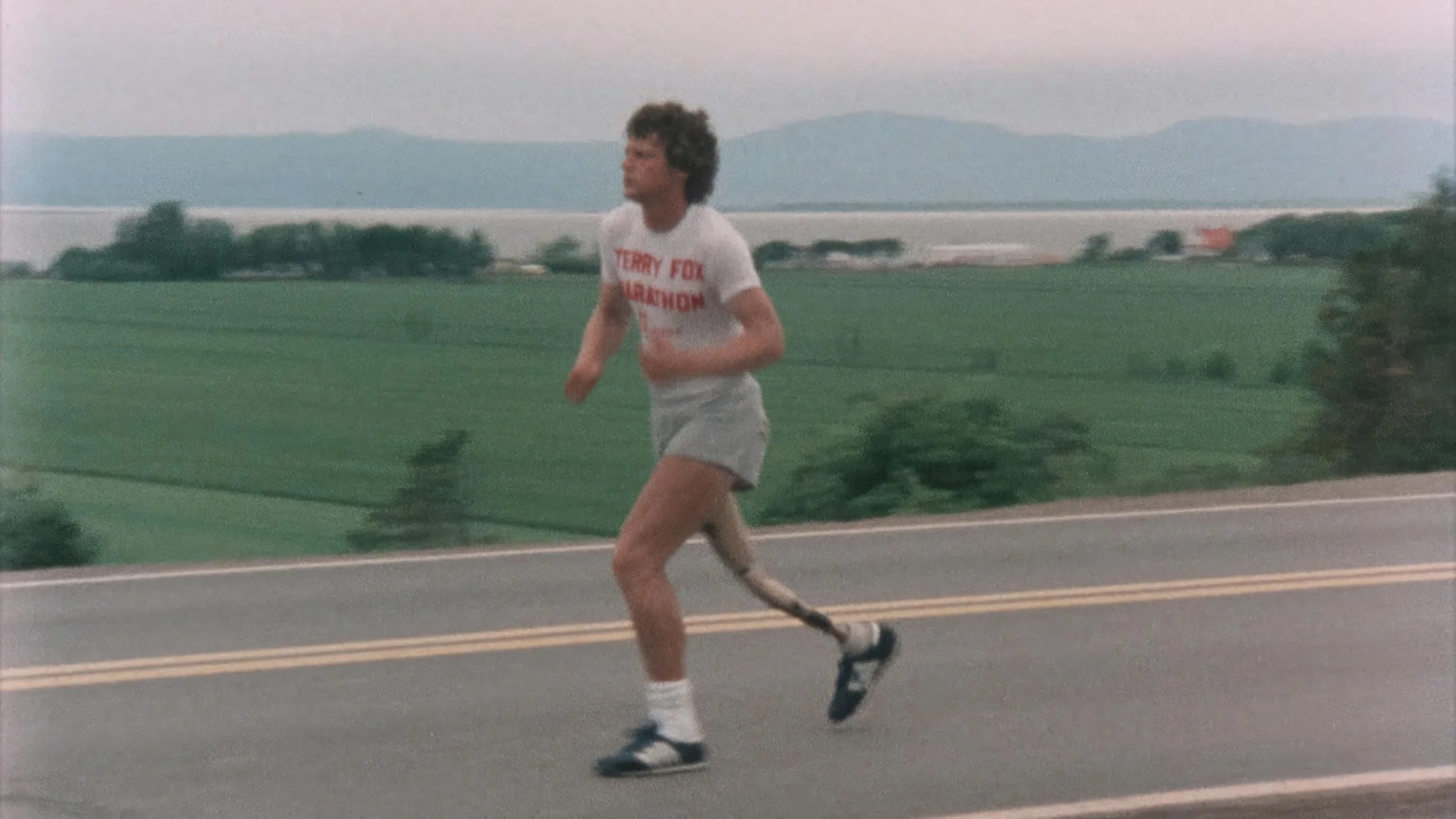

Leslie Scrivener recalls newsroom colleagues telling her that Terry Fox’s daily running was scarcely a story. He would become news when he stopped. Sean Menard places that recollection over footage of Fox preparing to run, giving the supposedly uneventful work a visible physical presence. The editorial judgment sounds especially hollow against a young man getting his body ready for another day on the road. In Run Terry Run, the difficulty of sustaining an undertaking repeatedly collides with the public appetite for an event.
Scrivener’s reporting helps change that relationship. Her modest Toronto Star coverage develops into “Running with Terry,” drawing letters, pictures, and donations. Publicist Bill Vigars organizes opportunities for the campaign to reach people and steers reporters toward its purpose.
Menard makes this work part of the marathon’s history: recognition requires people who can see value in repetition and persuade others to keep paying attention. Yet publicity brings demands of its own. Reporters seeking friction within the supporting camper van turn the exhausted travelling group into potential material for another kind of story. Fox needs coverage to raise money, while the coverage keeps finding reasons to ask for access to him.
The undertaking itself began in St. John’s, Newfoundland, in April 1980. Fox, aged 21 and living with an amputated right leg after bone cancer, intended to cross Canada to fund cancer research. Menard reconstructs the Marathon of Hope through news footage, home videos, family material, and newly recorded recollections from people who accompanied it.
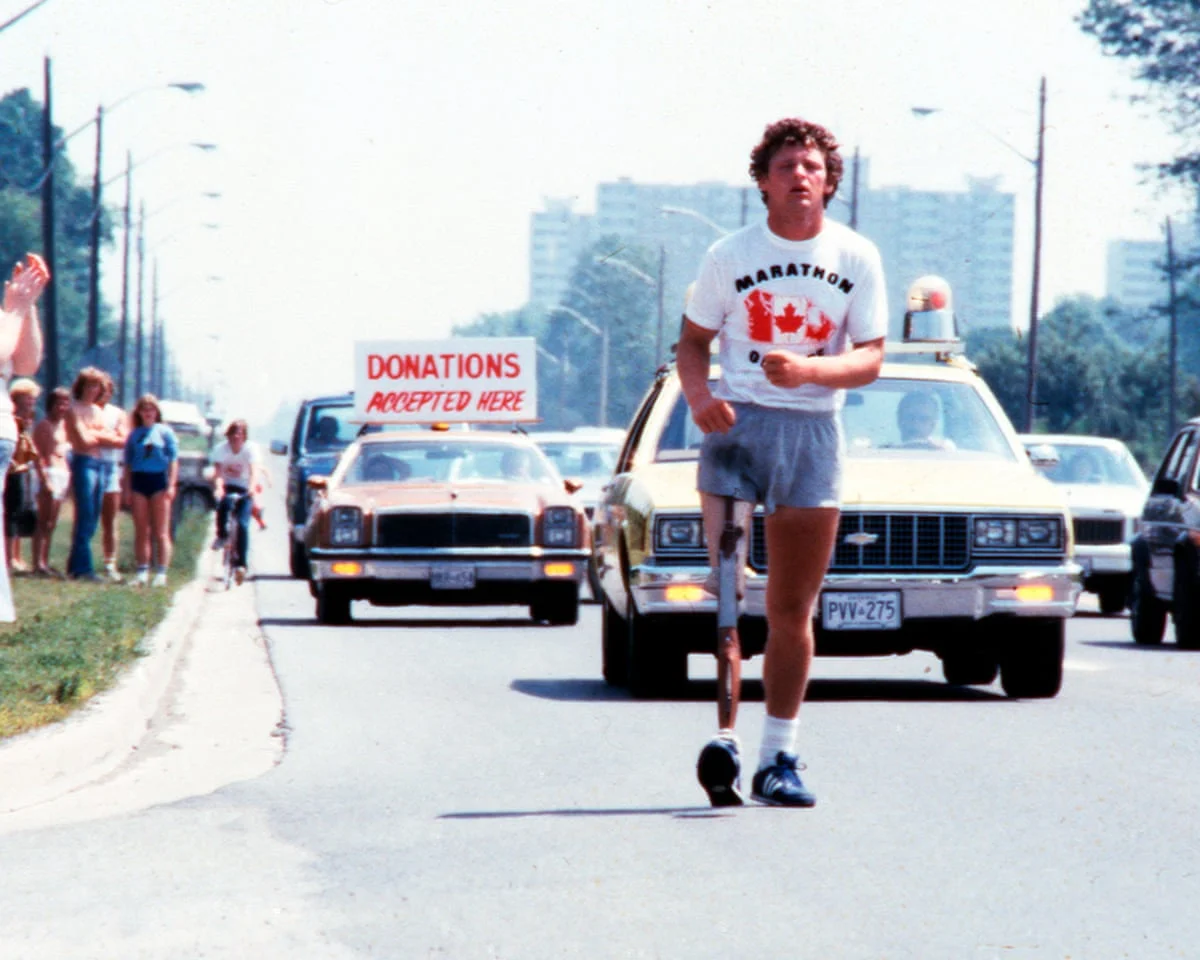
Previously unseen footage by John P. Simpson supplies an especially valuable record of the labour behind the familiar image. Differences in lighting, texture, and camera position keep Fox situated in particular days and places. The archive gives his undertaking a lived unevenness that a commemorative portrait can easily smooth away.
His prosthesis is central to that distinction. Poorly fitted and unsuited to sustained athletic use, it makes the repeated footage of running a record of difficult accommodation between body and equipment. Maritime weather and headwinds add pressures that resolve cannot simply cancel.
These images give the scale of the marathon physical meaning without requiring every stretch of highway to produce a fresh revelation. Returning to the same action can be instructive when the action has to be performed again tomorrow. Fox’s endurance accumulates through repetition, with the road continuing beyond what any individual shot can contain.
Doug Alward’s supporting camper van and Darrell Fox’s presence also restore the practical company behind an image often remembered as solitary. Their accounts describe fatigue and scarce rest, compounded by interviews, speeches, and meetings with crowds. The fundraising depends on a public encounter that consumes energy needed for the next day’s running.
Menard’s most affecting material stays close to this limited reserve. During downtime, Fox spends time with a boy who has also lost a leg to cancer. The encounter gives his stated concern for other patients a specific recipient, allowing care to register through the use of time he could scarcely spare.
Scrivener’s later admission that she withheld information about Fox’s heart being weakened by treatment complicates the film’s account of supportive journalism. She feared that reporting it would damage the story. That decision reveals how protection can become another form of selection: information about his vulnerability threatens the public image that is helping the campaign succeed.
Fox’s sensitivity to coverage questioning his abilities is understandable within this arrangement. A man already encountering doubts about what his body can do has reason to resist further qualification. Menard allows that pressure to become visible, though the film gives the travelling group’s internal strains relatively brief attention. Exhaustion enters the portrait more fully than disagreement does.
The Quebec passages widen the problem of recognition into a question of national belonging. Alward recalls the team’s limited French, while unfamiliarity with the campaign leaves Fox dangerously exposed to passing traffic. These are concrete difficulties of communication.
Menard’s cutaways to Pierre Elliott Trudeau opposing separation during the 1980 referendum invite a larger reading, placing the marathon beside a country’s anxiety about remaining together. The association gives Fox’s reception political significance without establishing a political intention on his part. His own repeated emphasis is cancer research. The film becomes less exact when that purpose is absorbed into the comforting image of a nation discovering itself through him.
The Ontario crowds carry genuine emotional force. People gather along the route and listen to a young man who keeps redirecting attention toward the cause. His resistance to corporate endorsements gives that insistence practical substance. Menard shows collective generosity becoming possible through his visibility, and there is pleasure in seeing attention produce donations and participation.
Across the film’s 108 minutes, however, successive arrivals and speeches begin to confirm an admiration already established. The highway footage can deepen an understanding of sustained effort; another welcoming crowd often supplies the same approval. The distinction matters because the documentary’s strongest passages make familiar material newly legible, while these receptions sometimes leave it familiar.
The score shares that tendency toward reassurance. Its triumphant passages give explicit emotional direction to images whose physical detail already invites a strong response. Menard has assembled footage capable of making preparation, weariness, and contact with another patient eloquent.
Musical reinforcement can reduce the space in which those details acquire their own emotional weight. The film’s affection for Fox is convincing, but its most rewarding discoveries occur when admiration has something particular to attend to. The bodily demands and pressures of publicity sustain a richer portrait than repeated assurances of his inspirational importance.
Fox stops near Thunder Bay after 143 days and over 5,000 kilometres, the cancer having spread to his lungs. He dies the following year. The documentary’s attention to daily activity gives this interruption force even for viewers who know it is coming: the accumulated expectation of another day’s running has to be relinquished.
Near the ending, students resist making sadness the principal response to his life. Their comments shift attention toward participation, allowing later generations a relationship with Fox that includes work still to be done. Menard returns to images of him running as the campaign continues. Those images belong to a life that ended, even as the fundraising passes into other hands.
Run Terry Run wide-releases through Elevation Pictures on October 9, 2026, following festival runs. The documentary presents an intimate look at Canadian hero Terry Fox during his historic 1980 Marathon of Hope, utilizing never-before-seen footage to capture his enduring legacy.
Full Credits
Title: Run Terry Run
Distributor: Elevation Pictures
Release date: October 9, 2026 (Wide release)
Rating: G
Running time: 1 hour 30 minutes (90 minutes)
Director: Sean Menard
Writers: Sean Menard
Producers and Executive Producers: Sean Menard
Cast: Terry Fox, Darrell Fox, Fred Fox, Doug Alward
Editors: Sean Menard
The Review
Run Terry Run
Run Terry Run restores physical effort and personal purpose to an image hardened by commemoration. Its archival detail and account of journalism reveal how Fox’s campaign gained public attention, and what that attention demanded of him. Repeated celebrations, an insistent score, and reassuring national symbolism sometimes soften the portrait’s sharper discoveries. The footage remains deeply affecting, especially when Fox’s concern for other patients gives admiration a concrete reason.
PROS
- Archival footage restores the marathon’s physical demands.
- Journalism becomes an integral part of the campaign’s history.
- Companions’ recollections reveal exhaustion and practical support.
- Encounters with other patients give Fox’s purpose emotional specificity.
CONS
- Repeated crowd receptions add limited insight.
- Triumphant music overdirects the emotional response.
- National unity framing simplifies the campaign’s specific purpose.