



























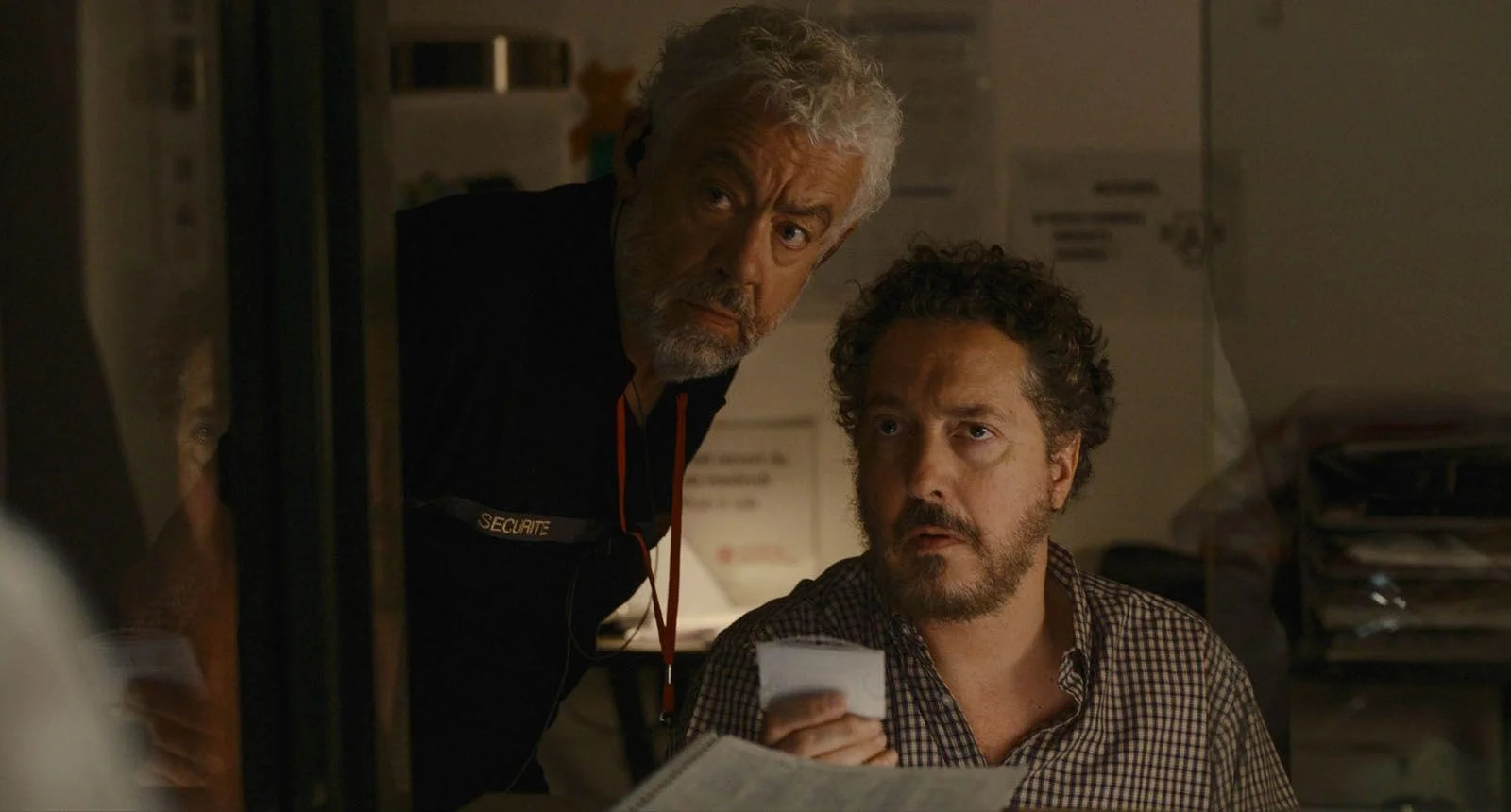

Nina cannot get into the theatre where she is supposed to direct Macbeth. She has forgotten her staff pass, and the security team treats this omission as a firmer reality than her professional existence. Pauline Clément plays the encounter as an early expenditure of patience that will soon become a scarce resource. Before a single piece of scenery malfunctions, the building has established its peculiar distribution of power: the person responsible for the evening can be stopped at the door by people responsible for checking a badge.
Once she gets inside, access gives way to circulation. Martin Darondeau and Bertrand Usclat use the stage, wings, dressing rooms, and foyer to make Comédie Française a comedy of connected spaces and poorly coordinated intentions. The tracking shots give backstage activity a physical continuity that the company’s behavior conspicuously lacks.
People occupy the same building while pursuing separate objectives; Nina must make those objectives converge by curtain time. Camera movement lends coherence to the workplace, encouraging us to perceive a functioning organism even while its members are doing their best to inconvenience one another.
The action stretches from six until nine, with half-hour markers keeping the deadline visible. Clément Ducol’s percussion adds propulsion without requiring the problems themselves to become especially grave. This is the psychology of a countdown: an obstruction acquires menace because time spent resolving it cannot be recovered.
The culture minister’s impending attendance and the €25,000 cost of cancellation tighten the constraint. Nina has nominal authority, but very little freedom to exercise it. Stopping the production would be a decision; keeping it going requires an apparently endless succession of accommodations.
Some of those accommodations are deliciously unreasonable. Christian Hecq’s stage manager can explain a technical difficulty at precisely the length least useful to someone who needs it fixed. Laurent Stocker’s Philippe has his own ambitions for Macbeth, including Nazi imagery, obliging Nina to manage interpretation alongside logistics.
The humor emerges from expertise becoming another obstacle. Both men have something to contribute, yet their contributions increase her burden. Clément’s steadiness is essential here. Her efforts to keep the evening viable give the separate sketches a common emotional destination, even when the surrounding performances threaten to turn the theatre into a competition for comic volume.
The trouble is that the film reaches that volume rather quickly. Nina’s difficulty entering, the actors’ demands, and the sudden absence of Lady Macbeth establish such an emphatic level of dysfunction that subsequent incidents sometimes add congestion rather than escalation.
The missing actress, delayed by television work she has accepted elsewhere, also exposes the screenplay’s willingness to arrange a crisis at the expense of professional credibility. Losing an essential performer three hours before opening should produce a substantial rupture. Here, the vacancy becomes another task for Nina, who must take the role herself. The comic convenience is clear; the company’s relatively easy absorption of the disruption makes the danger less persuasive.
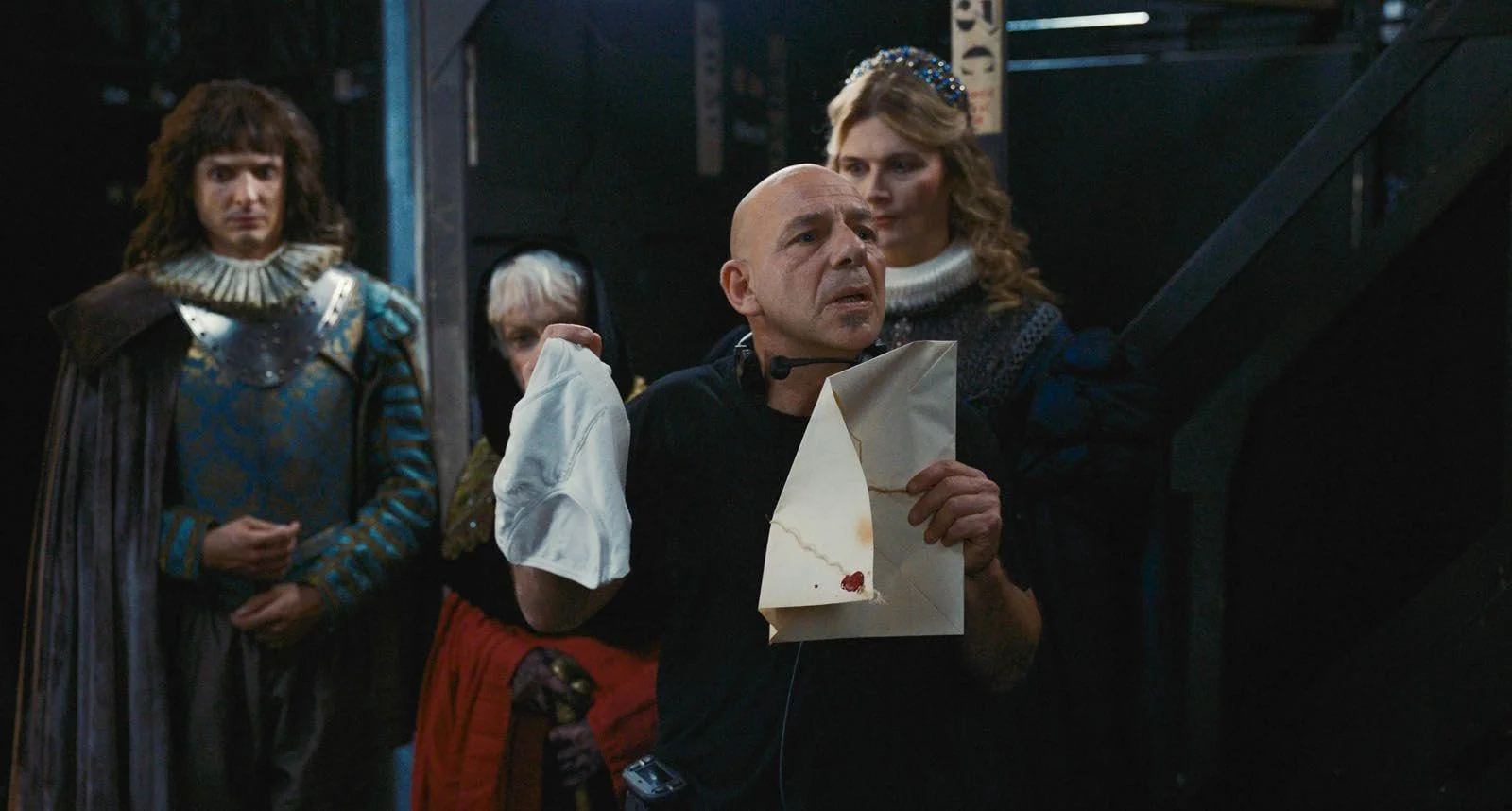
The superstitions surrounding Macbeth offer everyone a less embarrassing explanation. Avoid green. Avoid the title. Blame the curse. Human causes remain readily available: vanity, divided commitments, and a preference for making someone else solve the problem.
This gap gives the theatrical folklore a useful comic function. It allows the actors to imagine themselves subjected to mysterious forces while Nina handles the consequences of identifiable choices. Issa, the usher played by Sefa Yeboah, quietly complicates their professional self-image through his knowledge of the play. Competence has slipped outside the officially designated performers.
The affair between Emilie, played by Marina Hands, and Antoine, played by Julien Frison, gives the film a sharper mechanism of exposure. Their rehearsal and sexual activity overlap, making the supposedly disciplined performance inseparable from backstage appetite.
Then an active intercom carries discussion of the affair into the dressing room of Emilie’s partner, Philippe. Sound disregards the partition on which their secrecy depends. The building that has frustrated Nina now betrays another occupant, and the audience’s knowledge turns an ordinary communication system into an instrument of suspense. We wait for private information to reach the person least prepared to hear it.
Philippe’s disagreeable behavior makes that anticipation morally untidy. Stocker gives us ample reason to enjoy the puncturing of his importance, but arrogance does not cancel the injury of betrayal. The later confession during a blood-pressure check is particularly effective because emotional disclosure interferes with a procedure intended to measure physical distress.
The ambulance nurse becomes an unlikely facilitator of honesty. It is a compact, well-constructed joke, with discomfort built into its operation. The film’s affection for its actors does, however, encourage a swift return from humiliation to collective bustle, limiting how long that discomfort can register.
Nina’s child produces a less easily contained pressure. Her estranged partner brings the baby to the theatre and leaves her responsible for care while she is already directing and replacing Lady Macbeth. The imbalance needs no speech to become legible.
His arrival transfers another obligation onto the person whose time is most thoroughly occupied. Clément keeps Nina’s persistence credible under this accumulation, giving the farce an emotional continuity its exuberant supporting characters cannot supply. Her attempts to reconcile incompatible demands are funny because they remain recognizably difficult, rather than simply eccentric.
The child’s involvement with the hydraulic mechanism for Banquo’s ghost then redirects that difficulty into a physical set piece. It is an apt collision of domestic need and theatrical illusion, and a revealing narrowing of attention. The apparatus gives an unequal arrangement a spectacular expression, but the spectacle soon becomes the principal attraction.
Macbeth’s ghost machinery has found an unexpected practical use; Nina’s problem has acquired another audience. What receives less development is the parental decision that put the child there, leaving her to manage both the equipment and the responsibility that arrived with him.
De la Comédie-Française premiered in French cinemas on July 22, 2026. The comedy follows a chaotic theatrical troupe racing against the clock to save a premiere performance after mounting technical mishaps and stress threaten to derail the show.
Full Credits
Title: De la Comédie-Française (also known as Comédie Française)
Distributor: Zinc
Release date: July 22, 2026 (France)
Running time: 1 hour 15 minutes (75 minutes)
Director: Martin Darondeau, Bertrand Usclat
Writers: Martin Darondeau, Bertrand Usclat
Producers and Executive Producers: Not publicly specified
Cast: Pauline Clément, Guillaume Gallienne, Denis Podalydès, Benjamin Lavernhe, Laurent Stocker, Julien Frison, Suliane Brahim
The Review
Comédie Française
Comédie Française turns backstage circulation, percussion, and an indiscreet intercom into effective instruments of comic pressure. Pauline Clément gives the disorder a credible human anchor. Yet the farce reaches fever pitch too early, and its convenient crises weaken the threat of failure. Betrayal and unequal parental responsibility generate sharp situations, then surrender much of their discomfort to spectacle. An entertaining production with a selective interest in the damage backstage.
PROS
- Clément connects the comic chaos through Nina’s mounting responsibilities.
- Tracking shots make the theatre’s spaces work together.
- Countdown and percussion sustain urgency.
- Intercom disclosure and medical confession produce sharp, uncomfortable humor.
CONS
- Early exaggeration leaves limited room for escalation.
- The missing lead actress strains professional credibility.
- Comic bustle curtails the consequences of betrayal and unequal childcare.