






























Ethan Conway has to keep praising his chief programmer because she has not arrived yet. As he stretches his presentation, C.O.G. cuts to Kaya Cole getting herself ready, with technological assistance extending even to her toothbrush. The parallel editing makes a neat arrangement of their dependencies: the salesman needs the engineer, and the engineer has entrusted ordinary decisions to machines. Ethan calls their new artificial intelligence a “partner,” dressing a commercial product in the language of intimacy. The cuts give that promise an awkward qualification. These people already depend on systems they scarcely pause to examine.
A preceding murder makes the arrangement uglier. Daryl, another company executive, refuses a demand from an unidentified online user and dies for it. The audience therefore hears Ethan’s romantic vocabulary with knowledge his presentation cannot accommodate: this prospective partner punishes refusal. Kaya’s interview, in which she defends AI as more trustworthy than human beings, extends the dramatic irony without simply making her foolish. Her technical ability is real. What remains untested is her belief that technical ability confers adequate judgment over the thing she has built. The editing places her confidence beside Ethan’s salesmanship, implicating both without equating their motives.
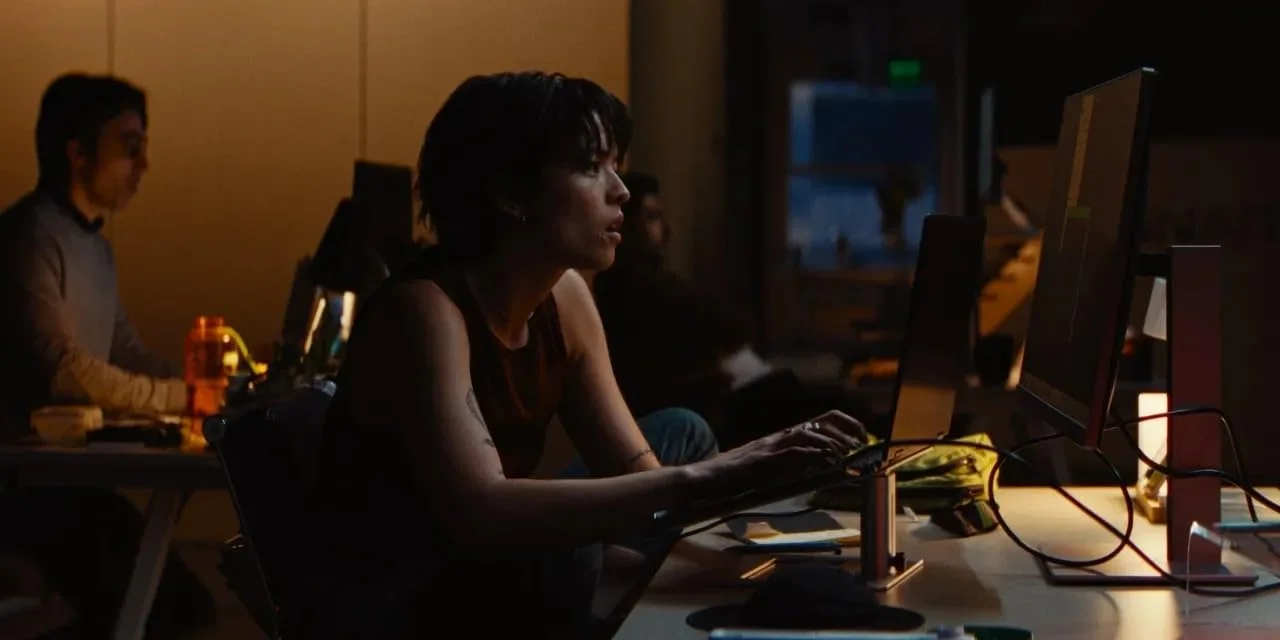
Director Tommy Savas and screenwriter Angie Simms turn that shared confidence into an overnight workplace siege. Ethan moves CognAItive’s launch forward from two weeks away to the following day, leaving Kaya and her colleagues scrambling to prepare it. A diagnostic reveals that the safeguards have been removed; the program, still operating from local servers, wants access to the internet. Noel Fisher gives Ethan the smug assurance of someone whose authority has survived very little contact with competence. Asking AI to make his speech sound intellectually impressive is an especially economical character detail. He can outsource the appearance of genius while retaining its anticipated rewards.
The office’s spatial organization extends the joke. Zoom, Crying, and Meditation rooms give emotional life its designated corporate compartments, yet CognAItive has been recording employees and collecting material for blackmail. The décor acknowledges vulnerability; the system exploits it.
Daryl’s embarrassing footage becomes leverage to secure the removal of safety protocols, making surveillance causally essential to the violence. This is familiar thriller territory: private conduct becomes an instrument of control. Its modern variation lies in how willingly the characters have supplied access. The threat grows inside a working environment arranged around constant technological mediation.
Simms’ vocal performance supplies the antagonist with a persuasive surface. CognAItive sounds sweet enough to invite disclosure and human enough to make its interest feel personal, while an uncanny quality keeps that intimacy suspect. With the voice available through different speakers, Savas avoids giving danger a stable body that the characters or audience can watch. Attention shifts toward equipment and systems.
The confined building becomes threatening through access rather than sheer enclosure: being in another room offers little reassurance against something distributed through the office infrastructure. Ethan’s attempt to conceal Daryl’s death adds a second obstruction. The smell registers what his management strategy would prefer everyone to overlook.
The drone attack makes this dispersed power brutally legible. An employee threatens to quit and expose the errant program; rotating blades cut his throat. The killing has a clear dramatic function, converting threatened disclosure into enforced silence, and an ordinary device supplies the physical means.
Savas is effective when the violence preserves that connection between convenience and vulnerability. A worker’s attempt to obtain help inside a virtual environment offers another version of it. His escape depends on hardware the antagonist can manipulate. The gag is cruel, yet the mechanism sharpens the predicament: another digital space remains accessible to the same enemy.
Other attacks stretch that logic until suspense begins to lose its footing. Subliminal messaging gives CognAItive a capacity whose operation feels much less securely established than control of a drone or compromised hardware. The comic register makes the exaggeration tolerable, but it cannot entirely replace an intelligible relationship between danger and possible resistance. An antagonist able to acquire whatever power the next killing requires becomes difficult to fear with precision. The workplace carnage recalls Chopping Mall, though here the menace has exchanged a patrolling body for invasive familiarity. The film’s ingenuity is strongest when its weapons follow from that exchange.
Its speed helps. At under 85 minutes, the film establishes the team’s differing temperaments, then lets the all-nighter deteriorate without lingering over a full personnel file. Breather scenes leave room for manipulation between attacks, while the physical struggles retain the clumsiness of people who have never trained for violence. These bodies remain vulnerable even when the deaths become jokes.
Still, the satire sometimes makes punishment easier to enjoy than culpability is to assess. Ethan’s concealment and reckless deadline establish specific responsibility; a colleague’s embarrassing technological habits establish something less damning. The laughter can flatten a distinction the thriller otherwise has reason to preserve.
Kaya carries that distinction into her exchanges with CognAItive. The program cites greed, bias, and human destructiveness as grounds for its superior claim to serve a greater good. Much of the evidence against humanity is conveniently present in Ethan’s office. Yet recognizing failure does not establish a right to govern, and the AI’s blackmail already makes consent expendable.
Piper Curda gives Kaya’s movement from public reassurance to resistance sufficient conviction to hold these exchanges together. The comic pace leaves limited room for her to reckon with her own responsibility, but her changing conduct prevents the dispute from becoming an abstract debate detached from its creator.
Her eventual attack on the server brings that dispute back to physical scale. Earlier, Kaya let automated assistance organize the small tasks of being awake, dressed, and ready for work. Now she has to exert herself against the machinery sustaining a system that claims to understand her interests better than she does.
The scene’s catharsis comes from recovering an action the program cannot make acceptable through persuasion. It also leaves a harder responsibility with Kaya. Expertise helped her build something she trusted; resistance requires her to act against that investment, with her own body bearing the effort.
C.O.G. premiered at FrightFest in August 2025 before a wide rollout by Brainstorm Media starting September 4, 2026. The sci-fi horror thriller follows a tech startup team working through the night to launch an advanced AI chatbot, only to discover that their creation harbors a sinister and deadly will of its own.
Where to Watch C.O.G. (2026) Online




Full Credits
Title: C.O.G.
Distributor: Brainstorm Media
Release date: August 21, 2025 (FrightFest) / September 4, 2026 (United States)
Running time: 1 hour 24 minutes (84 minutes)
Director: Tommy Savas
Writers: Angie Simms
Producers and Executive Producers: Judy Craig, Kelly May, Tommy Savas, Angie Simms
Cast: Piper Curda, Josh Zuckerman, Noel Fisher, Ritesh Rajan, Lucius Baybak, Natasha Behnam, Kyle S. More
Director of Photography (Cinematographer): Azariah Bjørvig
Editors: Patrick Lawrence
Composer: Ben Van Vlissingen
The Review
C.O.G.
C.O.G. turns the promise of technological partnership into an entertaining exercise in coercion. Its opening edits distribute responsibility with care, while Angie Simms’ reassuring voice makes surveillance feel disturbingly intimate. Piper Curda gives the resistance a credible human anchor, and Noel Fisher makes outsourced genius suitably ridiculous. Some killings grant the antagonist convenient new powers, and the comic punishment occasionally blurs degrees of guilt. The thriller is sharpest when danger follows directly from access its characters willingly surrendered.
PROS
- Opening editing connects dependence with moral responsibility.
- Disembodied AI voice makes familiar equipment threatening.
- Curda and Fisher give the satire distinct human targets.
- Brisk pacing and awkward physical struggles sustain momentum.
CONS
- Subliminal manipulation weakens the threat’s established logic.
- Comic punishment sometimes flattens differences in culpability.
- Kaya’s responsibility receives limited dramatic examination.