





























“Do you remember a time without cell phones?” asks Sara Robin’s Your Attention Please. It sounds like an easy invitation into a documentary about social media, until you consider how differently its subjects might answer. An adult can summon memories of weekends without notifications.
A teenager has no equivalent reference point. Robin’s question gives older viewers a familiar place to stand, but it also establishes an uneven relationship between the people remembering an earlier world and the young people whose experiences the film wants us to understand.
That difference matters in the early narration about children meeting spontaneously and in the discussion of body-image pressures. Remembered freedom becomes the measure of present damage, with too little room for the pressures that existed before smartphones or the friendships that still exist alongside them.
Social media can intensify insecurity without having invented it. I wanted Robin to make that distinction clearer, because it would strengthen her account of what these platforms have changed. The nostalgic framing makes a complicated historical argument feel deceptively settled before the documentary reaches its strongest evidence.
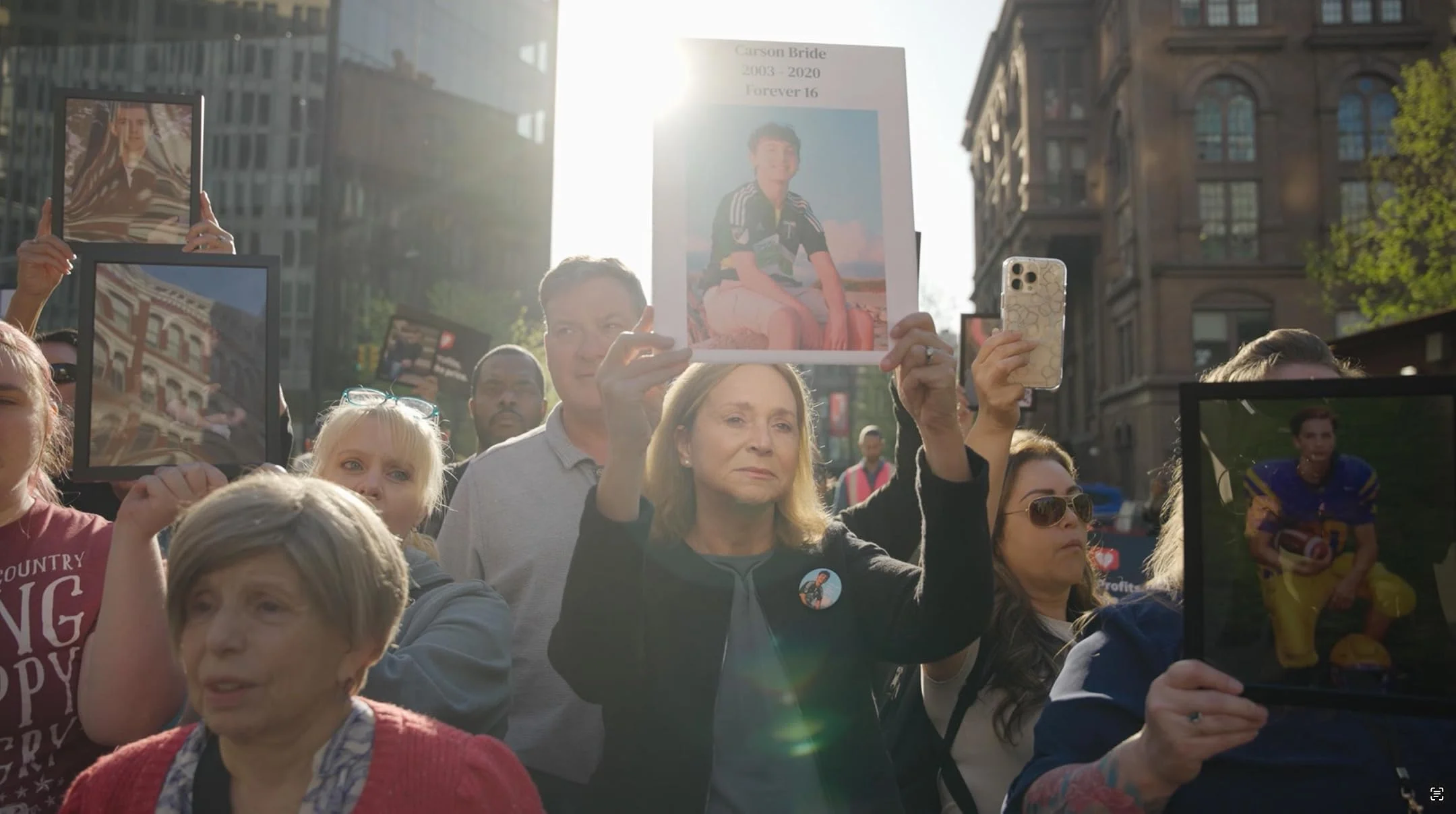
The family photographs, videos, and recollections offer a much firmer basis for attention. Kristin Bride’s son Carson died by suicide after anonymous cyberbullying on Snapchat. Robin includes him within a larger collection of children remembered by the families campaigning against online harm. These domestic records serve an important documentary function: they restore some of the life that a report of a death necessarily leaves out. We encounter children through the people who knew them, and the accounts acquire a specificity that statistics alone cannot supply.
Kristin’s continuing advocacy gives that material a direction. Her legal action and public campaigning turn the documentary toward choices being made now, allowing grief and activity to occupy the same story. Robin has someone to follow through an effort whose outcome remains uncertain.
That makes Kristin’s presence especially valuable to the film’s construction. Her motivation is immediately understandable, while the obstacles she encounters require explanation. The documentary can move from a family’s experience into questions of platform responsibility without abandoning the person who made those questions urgent.
The Senate hearing extends that movement with considerable force. Families holding photographs of their children bring the private records into a public proceeding attended by technology executives. The images now have a second function: they identify the people absent from a discussion conducted in the language of corporate responsibility.
Zuckerberg’s responses and Frances Haugen’s disclosures about Facebook’s knowledge of harm give the encounter an argumentative dimension beyond its emotional weight. Still, the scene’s power should not be confused with a completed reckoning. Making executives face the families is an observable event. Securing changes that protect other children remains a separate, unfinished action.
Robin surrounds these encounters with a busy visual presentation. Multi-screen arrangements, which place several images before us at once, draw the eye in competing directions; animation adds to the documentary’s energetic surface. There is an understandable practical choice here.
A film asking a wide audience to reconsider its attention habits must hold that audience long enough to explain them. The presentation avoids the feeling of a filmed lecture, while interviews with Vivek H. Murthy and Tristan Harris contribute explanatory material. The larger difficulty lies in how Robin assembles subjects that ask for very different kinds of attention.
The Offline Club passages make that difficulty visible. Participants at events in the Netherlands put away their phones and spend time with other people. These scenes offer relief, and it is useful to see an alternative enacted instead of merely recommended. Yet the movement between such recreation and the bereaved families is sometimes jarring.
Editing establishes an emotional relationship between subjects even when they are connected by a shared topic. Here, the club’s manageable experiment can feel too lightly attached to the parents’ demand for accountability. Both concern social media, but their immediate stakes and their capacity to change anything are quite different.
Trisha Prabhu’s ReThink provides a more precise connection between explanation and intervention. The system asks someone composing a potentially cruel message to reconsider before posting it. What interests me is the tiny change in the sequence of an action.
Writing a message no longer leads straight to sending it; a pause gives its author a chance to recognize the effect on another person. Robin presents this as a practical way to reduce bullying, and it complicates the film’s early longing for a less technological world. A designed digital intervention can help interrupt conduct enabled by another digital design.
The classroom restrictions instituted by Brockton High School principal Kevin McCaskill work at a different scale. Robin presents the policy as successful, showing that a shared environment can establish expectations which individual students need not negotiate alone. Set beside ReThink and the Offline Club, it helps reveal several distinct approaches: interrupting an impulsive act, changing the rules of a school day, and choosing a temporary social space without phones. The film is useful when those differences remain visible. Its collection of remedies becomes less persuasive when an enjoyable opportunity to unplug seems to carry the same weight as a sustained institutional change.
The later extension into AI chatbots puts another demand on this already crowded argument. The subject fits Robin’s concern about systems built to retain attention, but it broadens the inquiry just when the documentary has several unresolved strands in play. I was less interested in another warning than in further development of the interventions already introduced. ReThink has given us a specific action to examine. The chatbot material expands the field of concern without providing an equally precise account of how the problem might be addressed.
That problem of scale remains active in the film’s account of the Kids Online Safety Act passing the Senate and then stalling in the House. The legislative strand requires the documentary to follow a process that cannot be completed through personal restraint or a local rule.
Kristin’s campaign keeps that distinction tangible. She can pursue legal action, testify, and make Carson’s experience publicly known; the next decision belongs to institutions she is trying to persuade. Robin’s story reaches a point where the determination of the person we have followed continues, while the mechanism capable of answering her remains stalled.
Your Attention Please premiered on the festival circuit in 2026 before heading to digital platforms like Amazon Video. The documentary feature explores the pervasive influence of addiction-engineered technology, tracking a new generation challenging exploitative digital platforms to reclaim human connection.
Where to Watch Your Attention Please (2026) Online




Full Credits
Title: Your Attention Please
Distributor: Amazon Video
Release date: 2026 (Brooklyn Film Festival)
Running time: 1 hour 38 minutes (98 minutes)
Director: Sara Robin
Writers: Jack LeMay
Producers and Executive Producers: Dan Kennedy
Cast: Sherry Turkle, Tristan Harris, Frances Haugen, Vivek Murthy, Kristin Bride, Trisha Prabhu
The Review
Your Attention Please
Your Attention Please earns its urgency through Kristin Bride’s advocacy and the family records that give its arguments human specificity. Sara Robin makes practical interventions such as ReThink easy to understand, showing how a small design choice can interrupt harmful behavior. The nostalgic opening oversimplifies the past, while uneven tonal shifts and an underdeveloped expansion into AI dilute the film’s focus. Its strongest passages make the distance between public testimony and institutional action painfully clear.
PROS
- Family photographs and memories preserve the children’s individuality.
- Kristin Bride’s advocacy gives the documentary narrative direction.
- ReThink and classroom policies provide concrete examples of intervention.
CONS
- Nostalgic framing oversimplifies life before smartphones.
- Offline Club passages create jarring shifts from parental grief.
- AI chatbot material expands the argument without sufficient development.