





























In wintry Poland, police enter an immigrant family’s home through a camera mounted on an officer. Tzina is apprehended; later, an excavator lowers her into water while a crowd cheers. The machinery belongs to the present, the punishment to a witch persecution.
Carlos Reygadas’s Heil Jupiter! makes these periods coexist without explaining how one has become the other. Recording equipment and heavy machinery give an old ritual of exclusion new instruments. The Polish setting matters because the violence targets an immigrant household, locating persecution within a recognizable dispute over who is permitted to belong.
When Lina faces Mexican authorities on accusations of witchcraft and forbidden sensual pleasure, the film carries that punitive logic across an ocean. Its linguistic choices complicate the transfer. Much of the dialogue uses an invented language, stripping speech of the accents and idioms through which we usually locate people socially.
Spanish survives in portions of the trial, returning a particular cultural foothold to this Mexican filmmaker’s dispersed world. Yet comprehensible language accompanies an absurd prosecution. Translation allows us to understand the charge without making the charge reasonable. Between Poland and Mexico, Reygadas finds a shared mechanism of punishment, though the histories separating these places remain largely outside his attention.
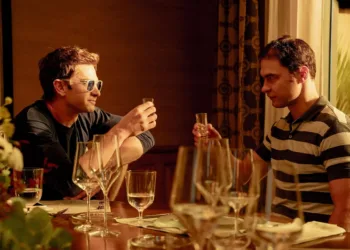
That abstraction has a cost, since immigrant exclusion and sexual persecution risk becoming interchangeable expressions of cruelty. It acquires greater force when the film gives us something precise that authority threatens. Lina, Tzina, Milu, and Said first encounter one another beside a turbulent sea, their naked bodies moving between water and mutual touch. Milu’s hesitation at Said’s approach, followed by his relaxation, gives this freedom a human scale. Permission develops between two people. Their intimacy does not need the sanction of an institution, and its small adjustment of trust supplies firmer emotional ground than the later procession of accusations.
The seaside passage also establishes a way of seeing that the police footage will disturb. After abstract flashes of color and sound, waves strike toward the camera for an extended stretch. The nearly square frame and short focal lengths make proximity difficult to escape, while beveled edges double or blur portions of the image.
We experience bodies through a vision that cannot keep them neatly separated from their surroundings. The firelit cave extends this sensual world through collective movement and sexual contact. These passages can be taxing in their duration, but they establish an experience of physical life before the state converts its pleasures into prosecutable acts.
The camera’s anatomical passage into a male body pushes that proximity into deliberate provocation. A comparison with 2001: A Space Odyssey is useful for the abrupt change of scale: Reygadas makes an interior organ the passage toward an apparently expanded reality.
The gesture is comic, invasive, and difficult to absorb into a solemn account of transcendence. It also raises a question that persists through the film’s different image formats. How much access does a camera acquire simply because a body is available to it? Sexual openness, medical inspection, and compulsory recording will offer sharply different answers.
Through the officer’s camera, that access becomes coercive. The image takes us into the home with the force entering it; the family’s privacy is breached from the position of the intruder. This gives the raid a disturbing immediacy, but immediacy is already politically organized.
We see what the apparatus can reach. Moving from sensual photography to police recording changes the relationship between the spectator and Tzina’s body before the public punishment begins. Her exposure has become something imposed and circulated. The crowd at the water supplies another mode of spectatorship, turning the enforcement action into an occasion for collective participation.
Ms. Trueba’s medical consultation interrupts this movement toward bodily domination. Discussing three previous breast operations and requesting another, she brings a particular wish into a setting equipped to examine and alter her body. The doctor’s attention develops into an embrace, allowing clinical curiosity to acquire warmth.
The scene’s tenderness comes from that change within the encounter. It gives a trans woman room to express desire without making her body serve only as evidence of persecution. The examination still contains an unequal relation between the person looking and the person being looked at, but the embrace makes that relation less settled than the police camera’s command.
The factory processing human body parts removes such reciprocity. Legs meet band saws; flesh enters a procedure indifferent to the person from whom it came. Beside the consultation, this is a particularly brutal change in the meaning of bodily attention.
Extreme close-ups of a piglet’s birth further unsettle the distinctions through which the film organizes human and animal life. Yet the accumulation begins to flatten some of its own discoveries. Birth, chosen alteration, sexual contact, and dismemberment each carry different stakes. When all become occasions for visceral astonishment, their differences can lose the specificity that made Milu’s hesitation or Ms. Trueba’s request affecting.
The soundscape opens another route through this uncertainty. Layered sound and occasional choral or operatic passages give the physical world a scale the human figures cannot contain. Fighter jets pursuing a mysterious earthly sound turn that excess into a target: military technology attempts to locate something it cannot readily comprehend. Nighttime fires across a mountain offer a similarly unstable encounter between beauty and threat.
These passages retain their power without a decoded cosmology. The uncertain identity of the forces governing this world leaves room for experience beyond its institutions’ classifications, even as the film repeatedly returns us to those institutions’ violence.
At 158 minutes, however, Heil Jupiter! asks its associative method to sustain a substantial burden. The prolonged trial makes its limitations clearest. Recorded courtroom views multiply across the screen, reproducing an administration of justice that acquires images while failing to establish a defensible basis for judgment. The form is apt, but extended dialogue and further panels do not consistently change our understanding of that failure.
Accusation persists; exposure expands. The scene’s length starts to reproduce the viewer’s captivity without giving each stretch a distinct pressure. Earlier shifts between Poland and Mexico made repression travel. Here, the film spends too long confirming the reach of an apparatus whose character is already clear.
The trial gains a fresh consequence when surveillance threatens people beyond Lina, including Milu and Said. Their earlier intimacy now carries the possibility of becoming evidence against them, altering the meaning of gestures we first encountered as exchanges of trust. The invented language had loosened their attachment to a particular society, but the courtroom restores a frighteningly familiar condition: private conduct can be translated into an accusation. The friends’ freedom becomes difficult to imagine continuing, since any future touch may have to account for an unseen spectator.
Heil Jupiter! had its world premiere at the New York Film Festival on September 27, 2026. The surreal drama follows two young couples navigating shifting realities on a remote coast while an unseen entity watches from above.
Where to Watch Heil Jupiter! (2026) Online
Full Credits
Title: Heil Jupiter!
Distributor: mk2 Films
Release date: September 27, 2026 (New York Film Festival)
Running time: 2 hours 38 minutes (158 minutes)
Director: Carlos Reygadas
Writers: Carlos Reygadas
Producers and Executive Producers: Cristina Velasco, Carlos Reygadas
Cast: Morgan Krantz, Mónica Calle, Neli de la Rosa, Alexis Sánchez Alonso, Flor de León, Alexis Said Villa de León
Director of Photography (Cinematographer): Daniel Valdes
Editors: Carlos Reygadas
The Review
Heil Jupiter!
Heil Jupiter! carries persecution between Poland and Mexico through invented speech, exposed bodies, and cameras that turn intimacy into evidence. Its strongest encounters preserve the differences between trust, curiosity, and coercion. Elsewhere, bodily spectacle blurs those distinctions, while the prolonged courtroom sequence repeats an argument already established. Reygadas’s sensory imagination remains arresting, but the film’s international reach sometimes sacrifices the cultural specificity that gives its violence force.
PROS
- Immersive seaside imagery and layered sound.
- Police footage makes the viewer’s position politically charged.
- Intimate gestures give bodily freedom human specificity.
- Invented language and surviving Spanish complicate cultural interpretation.
CONS
- Different forms of persecution sometimes lose cultural specificity.
- Accumulated bodily spectacle flattens distinct experiences.
- The extended trial repeats established pressures.