






![Kingdom Hearts Collection [I-III] Review](https://gazettely.com/wp-content/uploads/2026/10/Kingdom-Hearts-Collection-I-III-1-360x180.webp "Kingdom Hearts Collection [I-III] Review: KHII Holds Steady as Newer Entries Fluctuate 36")






The teenage Alfred likes having a plan. During the 1974 hike that introduces his relationship with Audrey, his preference for routines sits beside her willingness to let a day develop without deciding everything beforehand. Their tentative attraction gives that difference an affectionate setting, but Forever Ago keeps returning to it across their marriage. Audrey’s insistence that life cannot be planned eventually becomes a difficult proposition for a man accustomed to organizing his way through uncertainty.
Decades later, Alfred’s irritation at a changed diner has the same recognizable shape. The pecan muffins are gone, and he treats their absence as another objection to the present. At the convenience store, a talkative clerk named Milton interrupts his recollections, provoking a sharp response. These encounters establish how badly Alfred wants familiar places to behave according to his memories. His wife has died, leaving a journal of activities for him to complete on a camper van trip. Even with instructions to follow, he cannot make the places they loved return to their former condition.
Third Shift builds its approximately four-hour adventure around those discrepancies. Alfred visits a location in the present, while playable flashbacks establish what happened there during the couple’s life together. The structure gives his unpleasant behavior a history without making every outburst reasonable. It also avoids leaving Audrey entirely inside his account of her. Their disagreements, her drawings and notes, and the hesitant chemistry of their courtship give her preferences that exist independently of his grief. The voice performances are especially effective in that early awkwardness, when affection has to emerge through two people still unsure of each other.
The risk is that Alfred’s hostility can become familiar grumpy-old-man shorthand. Snapping at people offering assistance is an efficient way to communicate withdrawal, but repeating it does less to distinguish him. His younger attachment to predictability supplies a stronger explanation than age alone.
Later, his willingness to open up to a fellow hiker gives the arc a concrete change in behavior. The stray dog accompanying him also creates opportunities for companionship, though using it as an audience for his recollections sometimes lets the dialogue explain feelings the changed surroundings have already established.
For players familiar with What Remains of Edith Finch, the important comparison is how interaction contributes to an authored story. Limited choice need not prevent a narrative adventure from making participation expressive. Forever Ago finds its clearest answer in the instant camera.
The prologue initially lets us look through Audrey’s viewfinder, learning to zoom, focus, and take photographs before Alfred receives the camera and the perspective largely shifts to third person. Photography passes between the couple before becoming part of his solitary return to their shared places.
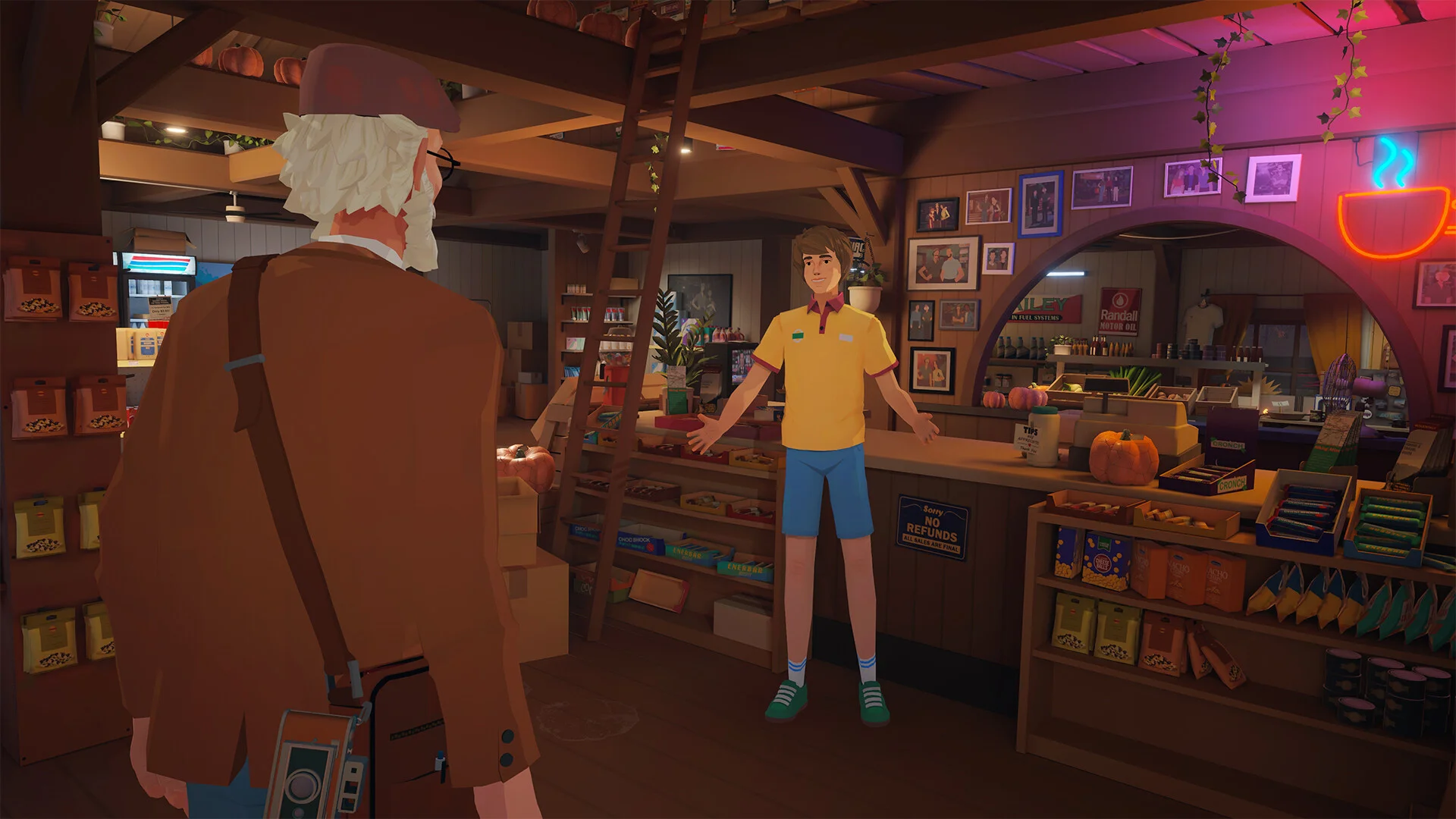
Taking pictures offers a small but useful freedom within the prescribed itinerary. After each chapter, four photographs can be selected for the journal, allowing the player to decide what deserves a place beside Audrey’s existing record. The painterly forests, deserts, and snowy mountains give that selection attractive subjects.
Warm light around the youthful hike supplies a different visual texture from the fractured, flower-covered home of Alfred’s dream sequences. Photographing these surroundings makes looking an activity, and choosing images gives the player some authorship over the record without pretending to change Alfred’s larger story.
The optional memories serve a different purpose. Finding clusters of flower petals reveals fragments that can be assembled through the camera into a fuller vignette. At Karl’s convenience store, these scenes establish the couple’s ease together, turning a remembered business into somewhere their relationship could develop.
Their value also exposes a structural compromise: some useful characterization depends on searching off the main path. Meanwhile, placing petal clusters close together can make the collection process feel arbitrarily divided. The memory rewards attention; the steps required to unlock it do not always deepen that attention.

Small persistent choices, such as selecting the van’s color or naming the dog, extend this sense of personal involvement. Dialogue options mostly adjust an exchange’s flavor rather than redirect events. That scale suits a story about revisiting an established life, though the camera’s limited effect on other people is less convincing. NPCs often fail to react to being photographed. Compared with narrative adventures whose interactions make the player’s presence consequential, Forever Ago offers stronger ownership of the scrapbook than responsiveness from the world being recorded.
Its slow pace needs a similarly selective assessment. Walking between journal activities can leave time for a memory to settle, particularly when a quiet passage follows an emotional scene. Alfred’s body also makes speed a matter of characterization.
The prolonged mountain ascent in Journey offers a useful comparison: movement can communicate difficulty through the time and effort it demands. A late passage in Forever Ago, where Alfred physically struggles forward, gives that duration a specific emotional purpose. The player spends time inside an effort that a brief cutscene would compress.
That argument does not justify every extended walk or the lengthy rowing sequence. Returning across an area to complete another objective can consume time without changing our understanding of the place. Rowing introduces an activity, but clumsy controls make it difficult to experience the passage simply as reflective space.
Watering flowers and opening routes with bolt cutters provide other modest tasks, yet they rarely develop into sustained problems to solve. Against its genre peers, the game is uneven at distinguishing time spent absorbing an experience from time spent waiting for it to proceed.

Unreliable interaction prompts make that distinction harder still. Approaching an object is sometimes insufficient; Alfred’s position and the camera angle must align precisely before the button prompt appears. The bolt-cutter interactions provide a particularly clear example of a simple action becoming awkward to activate.
Instead of attending to the place and its associations, the player adjusts the viewpoint to persuade the interface to acknowledge an obvious intention. Frame-rate drops during camera rotation on base PS5 add another interruption, while distant-sounding voices and dialogue competing with music can obscure the conversations carrying the story.
Infrequent autosaves impose the most damaging form of repetition. A restart after a bug can send the player back through a substantial stretch of an already slow adventure. The journal allows photographs to be revisited by choice, with the player deciding which details deserve another look.
Lost progress requires a different return: scenes and activities must be repeated before the trip can continue. Material first encountered with curiosity becomes a sequence whose next development is already known, leaving the player waiting for Alfred to catch up with what they remember.
The Review
Forever Ago
Forever Ago builds a touching portrait of marriage through Alfred’s difficult return to familiar places. Its camera and customizable journal give players a modest stake in remembering, though interaction rarely achieves the expressive range of the genre’s strongest adventures. Slow movement sometimes carries real emotional weight; elsewhere, awkward prompts, clumsy activities, and lost progress strain that patience. Alfred and Audrey’s relationship deserves the attention the game asks for. Its execution makes giving that attention unnecessarily difficult.
PROS
- Past-and-present structure develops both Alfred and Audrey.
- Photography gives the journal a personal character.
- Painterly environments reward attentive exploration.
- Key passages connect physical effort with emotion.
CONS
- Unreliable interaction prompts and awkward rowing controls.
- Uneven pacing turns some activities into errands.
- Infrequent autosaves force substantial repetition.
- Frame-rate drops and difficult-to-hear dialogue interrupt immersion.