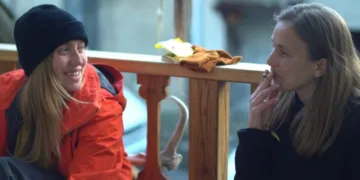
















The flatter paths through the mountains near Montgenèvre are easier for families to walk, and easier for police to watch. Higher routes offer concealment beneath heavier snow, where hours of walking can end in frostbite or hypothermia. This practical calculation governs Juliette de Marcillac’s Nightwatchers, a documentary accompanying volunteers who assist migrants crossing from Italy into France. Before the film asks anything of its audience’s compassion, it establishes how the terrain is being used. A mountain’s dangers acquire a different meaning when people climb further into them to avoid being found.
De Marcillac briefly interrupts her observational approach with white text against a black screen. In silence, the film explains that people entitled to request asylum on arrival are being returned to Italy before they can apply. The intervention is blunt and necessary. It supplies a cause that images of exhausted bodies cannot establish alone. Without it, the snow could become an all-purpose explanation for suffering, leaving the practices that drive people towards higher routes outside the frame. The documentary’s account makes the distance between a stated right and the opportunity to exercise it measurable in cold, altitude, and damaged feet.
That damage also exposes the limits of an apparently simple humanitarian encounter. A volunteer recalls approaching a man who mistook the helpers for police and refused to trust them. Problems with his shoes led him to continue downhill in his socks; when she saw him later at the refuge, his feet were swollen and he had nearly lost them. The story troubles any easy satisfaction in the presence of good people. Assistance has to be recognized before it can be accepted. Here, the fear of interception reaches into an encounter with someone offering help, with consequences that remain after the misunderstanding has passed.
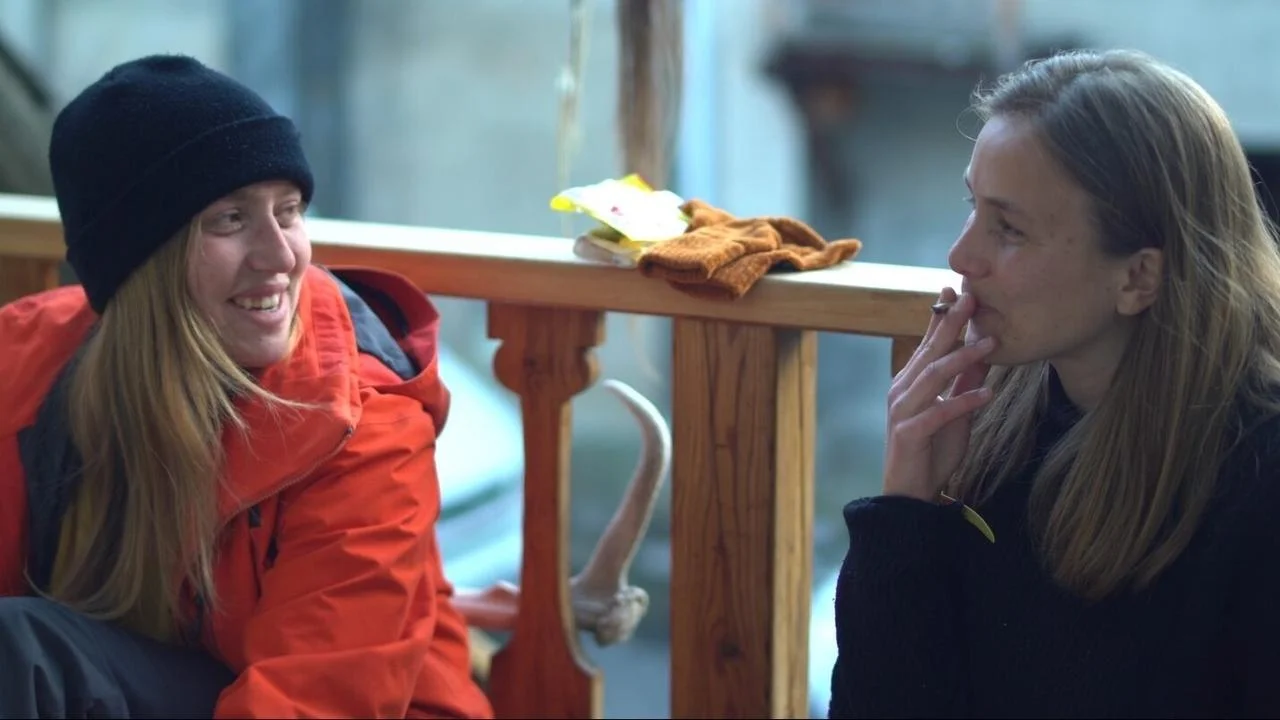
The film is particularly attentive to what assistance requires before such encounters happen. Volunteers fill a thermos, take vitamins, and travel to their shifts. These preparations give their work an ordinary texture without diminishing its difficulty. Tea has to be made; warm clothing and medical supplies have to reach the mountain; someone has to wait in the right place. People associated with Médecins du Monde appear as workers making care available under difficult conditions. Their commitment becomes tangible through these arrangements, and through the hot water and space blankets offered to people who have spent hours exposed to the cold.
Their exchanges with police resist a completely uniform portrait. Some encounters remain relatively civil, with volunteers prepared to produce identification; other experiences involve intimidation and accounts of hostility. De Marcillac allows those differences to remain visible without making individual courtesy an answer to the film’s central problem. A polite identity check does not make the higher path safer.
Florian Berthellot’s camera makes visibility itself a source of suspense. People need to be located by volunteers while remaining concealed from patrols, and the same movement in the dark can carry either possibility. Whispered exchanges and long periods of waiting make the searches tense without requiring a constant procession of emergencies. Handheld footage registers the difficulty of remaining close to events whose direction cannot be controlled. The restricted view also leaves the audience dependent on the helpers’ incomplete knowledge: someone may be nearby, injured, afraid to approach, or already intercepted.
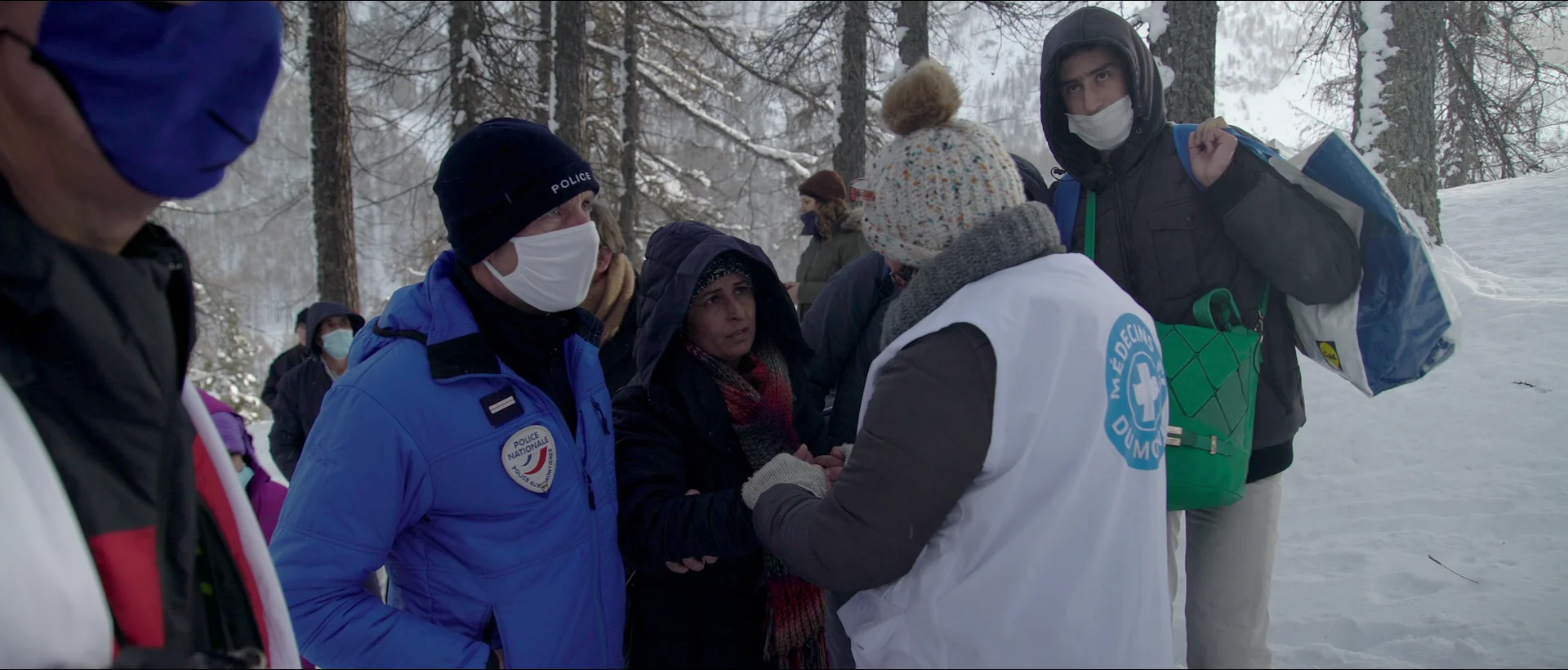
A hillside encounter concentrates these pressures. From a distance, the camera watches people moving towards a waiting car before another vehicle arrives. Some flatten themselves against the incline. An officer identifies people below, while a volunteer explains that they need hospital treatment. De Marcillac then cuts to a Montgenèvre resort sign partly submerged in snow, withholding further dialogue from the confrontation. The edit connects the immediate dispute over access to care with the place’s advertised identity. The resort remains legible and recognizable while the people beside it are trying to escape notice.
Elsewhere, camera movements from exhausted travellers towards gondola lifts and colourful advertising make tourism part of the film’s geography. The comparison needs no claim about the private attitudes of every skier or resident. The visible infrastructure already establishes how thoroughly this difficult terrain can be organized for comfort and recreation. Against it, migrants’ exposure ceases to look like an unavoidable property of mountain travel. Warm valley lights, seen from the cold blue slopes, mark shelter close enough to perceive without establishing that it is accessible to those watching from above.
The landscape photography sometimes holds this relationship with precision, and sometimes stays with its beauty after the point has registered. Repeated views of villages and mountains ease the pressure generated by the searches without always giving that pause a fresh purpose. Oiseaux-Tempête’s slow drums and guitar chords sustain a subdued melancholy, but the combination of attractive scenery and mournful music can make a difficult situation too available as atmosphere. The film is sharper when an image specifies a distance, an obstacle, or a nearby refuge than when it invites prolonged contemplation of the Alps.
Much of its knowledge nevertheless comes through people who can leave the mountain after their shift. Accompanying volunteers in cars and during preparations gives the documentary valuable practical access, while keeping migrant lives more intermittently within reach. The late audio testimony changes the scale. Speakers connect these snowy crossings with earlier passages across seas and deserts, describing risks that precede this local network of assistance. They become interpreters of their own circumstances, extending the film’s understanding beyond what a search party can witness.
The final daylight views arrive after those accounts. Snow and mountain contours are easier to see, but the testimony has made this stretch of terrain part of a much longer passage. The brightness supplies no information about permission to remain, reunion with family, or the next place to sleep.
Nightwatchers premiered at the Visions du Réel International Film Festival on April 21, 2023, and has since been featured on the international festival circuit. Directed by Juliette de Marcillac, the documentary offers a striking look into the daily realities, struggles, and quiet resilience of young activists and volunteers navigating systemic pressures.
Full Credits
Title: Nightwatchers (French: Gardiens de la nuit)
Distributor: Terratama, Visions du Réel
Release date: April 21, 2023
Running time: 1 hour 12 minutes (72 minutes)
Director: Juliette de Marcillac
Writers: Juliette de Marcillac
Producers and Executive Producers: François d’Artemare, Hélène Badinter
Cast: Not publicly specified
Director of Photography (Cinematographer): Juliette de Marcillac
Editors: Martial Salomon
The Review
Nightwatchers
Nightwatchers makes the dangers of an Alpine crossing inseparable from the enforcement practices shaping its routes. De Marcillac’s attention to practical care, damaged trust, and the risks of being seen gives the documentary political precision and emotional weight. Repeated scenic passages occasionally soften its urgency, while migrant perspectives remain less consistently accessible than the volunteers’ work. Its strongest encounters keep compassion attached to the difficult conditions of offering and receiving help.
PROS
- Concrete links between border enforcement and physical danger.
- Suspense grounded in the conflicting consequences of discovery.
- Practical, unsentimental attention to volunteer work.
- Migrant testimony expands the film’s local perspective.
CONS
- Repeated scenic interludes sometimes dilute urgency.
- Volunteer-centered access limits sustained attention to migrant lives.