





























Ramappa’s ancestors have a musical method for keeping him obedient. They open his brain and set about altering it, turning the transmission of family prejudice into a song-and-dance operation. Venkatesh Maha gives inherited authority a physical process in Rao Bahadur: somebody enters, makes adjustments, and leaves a descendant equipped to repeat the family’s convictions. The grotesque playfulness matters. Customs presented as natural and eternal acquire the appearance of something manufactured, with the ancestral custodians busily involved in their maintenance.
Earlier glimpses of Ramappa dancing in clubs complicate this musical intervention. His youthful ease suggests a man enjoying release from aristocratic expectations, yet freedom of movement proves a poor measure of freedom from prejudice. Maha places dancing on both sides of that uncertainty. It can express Ramappa’s appetite for independence or become the means through which independence is curtailed. The expressive freedom of the Indian film song allows an invisible social process to become an event, complete with participants and a subject upon whom they act.
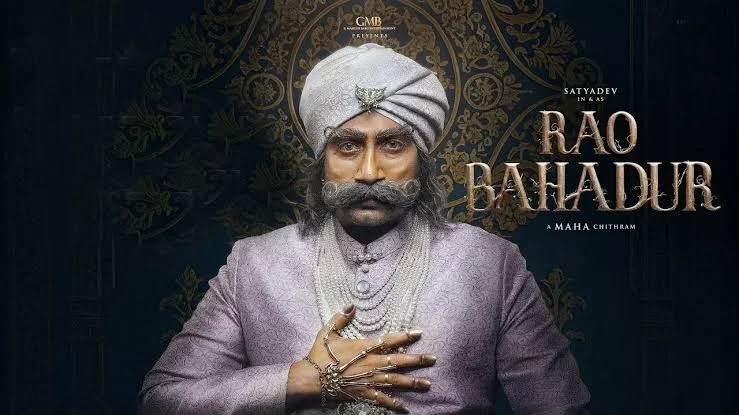
The man left with this inheritance is dying, slowly and resentfully. Played by Satyadev Kancharana, Ramappa is an ageing aristocrat with terminal liver cancer who has outlived his prognosis. Inside his deteriorating palace, Bhuvanalayam, he remains consumed by a doubt about his younger son’s paternity. Maha, who writes, directs, and edits this Telugu drama, moves between this troubled present and the younger man’s apparent openness.
Ramappa’s courtship of Renuka supplies the sharper test of his independence. A nurse caring for his father, she comes from a modest economic background and initially refuses his proposal. Their early warmth makes his later cruelty painful without making it inexplicable. He can question caste markers and the external symbols of royalty while assuming that his own family should satisfy an exacting private ideal. His readiness to cross an economic divide in choosing a partner leaves his expectations of that partner largely intact.
Those expectations become violent when the darker complexion of his younger son, Kusuma, feeds his suspicion. Colorism here has a specific domestic action: a father treats his child’s appearance as evidence against his wife. His preference for the elder son, Lavana, distributes affection according to the same imagined certainty about inheritance. Caste, wealth, and skin prejudice meet within this household, but each performs a different task. Status authorizes Ramappa’s expectations; complexion becomes his supposed proof. The assault on Renuka exposes how readily a question he cannot answer becomes punishment inflicted upon somebody else.
Satyadev sustains the connection between the charming young suitor and the older man’s destructive self-importance. His expansive delivery gives Ramappa the scale he believes he deserves, while the emotional breakdowns reveal how poorly that grandeur protects him from uncertainty. The performance allows grief and insecurity to register without making them adequate excuses. Deepa Thomas’s Renuka establishes an opposing desire through her early refusal: she has a life she wishes to choose. By the later timeline, she has spent eight years within her quarters. That withdrawal gives Ramappa’s anguish a consequence outside his own body, in the altered daily existence of the woman he claims to love.
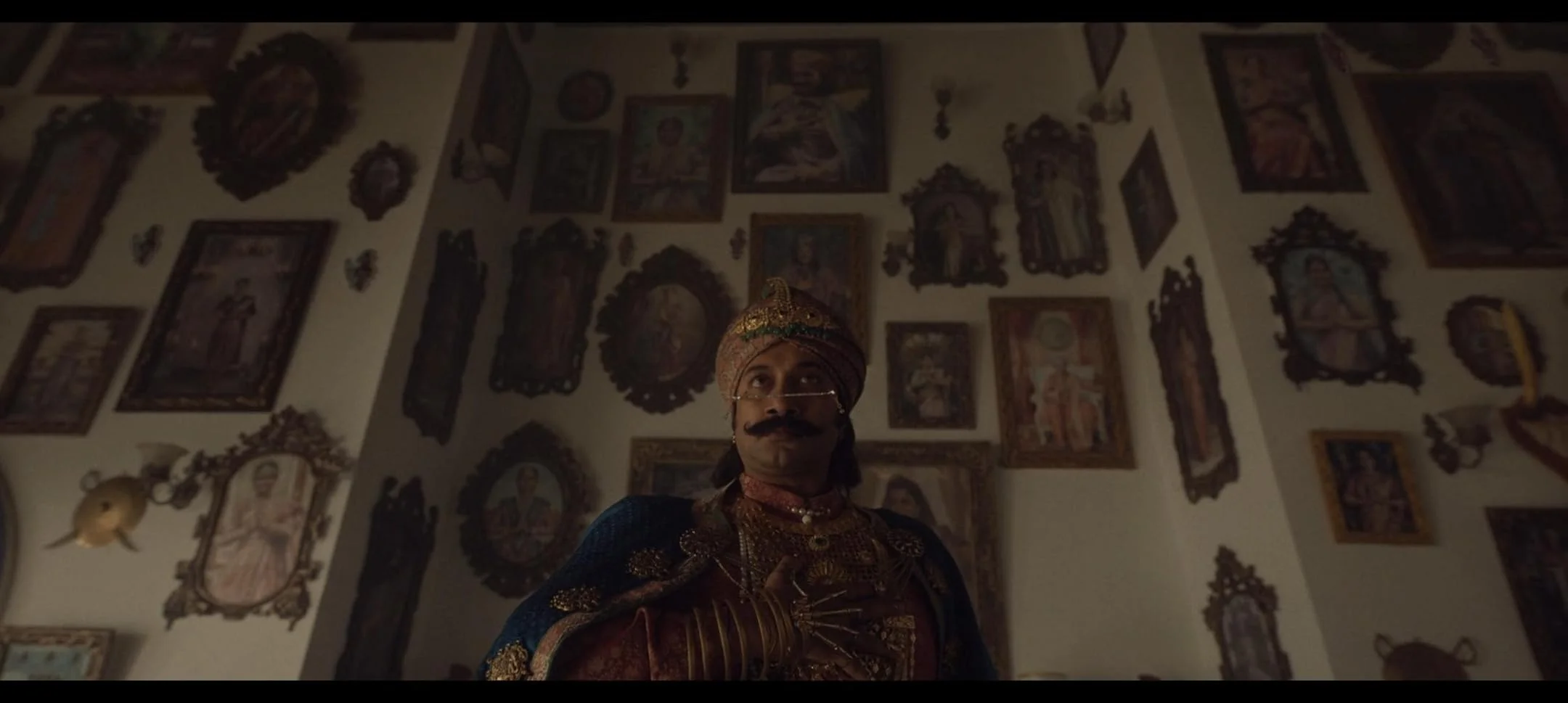
Bhuvanalayam makes such separations tangible. Rohan Singh’s production design offers ancestral portraits and deteriorating grandeur, but the palace’s force comes through the difficulty of entering and understanding its rooms. Ramappa and the househelp Achamma peer through windows or narrow openings before going inside. Access is tentative, even within the home. Kartik Parmar’s cinematography gives this behavior a different function from the walls rotating around Ramappa: the turning room unsettles his perception, while the guarded openings suggest how little the inhabitants can confidently know about one another.
The conversations with Dr Narayanachari, played with restraint by Vikas Muppala, extend that uncertainty into friendship. Achari comforts Ramappa and challenges him, with a competitive undertone that keeps their intimacy from becoming reassuring. During an exchange in a cavernous room crossed by shafts of light, their discussion reaches into the Mahabharata. Ramappa’s familiarity with its dynastic conflicts makes the epic available as a language for his own concerns about family and inheritance. Maha lets the reference emerge from his habits of thought, including his tendency to grant his private troubles an imposing scale.
Achari’s reserve helps these exchanges resist Ramappa’s preferred proportions. His presence gives the aristocrat somebody who will listen without automatically accepting his account of himself. Yet their conversations also expose the demands Maha places on the audience’s patience. Across 169 minutes, extended speech sometimes occupies space that an image has already made productive. The ancestral number is the clearest example: the physical alteration of a brain communicates conditioning with immediate force, then the song explicitly identifies the process. Its theatrical invention is pleasurable; its insistence on securing the interpretation can diminish that pleasure.
A smaller comic episode follows the same appetite for elaboration. Achamma’s confusion about black coffee receives a demonstration involving different kinds of milk, allowing the misunderstanding to become a fully staged event. There is charm in Maha’s willingness to pursue a literal interpretation to its absurd destination. Repeated across jokes, speeches, and symbolic spectacles, however, that fullness can leave the film laboring over ideas the audience has already understood. The difficulty lies in the amount of explanation attached to the invention, rather than in its departure from realism.
The late revelation creates a different strain by introducing comic release into a story carrying domestic violence and bereavement. Deflating Ramappa’s certainty is an appropriate target for farce; asking the family’s injuries to accommodate that change of register is harder. His obsession has occupied the palace and directed the narrative, making an answer feel like something everyone has been waiting for. Renuka’s years of withdrawal place another demand on that answer. The comedy gives his consuming doubt a release that her experience cannot receive on the same terms.
Rao Bahadur premiered in theaters on July 3, 2026, and is available for streaming on Netflix. Written and directed by Venkatesh Maha, the Telugu psychological period drama centers on an eccentric aristocrat in a fading royal manor whose guilt and obsession with his late son’s parentage push him into a fractured, hallucinated reality.
Where to Watch Rao Bahadur (2026) Online


Full Credits
Title: Rao Bahadur
Distributor: Prathyangira Cinemas, Mahayana Motion Pictures, GMB Entertainment, SriChakraas Entertainments
Release date: July 3, 2026
Rating: UA 16+
Running time: 2 hours 49 minutes (169 minutes)
Director: Venkatesh Maha
Writers: Venkatesh Maha
Producers and Executive Producers: Mahesh Babu, Namrata Shirodkar, Anurag Reddy, Sharath Chandra, Chinta Gopalakrishna Reddy, Dinesh Yadav Bolleboina
Cast: Satyadev Kancharana, Deepa Thomas, Vikas Muppala, Master Kiran, Pranay Vaka, Bala Parasar, Anand Bharathi, Kunal Kaushik
Director of Photography (Cinematographer): Kartik Parmar
Editors: Venkatesh Maha
Composer: Smaran Sai
The Review
Rao Bahadur
Rao Bahadur turns ancestral authority into musical spectacle, then traces its damage through a marriage and a father’s suspicion. Satyadev gives Ramappa’s charm, entitlement, and anguish a persuasive continuity, while the palace’s guarded spaces make family estrangement tangible. Maha’s inventions sometimes suffer from repeated explanation, and the late comedy offers an uneasy release from the household’s pain. Its strongest passages make prejudice visible without allowing suffering to excuse cruelty.
PROS
- Song and choreography make social conditioning tangible.
- Satyadev sustains Ramappa’s contradictions.
- Palace design gives family estrangement physical form.
- Domestic consequences sharpen the critique of inherited privilege.
CONS
- Extended explanations blunt inventive scenes.
- Late comic release strains the treatment of family trauma.