















Russell’s grant interview in Breeder could belong to a different American film, one about a gifted young man waiting for somebody to recognize his potential. He wants to protect threatened bee populations; the people considering his application want an academic qualification he has not completed. Intelligence, dedication, and a socially useful project cannot quite get him through the door. Writer-director Alex Goyette places his scientist inside a familiar promise of advancement through talent, then leaves him searching for someone willing to pay.
Patti, a wealthy poodle breeder, recognizes his potential rather too enthusiastically. Having encountered his intelligence through Mensa, she invites him to her remote ranch and offers to finance his research if he impregnates her daughter Ainsley. The change in how Russell is assessed gives the proposition an ugliness beyond its immediate sexual coercion. His mind has attracted a patron who values what she believes his body can reproduce. Academic credentials and eugenic selection carry radically different moral stakes, but Russell’s passage between them exposes his dependence on whoever gets to set the conditions.
Those conditions reach into his relationship with Haley, his supportive fiancée, whose family doubts his ability to provide. Daniel Doheny gives Russell an anxious eagerness that makes professional recognition and financial security difficult to separate. He wants his research to matter, and he wants the standing that successful research might bring. Patti’s money promises relief from several humiliations simultaneously. The arrangement threatens the future with Haley that it might ostensibly help him afford.
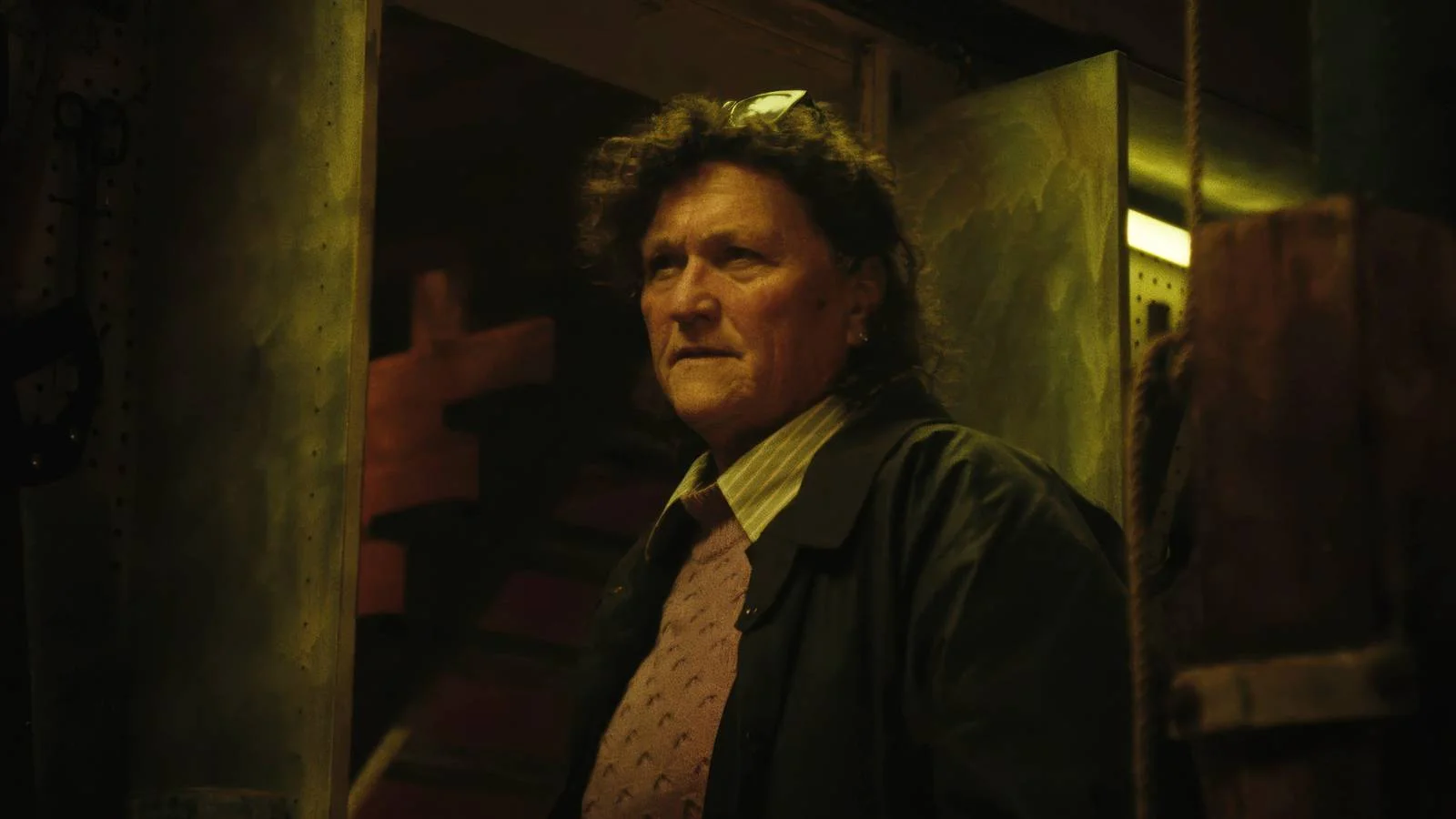
Dot-Marie Jones makes Patti’s conviction more disturbing than any elaborate justification could. Watch her showing Russell the videotapes of her championship poodles. Here, she has access to pleasure, pride, something approaching ease. Ordinary hospitality is harder work. When Russell asks about dinner, her irritation interrupts the performance of welcome, revealing how little room there is for another person’s needs. Jones’s strained attempts at whimsy are especially effective: Patti seems to have studied charm without understanding the mutual accommodation it requires.
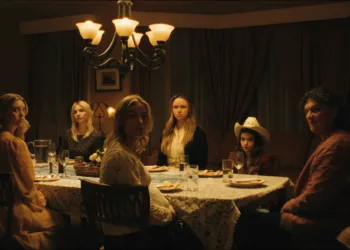
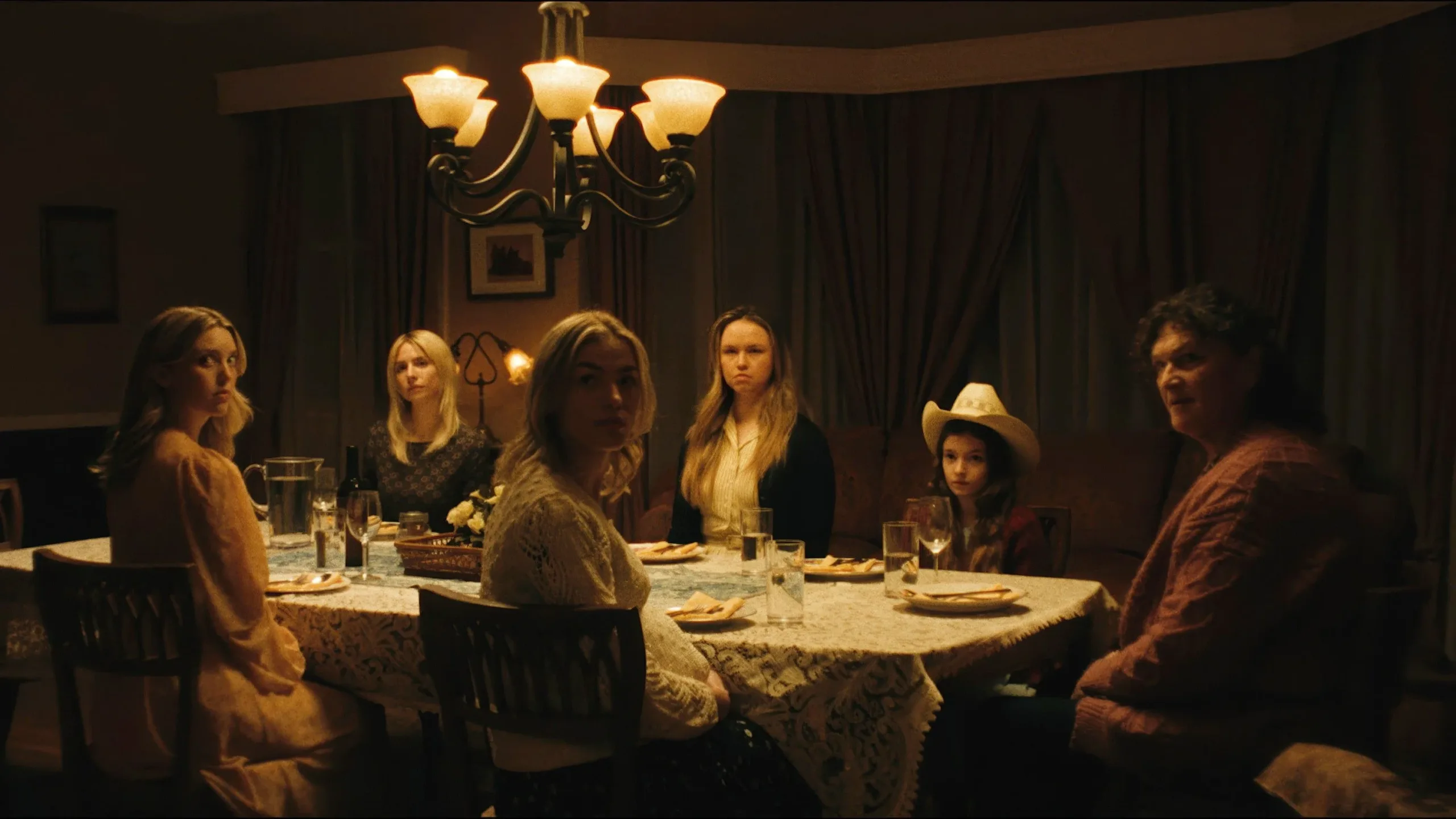
At the dinner table, that failure becomes a governing principle. Ainsley’s intelligence is presented as a desirable attribute, and Patti discusses breeding people with the assurance of someone explaining an established professional practice. Jones lets the absurdity remain available without inviting us to laugh it away. Her deadpan delivery gives the proposal administrative weight. A conversation can be funny and threatening because Patti recognizes no reason for either response.
The household gives this performance a structure. Patti calls herself the “chief,” a revealing title for a mother living with five daughters. Ainsley, played by Maddie Phillips, is appraised according to her usefulness to the project before Russell can establish much relationship with her. The daughters’ participation takes place beneath an authority that claims the right to define their futures. Their apparent cooperation cannot simply settle the question of their freedom, any more than Russell’s interest in the money settles his.
Goyette locates this reproductive regime within the familiar territory of American rural horror. The remote property and threatening household recall the tradition of The Texas Chain Saw Massacre, but the menace here has its own domestic economy: breeding, judging, displaying, improving. Production designer Skye Dyken embeds poodles into the gates and furnishings until an enthusiasm becomes the organizing identity of a place. The taxidermied poodle is particularly unpleasant. Within Patti’s world, its preserved appearance suggests the final convenience of an ideal specimen that can no longer do anything unexpected.
Cinematographer Jaryl Lim’s amber barn lighting gives that world an oppressive warmth. Illuminated areas offer visibility without much reassurance, surrounded as they are by darkness. The animal environment also enters Hannah Parrott’s score and Ryan Marchant’s sound design, where dog cries and organic textures keep the breeding operation present beyond the immediate conversation. Silence is equally useful. When the soundtrack withdraws and the camera stays with Patti, Russell seems obliged to wait for her permission to determine what happens next.
Across a different cinematic tradition, Yorgos Lanthimos’s Dogtooth offers a useful comparison. Its controlled household derives much of its force from the division between a family’s imposed reality and the society outside it. Breeder makes that division less secure. Russell arrives carrying pressures about achievement, money, and reproduction that Patti can exploit without having invented them. Her ranch is extreme, but some of the desires sustaining his involvement are recognizable before he reaches it.
That overlap gives the film an opportunity it only partly develops. The world beyond Patti’s property already has a heightened quality, particularly in the pressure surrounding Russell’s prospects. This makes it possible to read the ranch as an intensification of ordinary expectations. It also leaves the film uncertain about the distance between social satire and private nightmare. Jones supplies such precise behavioral menace that the broader exaggerations can feel comparatively vague. Patti’s system is easier to understand than the society against which Goyette wants us to measure it.
A related uncertainty affects Russell. Doheny communicates vulnerability persuasively, especially when his wish to remain agreeable becomes visibly difficult to maintain. Financial desperation explains why he hears Patti out, and ambition explains why he continues considering something repellent. Yet the extended negotiations do not always uncover another layer of that compromise. Some exchanges deepen his predicament; others leave him suspended between familiar alarm and familiar temptation. The deliberate pace becomes tiring when another hesitation contributes little to the reasons he stays.
The pistol at Patti’s waist and her increasingly restrictive control also change the terms. Russell’s early willingness to bargain cannot make him responsible for everything subsequently imposed on him. The film is more interesting when it allows coercion and self-interest to coexist than when his behavior merely delays the next escalation. Haley, played with warmth by Tanaya Beatty, gives that coexistence a cost beyond Russell’s immediate discomfort. She has supported work whose promised future he is now prepared to negotiate elsewhere. Whatever scientific benefit Patti’s money could purchase, the relationship that helped sustain his ambition has already become something he is willing to put at risk.
Breeder premiered at the Tribeca Festival on June 6, 2026, before its wide theatrical and streaming release via Independent Film Company and Shudder on October 28, 2026. Directed by Alex Goyette, the horror film follows an eccentric poodle breeder who lures a broke college student to her remote ranch under the guise of offering research funding, only for him to discover a terrifying trap.
Where to Watch Breeder (2026) Online

Full Credits
Title: Breeder
Distributor: Independent Film Company, Shudder
Release date: June 6, 2026 (Tribeca Festival), October 28, 2026 (United States)
Rating: R
Running time: 1 hour 37 minutes (97 minutes)
Director: Alex Goyette
Writers: Alex Goyette
Producers and Executive Producers: Ian Start, Byron Ashley, Brian Mitchell, Chris Wilkinson, K. Asher Levin, Bill Keenan
Cast: Daniel Doheny, Dot-Marie Jones, Maddie Phillips, Tanaya Beatty
Director of Photography (Cinematographer): Jaryl Lim
Editors: Alex Goyette
Composer: Hannah Parrott
The Review
Breeder
Breeder brings a disturbing variation to American rural horror, turning intellectual promise and family ambition into assets for a private breeding scheme. Dot-Marie Jones gives Patti’s authority a chilling everyday logic, reinforced by the ranch’s oppressive design and sound. Goyette is less precise when extending that household’s values into a broader social argument, and Russell’s prolonged negotiations sometimes exhaust their dramatic purpose. The most convincing horror remains the ease with which Patti makes ownership resemble care.
PROS
- Dot-Marie Jones’s commanding, unnervingly funny performance.
- Production design that makes Patti’s worldview tangible.
- Oppressive lighting, animal sounds, and effective silence.
- An unsettling connection between patronage and reproductive control.
CONS
- Russell’s compromises receive uneven development.
- Repetitive negotiations slow the deliberate pacing.
- Broader social satire lacks the household’s precision.