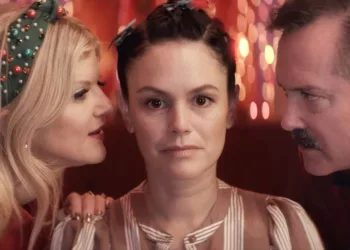





























Scarlett and Adam respond to the cameras in their borrowed Stockholm home by covering some of them. There is one in the bedroom, which gives the arrangement a peculiar understanding of hospitality. The couple have exchanged their Sicilian villa for this sleek island property through a house-swapping website; its owners, Carl and Helene, are already settling into the Italian accommodation. In A Couple of Lies, domestic privacy is something even these affluent holidaymakers cannot take for granted. The surveillance equipment makes that insecurity explicit before anyone has to confess to anything.
The Sicilian villa exposes its occupants through messier means. Dirty laundry, lipstick on glasses, unpleasant smells, and a dead rat disturb Carl and Helene’s retreat. Eventually, Carl discovers a body in the well. Director Kasper Barfoed keeps moving between the cooler Swedish setting and the Italian sunshine, allowing the attractive locations to retain their appeal while their interiors become incriminating. The series gets considerable mileage from this double use of property. Netflix can offer a desirable holiday setting and a reason to fear staying there within the same sequence. The dirt complicates the view without spoiling the real estate.
Adapted by Amanda Högberg and Axel Stjärne from Stefan Ahnhem’s novel, this four-part Swedish thriller organizes its households around unequal access to information. The visitors encounter traces of lives they do not understand; their hosts have left things behind that resist innocent explanation.
Temporal shifts gradually disclose connections between the couples, turning an apparently impersonal online transaction into something less accidental. It is an efficient arrangement for a compact series. Each property supplies clues, each marriage supplies concealment, and movement between them gives the narrative somewhere else to go whenever an explanation threatens to settle.
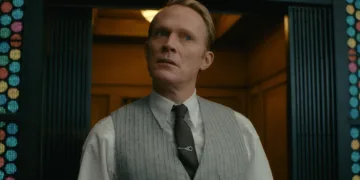
Carl’s failing memory introduces a less comfortable dependency. A wealthy hotelier played by Fares Fares, he has taken this break after a disturbing incident at work, initially attributed to exhaustion and stress. Helene tells him he has visited the villa before. He cannot remember doing so.
Once a missing-person investigation reaches the property, his uncertainty becomes dangerous: other people can supply accounts of his behavior that he has little means of challenging. Fares makes the confusion and anger work together. Carl’s frustration retains the force of a man accustomed to authority, even as he loses authority over his own experience.
The writing is less persuasive about his response to these symptoms. The severity of his lapses makes the continued reliance on overwork as an explanation difficult to accept without stronger scrutiny. Yet his business interests remain sharply present. A potential resort acquisition interrupts the holiday, and the investigation threatens the deal. These details prevent vulnerability from washing away his priorities. The series gives us reasons to worry about Carl while keeping his commercial self-interest visible. Its class perspective is most useful here, in the coexistence of genuine distress and the expectation that business should continue around it.

Emma Appleton gives Scarlett a different kind of continuity. Her concern for her estranged brother Tom, who owes money and wants help from her, establishes an emotional obligation that survives changes in the mystery. So does the uncertainty surrounding Adam’s fidelity.
Appleton allows sadness and trust to remain perceptible as Scarlett becomes firmer in her pursuit of answers. The performance gives those discoveries a personal cost. Learning something about a husband or brother changes a relationship she already values; it does not merely move another name around the suspect list. That distinction supplies much of the series’ emotional interest.
Helene’s position offers similarly promising material, with less satisfying development. A former waitress married to a wealthy hotelier, pregnant and away with a husband whose work follows him abroad, she occupies several relationships to power at once. Frida Gustavsson’s role becomes most immediately legible through Helene’s handling of Carl: she remembers what he cannot, and her assurances shape his understanding of himself.
The suspense benefits from making her difficult to read. The characterization suffers when that informational role carries too much weight. Her background gives the marriage a social dimension that the plot’s preoccupation with her knowledge only intermittently develops.
The distinction matters because concealment remains the adaptation’s most dependable source of movement. Adam’s secrets generate suspicion, while the shifts into the past keep revising the apparent separation between the households. Some of the larger developments are foreseeable before the series reaches its final stretch.
That need not empty the confrontations of tension. Knowing roughly where a revelation is heading can make the interval before a character learns it uncomfortable, especially when a marriage depends on maintaining the deception. The show is often entertaining in that interval, when its characters must keep interacting with people whose accounts are becoming harder to believe.
Four episodes also keep the thriller from prolonging every uncertainty into a separate ordeal. Carl’s symptoms continue to affect events, and the later disclosures produce further confrontations rather than leaving the premise untouched. The limitation lies in how readily motives become material to be released at the appropriate moment.
The distinction between a person hiding something and a script withholding characterization can grow thin. A compact running time offers little benefit if an explanation arrives efficiently but leaves the person delivering it scarcely understood. Here, the repeated changes in what we know receive greater attention than the slower question of how these people live with one another.
Scarlett makes that allocation of attention especially noticeable. Her brother’s debts turn affection into a financial demand; her husband’s secrecy makes trust difficult to sustain. Neither pressure requires an ingenious solution to matter. Appleton keeps both relationships emotionally active while the series assembles its answers, creating an interest that extends beyond identifying the next deception. When Scarlett grows more determined, there is room to consider what that resolve might cost a woman accustomed to believing people she loves. The mystery keeps requiring her attention at precisely the point when her changing attachments deserve ours.
A Couple of Lies premiered globally on Netflix on October 30, 2026. The four-part psychological thriller series follows two wealthy couples whose seemingly idyllic home swap between Sicily and Stockholm turns toxic as they go to extremes to protect their secrets.
Where to Watch A Couple of Lies Online


Full Credits
Title: A Couple of Lies
Distributor: Netflix
Release date: October 30, 2026
Rating: TV-MA
Running time: 60 minutes per episode
Director: Kasper Barfoed
Writers: Amanda Högberg, Stefan Ahnhem
Producers and Executive Producers: Frida Asp, Fatima Varhos
Cast: Emma Appleton, Fares Fares, Frida Gustavsson, Jakob Oftebro, Magnus Krepper, Diarmuid Noyes, Anna Bjelkerud, Francesca Romana Bergamo
Editors: Kristofer Nordin, Linda Jildmalm
The Review
A Couple of Lies
A Couple of Lies turns luxury homes and marital distrust into an efficient four-episode thriller, with Emma Appleton giving its shifting suspicions an emotional anchor. Fares Fares also sustains the uneasy overlap between privilege and vulnerability. The compact format keeps revelations moving, but characterization receives less attention: Helene’s informational role outweighs her independent development, and Carl’s severe symptoms strain the exhaustion explanation. Netflix’s attractive holiday nightmare remains watchable, with its people sometimes waiting behind its secrets.
PROS
- Emma Appleton’s emotionally grounded Scarlett.
- Fares Fares’ convincing confusion and anger.
- Luxury properties used effectively as sources of unease.
- Compact plotting sustains confrontational tension.
CONS
- Helene’s characterization leans heavily on concealment.
- Carl’s symptoms make the exhaustion explanation unconvincing.
- Some major revelations are easy to anticipate.