























The instruction about noises in the storage room does an impressive amount of unpaid work. Before anything comes through a door in Dead-End Job, the warning has told us where to look and what to listen for. At midnight, a remote convenience store becomes a place whose employee handbook appears to have been written by previous casualties. Rules appear on screen; a scream supplies an unhelpful demonstration. The pleasure is in the waiting. Every second that the storage room remains closed gives it a little extra importance.
Then the second worker arrives two hours late. A familiar workplace irritation acquires several unpleasant possibilities, especially in a store with no apparent customers to justify two employees. The scene gains another question without having to discard the first: alongside the danger behind the door, there is now uncertainty about the person sharing the shift. This is an efficient way to build an episode. The setting stays ordinary enough for small irregularities to register, and the instructions give the audience something to anticipate before the monster supplies something to flee.
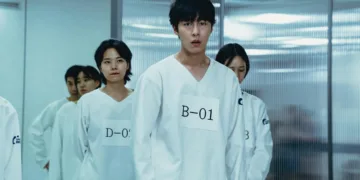
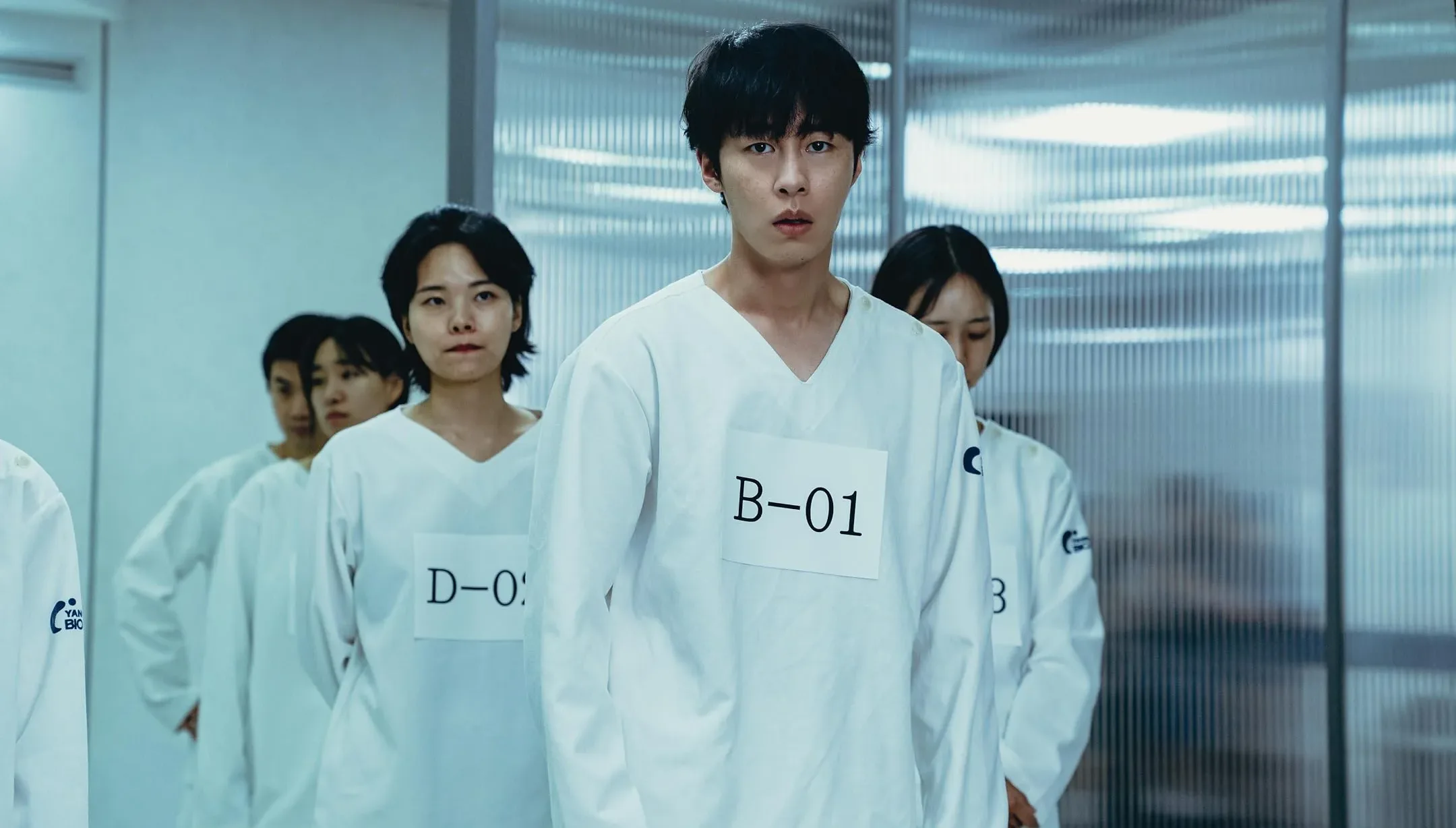
The man entrusted with this shift is Byeon Hyeok-jun, played by Lee Jae-wook with a useful shortage of heroic composure. Crushed by debt and threatened by a violent lender, he encounters an advertisement for lucrative temporary work beneath a bridge during a suicidal crisis. Spider Staffing Agency offers him four million won for a night at the convenience store. Across the first five episodes, that financial pressure gives the series its recurring mechanism: Hyeok-jun survives an assignment, acquires excellent reasons to avoid another, and still needs the money.
An assignment-per-episode format could easily make him look foolish. Here, his growing reluctance helps preserve his credibility. He understands that the agency is dangerous; understanding does little to improve his alternatives. Mr. S, the manager played by Lee Hee-joon, knows his name before an ordinary introduction and requires secrecy backed by severe penalties. His recruitment manner combines ominous familiarity with a remarkably incomplete job description. Each return to the agency carries the residue of the previous shift, even as a new location allows the show to change its immediate rules.
That arrangement gives the labor satire a practical dramatic use. An old classmate whose health has been damaged by punishing work makes the connection between earning and bodily depletion explicit. Hyeok-jun’s younger sister, Ji-yoon, reaches a colder calculation: poverty frightens her enough to make ghosts seem an acceptable occupational risk. These attitudes keep the supernatural premise attached to recognizable decisions. They also prevent the siblings from becoming interchangeable participants in a series of elaborate scares. One needs considerable persuasion to go back. The other has already done the arithmetic.
Kim Min-ha makes Ji-yoon’s composure funny without requiring her to announce a joke. Her relatively unruffled response to supernatural hazards changes the temperature of a premise that Lee plays at a sustained state of alarm. His running, scrambling, and escalating exasperation give the dangers physical weight, particularly when survival involves climbing along the side of a hallway. He remains a frightened man doing strenuous things under protest. That distinction matters to the comedy: competence has not cured his perfectly reasonable objection to being there. Between the siblings, the series can make the same employment opportunity look exhausting or grimly practical.

The creatures have a less consistent grasp of their responsibilities. The convenience-store rat monster, assembled from smaller rats, is a nasty piece of design. It turns infestation into an organism, giving a familiar disgust somewhere much larger to go. Its glossy digital surfaces, however, sit awkwardly against the grubby surroundings. The idea belongs in the store; the rendered body sometimes appears to have arrived from another production. This weakens the encounter’s physical credibility precisely where Lee’s exertion is working to establish it. His panic is persuasive enough to deserve something that looks capable of occupying the same floor.
Episode two finds a better use for digital manipulation through optical illusions and distorted environments. When the space itself becomes unreliable, artificiality can contribute to the threat instead of drawing attention away from it. The distinction is useful because the series does gain energy from changing its visual approach between assignments. A clown encountered in daylight places danger somewhere exposed rather than safely hidden in darkness. These changes keep the recurring format hospitable to different kinds of fear. A new location earns its place when it changes what the worker, and the audience, must watch for.
Running alongside the assignments is a different kind of suspense. Yeon-joo, played by Go Min-si, investigates the agency and the disappearance of workers, while also giving Hyeok-jun guidance. Her encounter with him after his first shift is an economical connection between the two stories: he has fallen asleep waiting for a bus; she checks his identification and anticipates seeing him again. His episode appears to be over, but someone else is already treating him as part of a continuing case. The exhausted body at the bus stop becomes evidence without knowing it.
The agency mystery therefore makes a separate promise from the next hazardous shift. Mr. S’s unexplained knowledge and selective disclosures encourage curiosity, while Yeon-joo’s investigation suggests that the workers’ experiences have a pattern they cannot yet see. The most productive tension in that arrangement concerns the value of the instructions themselves. Hyeok-jun can learn which room to avoid, which warning to heed, and how to get through another night. He is becoming qualified for a job whose employer still controls the description. How much can experience protect him if the agency keeps deciding what he is allowed to know?
Dead-End Job premiered globally on Netflix on October 30, 2026. Created by Han Jun-hee and directed by Kim Da-min, the South Korean horror-fantasy series follows a debt-ridden young man who takes on dangerous part-time gigs offering astronomical pay through a mysterious employment agency, only to encounter terrifying, hellish workplaces.
Where to Watch Dead-End Job Online


Full Credits
Title: Dead-End Job (Korean: 꿀알바)
Distributor: Netflix
Release date: October 30, 2026
Rating: 16+
Running time: 8 episodes
Director: Kim Da-min, Han Jun-hee
Writers: Kyung Min-sun, Lee Shin-ji
Producers and Executive Producers: Not publicly specified
Cast: Lee Jae-wook, Go Min-si, Kim Min-ha, Lee Hee-joon, Yoon Kyung-ho, Choi Hyun-wook, Liz Burnette, Robert M. Leemore
The Review
Dead-End Job
Dead-End Job makes a persuasive case for reading the employee handbook, then finding another employer. Through its first five episodes, sharp workplace suspense, credible financial desperation, and the siblings’ contrasting reactions keep its assignment format lively. Lee Jae-wook makes survival look properly exhausting; Kim Min-ha supplies the cooler comic temperature. Glossy creature effects occasionally weaken the danger, while environmental trickery proves far more effective. The agency mystery invites curiosity, but the individual shifts already earn their wages.
PROS
- Workplace rules build suspense before creatures appear.
- Debt gives the recurring assignments credible stakes.
- The siblings’ contrasting performances sustain the horror-comedy.
- Environmental illusions make familiar spaces threatening.
CONS
- Glossy creature CGI weakens physical credibility.