


























Bhavani and Mutthakka’s conversation about biological children and adoption makes the family politics of Akka briefly feel intimate. These women belong to a ruling order that has abolished marriage while retaining female succession, so a discussion of motherhood carries questions about who may inherit and how belonging is established.
Keerthy Suresh and Tanvi Azmi give the exchange a welcome ease. The absence of a husband from this arrangement leaves plenty of expectations intact, and the scene allows affection and dynastic obligation to occupy the same conversation without turning either woman into a mouthpiece.
Nanda, Bhavani’s lover, brings a different understanding of commitment. He insists on marriage before sexual intimacy, placing a familiar condition inside a society that permits relationships while prohibiting the wedding. The reversal is productive: a convention often presented in Indian screen romances as the destination of respectable love becomes an obstacle to the lovers’ agreement.
His preference deserves consideration as a personal wish, just as Bhavani’s resistance deserves consideration as her own. The dramatic possibility lies in discovering how much choice either person has when private attachment encounters an inherited law.
Writer-director Dharmaraj Shetty situates these tensions in Pernuru, a fictional South Indian region between the Arabian Sea and the Western Ghats. An animated account explains how women assumed control after war removed the men, establishing an order that survives for roughly eight centuries across three ruling houses.
By 1985, the principal setting of this five-episode series, female inheritance has become an institution. “Akka,” meaning elder sister, gives authority the vocabulary of kinship. It suggests protection and familiarity, though the liquor business sustaining this order requires rather harsher methods of maintaining obedience.
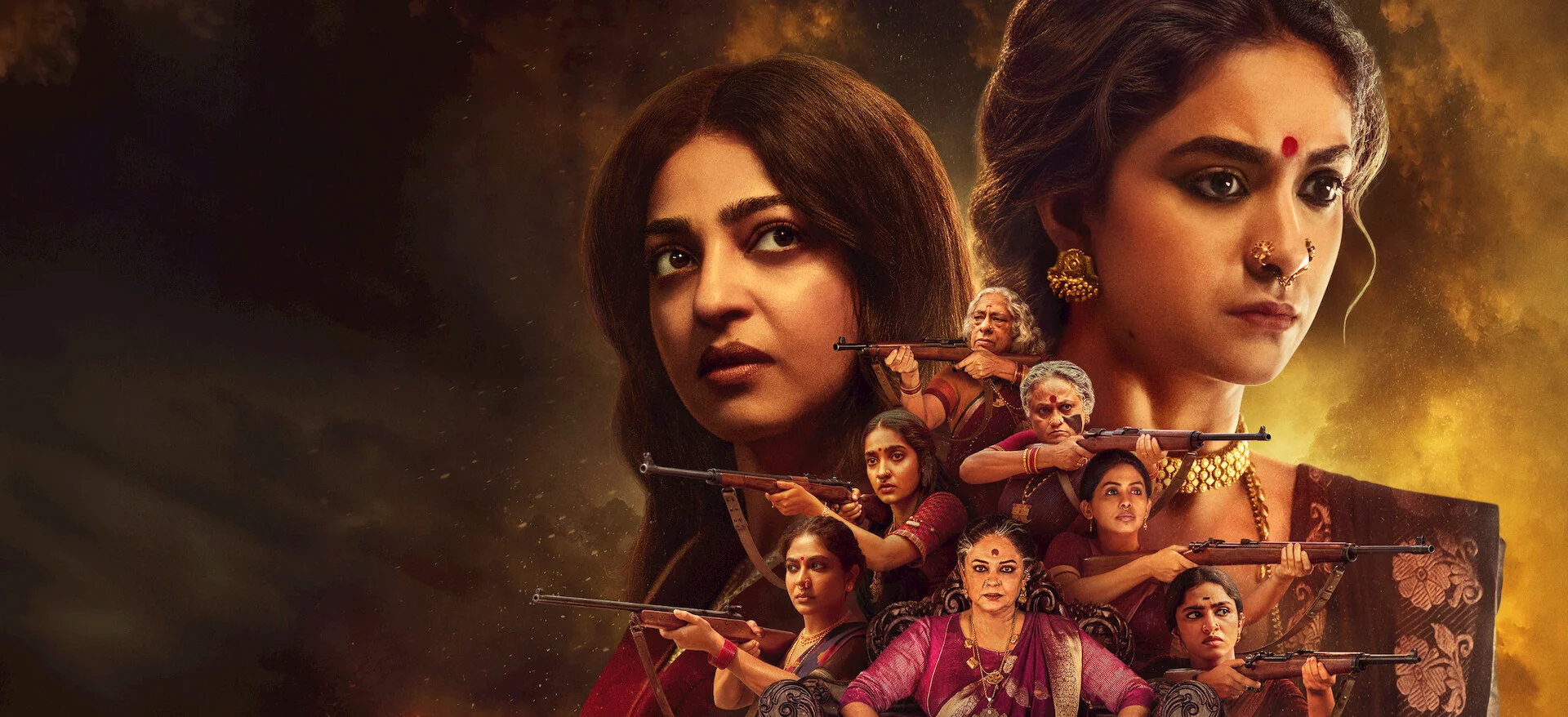
Suresh makes that combination immediately legible. A gun tucked into the back folds of Bhavani’s sari gives her clothing a practical relationship with the violence she commands. Her upright bearing and measured delivery suggest someone who expects an instruction to be followed.
She has little need to advertise strength through perpetual agitation. Sheetal Sharma’s costumes extend that assurance across the ruling women: silk, gold and conspicuous nose rings make wealth and ceremonial standing visible. The jewellery belongs to women who control the resources that purchase it. Its abundance expresses possession rather than dependence on a husband’s status.
The killing of a businessman competing for a liquor licence establishes what Bhavani’s composure can conceal. A threat to commercial control receives a lethal answer, and Suresh’s authority becomes troubling precisely because it is so convincing. Akka relocates the family loyalties and territorial claims of the Hindi gangster drama into a female dynasty, keeping the violence that makes such claims enforceable.
There is no reason these women must behave as exemplary leaders to justify their presence. The useful question is how closely the series examines the distance between their protective role and their economic interests. That licence dispute gives the distance a concrete, ugly form.

Radhika Apte’s Rudra attacks the privilege underpinning this confidence. Arriving through an alliance with Bombay gangster Shankar, she regards the Akkas’ inherited position with the resentment of someone who has had to fight for access to power. Her predominantly black Western clothing separates her visually from Pernuru’s silk-clad establishment.
The contrast efficiently identifies rival kinds of authority: one publicly rooted in continuity, the other making disruption its calling card. Apte supplies a threatening directness that disturbs the settled register Suresh cultivates. Their encounters draw energy from the unequal relationship each woman has with the place she seeks to command.
Rudra’s hostility also offers the series a route into grievances the dynasty would prefer to leave undisturbed. Her ability to recruit among people alienated by the ruling houses matters independently of her ruthlessness. A manipulator can find genuine injuries to exploit.
Yet as personal revenge increasingly directs her campaign, the relationship between those injuries and her ambitions receives less development than it needs. Apte can make an intention feel dangerous; the writing is less consistent about giving that intention political substance. The movement toward private vendetta reduces the space available to examine what those joining her expect to gain.
This difficulty becomes especially clear when Rudra recruits a priest to circulate an embellished heroic account of her life. He warns that establishing such a reputation will be difficult and require time. The transition then presents her popular acceptance as effectively accomplished.
The premise of the exchange is excellent: an aspiring ruler understands that force needs an accompanying story, and that a religious intermediary can help confer legitimacy. The editing skips the resistance and negotiation that would make this process dramatic. We hear that persuasion is hard, then receive its success without enough intervening experience.
That shortcut helps explain the peculiar rhythm of a series that can feel burdened with explanation and hurried in its developments. The founding history, family relationships and governing customs require attention, but the account of how Pernuru came to exist receives patience that its changing allegiances often lack. The issue is the allocation of dramatic time. Rules acquire detail; people’s responses to those rules can arrive as completed decisions. Pernuru’s elaborate appearance encourages us to believe in accumulated habits and loyalties, making their rapid rearrangement harder to accept.
The Kathawa leader’s change of position exposes the cost. She initially refuses to fight beside Bhavani, then relents after a brief appeal asserting that Bhavani differs from her ancestors. That distinction could sustain a difficult negotiation: inherited office need not mean inherited conduct, yet those carrying old grievances have reasons to demand proof. The scene settles the matter before such proof becomes necessary. Having imagined a society where women determine the terms of family, property and rule, Akka gives this woman too little opportunity to determine the terms of her own support.
Akka premiered worldwide on Netflix on October 30, 2026. Created and directed by Dharmaraj Shetty, the Hindi crime thriller series is set in a fictional South Indian town governed by a matriarchal sisterhood, following the violent power struggle that erupts when a ruthless outsider arrives to challenge the established ruling order.
Where to Watch Akka Online

Full Credits
Title: Akka
Distributor: Netflix
Release date: October 30, 2026
Rating: TV-MA
Running time: 30 to 46 minutes per episode (5 episodes)
Director: Dharmaraj Shetty
Writers: Dharmaraj Shetty, Hussain Dalal, Abbas Dalal
Producers and Executive Producers: Aditya Chopra, Yogendra Mogre, Akshaye Widhani
Cast: Keerthy Suresh, Radhika Apte, Anshumaan Pushkar, Mahesh Manjrekar, Tanvi Azmi, Monika Panwar, B. Jayashree, Nivedita Bhargava
Editors: Sanyukta Kaza, Saheéb Bagchi
Composer: John Stewart Eduri
The Review
Akka
Akka gives the Hindi gangster dynasty a striking female inheritance, with Keerthy Suresh making Bhavani’s authority persuasive through posture, restraint and sudden violence. Its marriage and adoption debates suggest a society worth examining closely. Yet the series spends time establishing customs that its hurried political reversals barely test. Rudra’s campaign promises an examination of inherited privilege, then contracts around personal revenge. The silks, weapons and family obligations establish Pernuru vividly; the people deciding whom to follow receive less patient attention.
PROS
- Keerthy Suresh’s controlled, commanding performance.
- Costumes that express wealth and inherited authority.
- Thoughtful tensions around marriage, adoption and succession.
- Distinct approaches to power energise the central rivalry.
CONS
- Abrupt shifts in allegiance.
- Personal revenge restricts the political conflict.
- Historical exposition receives disproportionate dramatic time.