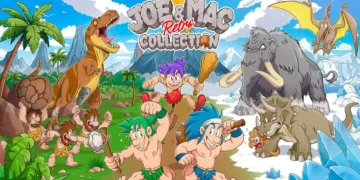























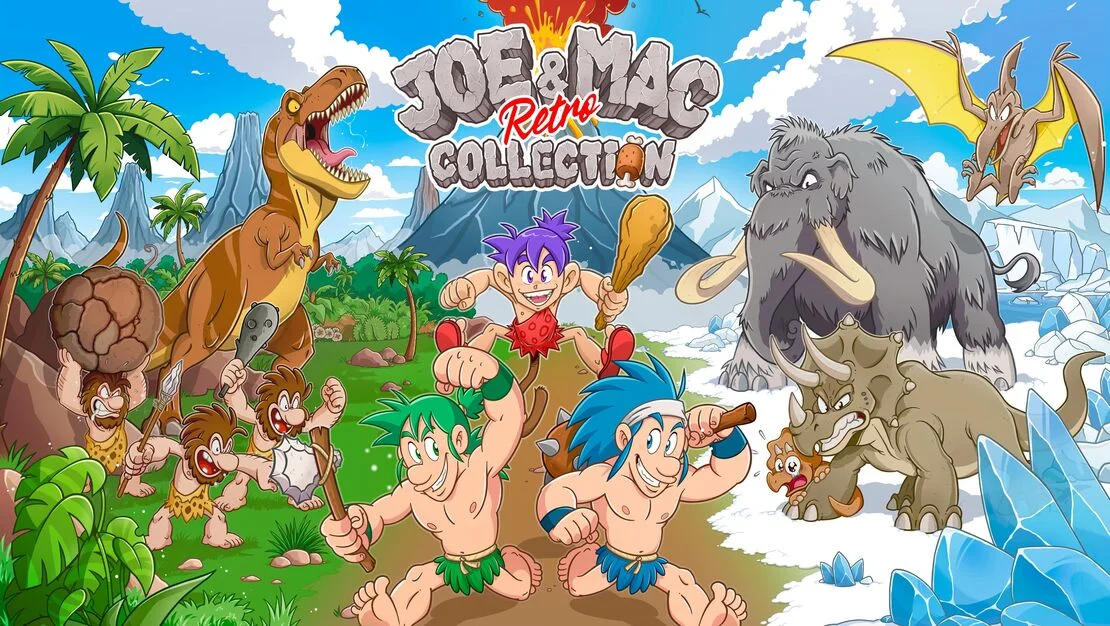

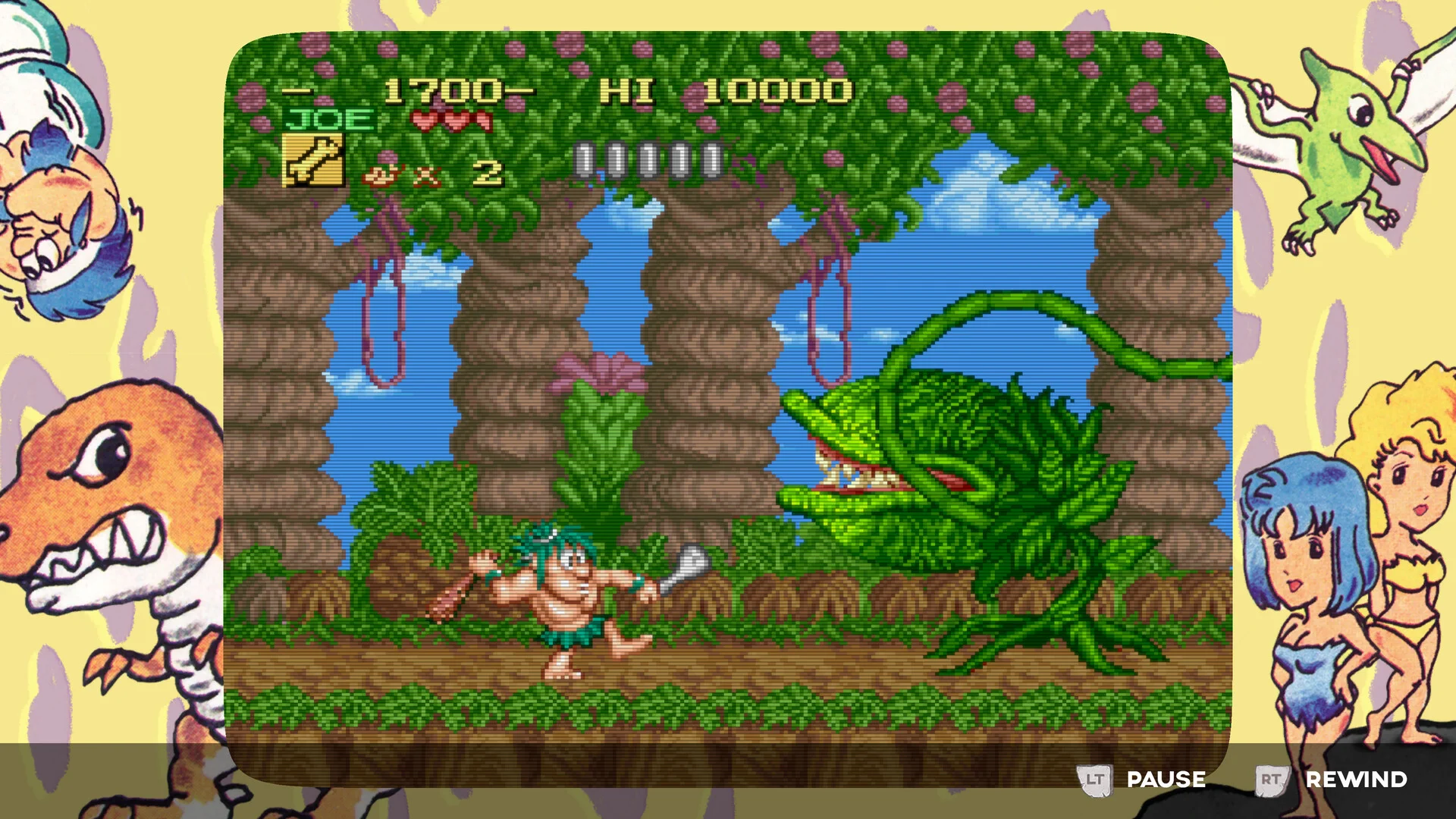
The original Joe & Mac gets considerable mileage out of keeping its stages short. Pick up a projectile weapon, work through the cavemen and dinosaurs ahead, and a large boss soon gives the action a new focus. Revisited in Joe & Mac Retro Collection, the SNES version of Caveman Ninja still benefits from that compact rhythm. Bones, boomerangs, fireballs, and rolling stone wheels extend your reach beyond the club, changing how closely you need to approach enemies. There is enough variety to keep this simple routine entertaining without stretching each stage until its ideas wear thin.
Playing with a second person makes that straightforward structure pleasantly disorderly. The original’s B Mode lets the two players hit each other, so cooperation includes the possibility of becoming your partner’s immediate problem. That option suits a game whose mammoth boss has a trunk you can break: both turn familiar action into physical comedy through something the player actually does. Movement feels a little sluggish, but the short routes and frequent bosses keep the pace from settling. The high somersault jump also gives the heroes an exuberance that becomes easier to appreciate after trying their later adventure.
Red Art Games has included three SNES titles here, and their differences give the collection much of its interest. Alongside Caveman Ninja are Congo’s Caper and Joe & Mac 2: Lost in the Tropics, known as Joe & Mac 3 in Europe. The numbering can suggest a tidier progression than the games provide. Congo’s Caper changes the protagonist and emphasizes platforming, while Lost in the Tropics brings the duo back into an expanded adventure. Playing them together reveals a series trying different ways to develop its initial appeal.
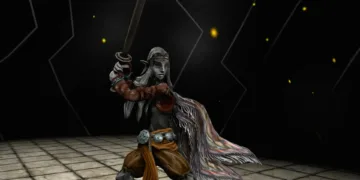
Congo’s Caper makes the sharper departure. Its hero shifts between human and ape forms, with damage knocking him down from one state to the other. Collect three red jewels and he gains a powered-up form with better speed, jumping, and damage tolerance.
Those changes matter in stages that put greater emphasis on vertical movement, exploration, and chases. Compared with the first game’s brisk procession toward the next boss, Congo asks you to pay closer attention to the spaces between encounters. Transformation gives its platforming a distinct identity rather than simply supplying another caveman with a club.
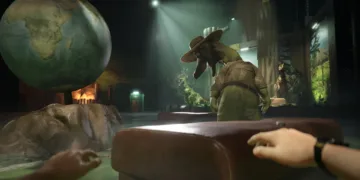
The trouble is that the increased emphasis on traversal exposes the less comfortable movement. Congo can be awkward to place, and enemy hitboxes sometimes make contact feel harsher than it should. With little damage tolerance in his ordinary forms, small mistakes carry considerable weight. Still, there is personality worth persevering for. Pirate, vampire, and scientist cavemen push the prehistoric silliness in different directions, giving the bosses an appealing disregard for consistency. This is also the single-player entry, so anyone approaching the package primarily as a co-op collection should account for that interruption.
Lost in the Tropics returns to Joe and Mac while changing the pace around them. Its longer stages offer space to explore, and some routes require a key before you can proceed. The absence of the original’s high somersault jump makes the returning heroes feel different before the village activities even enter the picture. Progress now involves searching and working through larger locations, reducing the concentrated rhythm of short stage, large dinosaur, next stage. Players who liked the original’s directness may find this a less immediately satisfying sequel, even as its structure gives them additional reasons to look around.
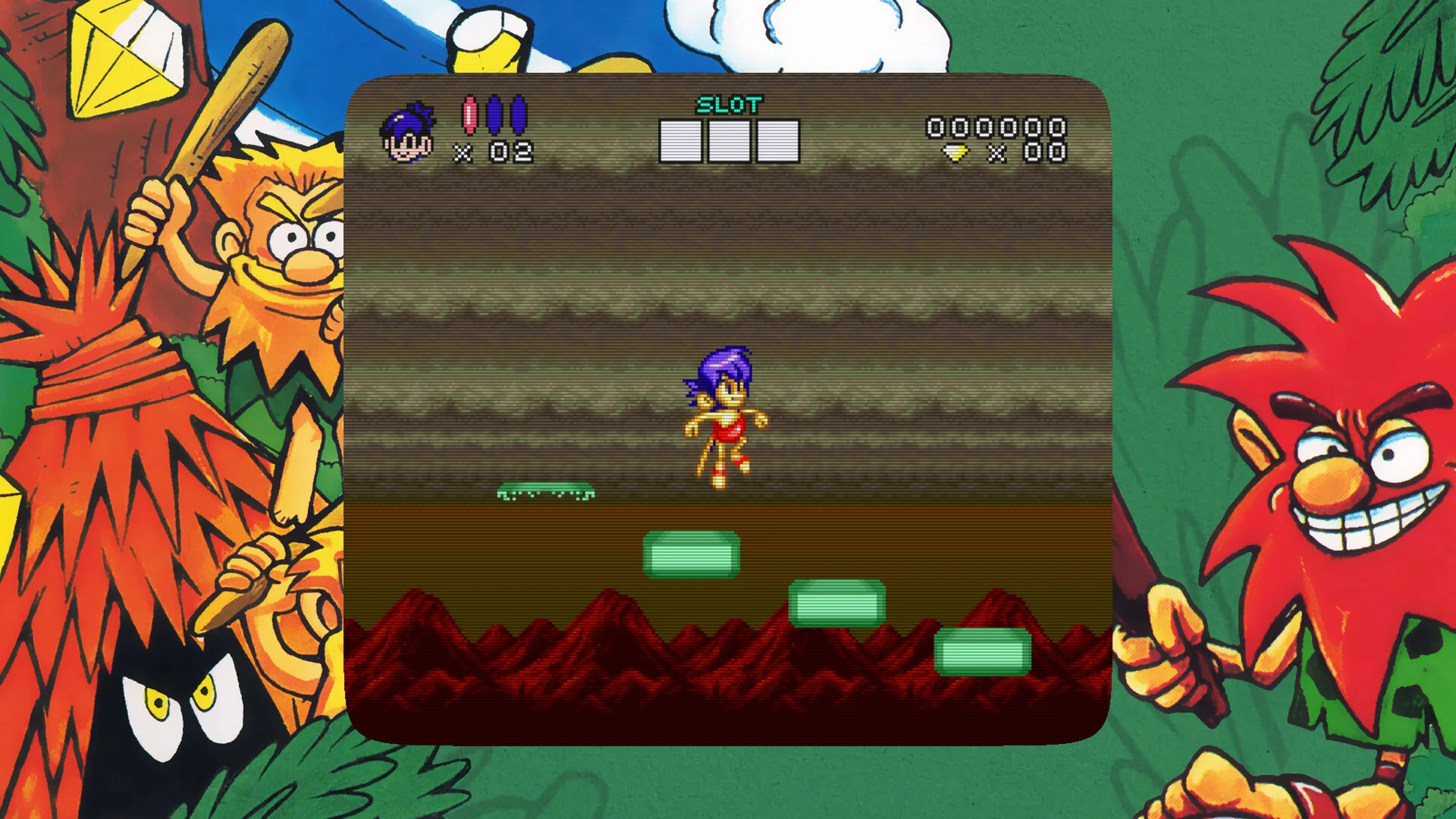
The village extends that change into the time between outings. You can interact with residents, decorate your home, and pursue courtship and marriage. These are light additions, with limited depth, but they give the heroes an existence beyond rescuing someone and hitting whatever blocks the route.
The interesting comparison is how much room each game leaves around its action. Caveman Ninja puts most of its appeal directly in your path; Lost in the Tropics asks you to settle into a place and accept a slower rhythm. Its extra activities give the setting character, though they cannot replace the first game’s immediacy for players who valued it.
The collection’s rewind and save states help make these differences easier to explore. Three save slots per game let you preserve progress without organizing a session around the original restrictions. Rewind is particularly useful when Congo’s limited damage tolerance turns an awkward contact into a costly mistake, while saving suits the longer stages of Lost in the Tropics.
Neither feature changes the underlying movement or layout. They reduce the amount of material you must repeat, leaving each game’s particular strengths and irritations available for inspection. Boss Rush options also provide a direct route back to the encounters that supply so much of the series’ personality.
Display settings cover the practical essentials: 4:3, pixel-perfect and stretched presentation, borders, and a basic CRT filter. The filter offers limited adjustment, so there is little scope for fine-tuning its effect. The supplementary presentation is considerably fussier in a welcome way.
Boxes can be rotated and opened, cartridges examined, and manuals read page by page. North American, European, and Japanese versions preserve regional variations, while the jukebox lets the music stand apart from the demands of play. Reading the manuals beside those differing packages gives the regional titles some tangible context.
The archive becomes less satisfying when attention turns from the products to their creation. Much of the art gallery concerns the collection’s new cover and menu artwork, with little explanatory context, rather than providing substantial development material for the original games.
The interactive packaging establishes how these releases were presented to their buyers; it offers limited help with understanding how the games changed during production. For a package containing such noticeably different approaches to the same premise, that is a missed opportunity to explain the decisions connecting them.
Its selection also stops at the SNES branch. The original arcade game, other console adaptations, and Joe & Mac Returns are absent. That matters particularly for Caveman Ninja, whose arcade origins form part of the history behind the version included here. You can inspect the regional boxes and manuals closely, then move between the three SNES games to trace their changing priorities. Comparing that first console adaptation directly with its arcade source still requires leaving the collection.
The Review
Joe & Mac Retro Collection
Joe & Mac Retro Collection makes a persuasive case for revisiting the series’ SNES years. The original’s compact stages and unruly co-op remain its most immediate attraction, while Congo’s transformations and Lost in the Tropics’ village life reveal how differently the sequels approached expansion. Rewind and saves ease the rougher passages, and the interactive packaging rewards curiosity. Awkward movement and a thin development archive temper the appeal, particularly for anyone seeking a fuller account of the franchise.
PROS
- Compact action and chaotic co-op in Caveman Ninja
- Sequels with distinct mechanical identities
- Useful rewind and save options
- Interactive packaging, readable manuals, and regional versions
CONS
- Awkward movement and harsh hitboxes in Congo’s Caper
- Limited development material and historical explanation
- Missing arcade games and other console adaptations