















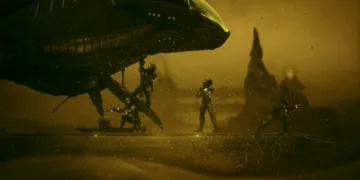

On New Year’s Eve, Kanna and Haseo watch Wim Wenders’s Wings of Desire at his home. The angel in Wenders’s Berlin can listen to people’s thoughts and keep them company without taking part in their lives. At Haseo’s home, the distinction between company and participation has a use that Wenders’s angel would recognize. Kanna and Haseo can spend the evening together with something to look at besides each other. Watching a film gives the two old friends a way to be close that requires very little agreement about what they’re doing there.
Yukiko Mishima’s Japanese title, Otoko Tomodachi, means “male friend.” It offers a perfectly ordinary answer to the question of who Haseo is to Kanna. The English title, Two Cigarettes, Three Nights, gives us a set of occasions and leaves the relationship open. A viewer arriving through that title might take each meeting as another step toward a declaration. Start with “male friend” and the same meetings pose a different question. What can Kanna ask of a friend that she can’t ask of a lover?
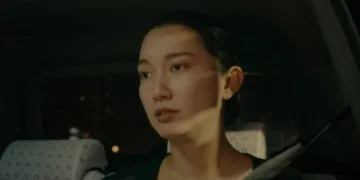
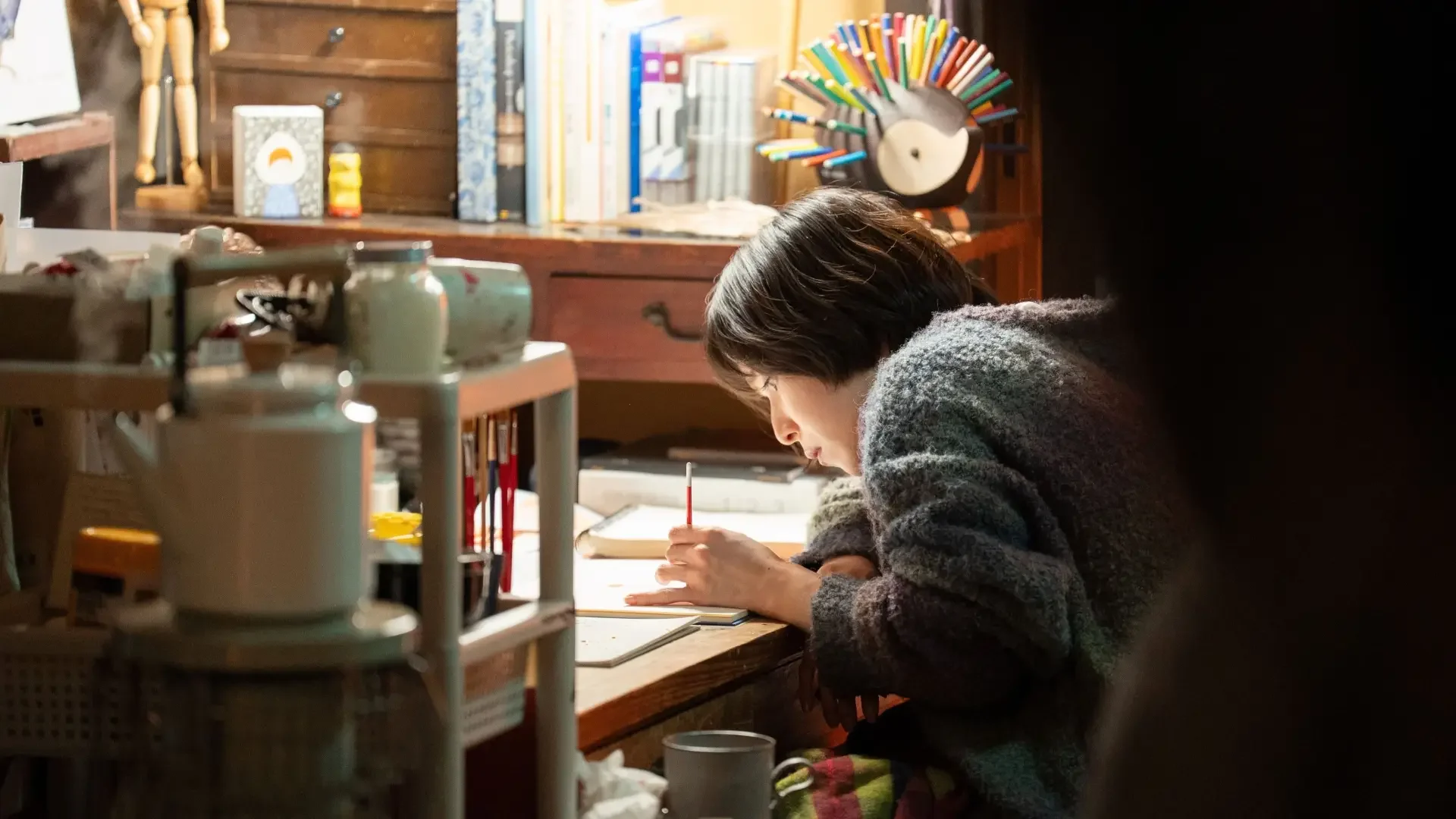
Haseo (Ryo Narita) calls Kanna (Mayu Matsuoka) after seven years apart, and on their first night together they walk through Kyoto trading memories. Kanna lives and works as an illustrator in the city, but Haseo knows a version of her that predates the career in which she now feels stuck. An award-winning picture book gave her an early success she has struggled to follow. She lives with her partner and is having an affair with a doctor named Shinji. The Kyoto walk takes its time. Here is someone with whom she can talk about the life she’s living without having to start at the beginning.
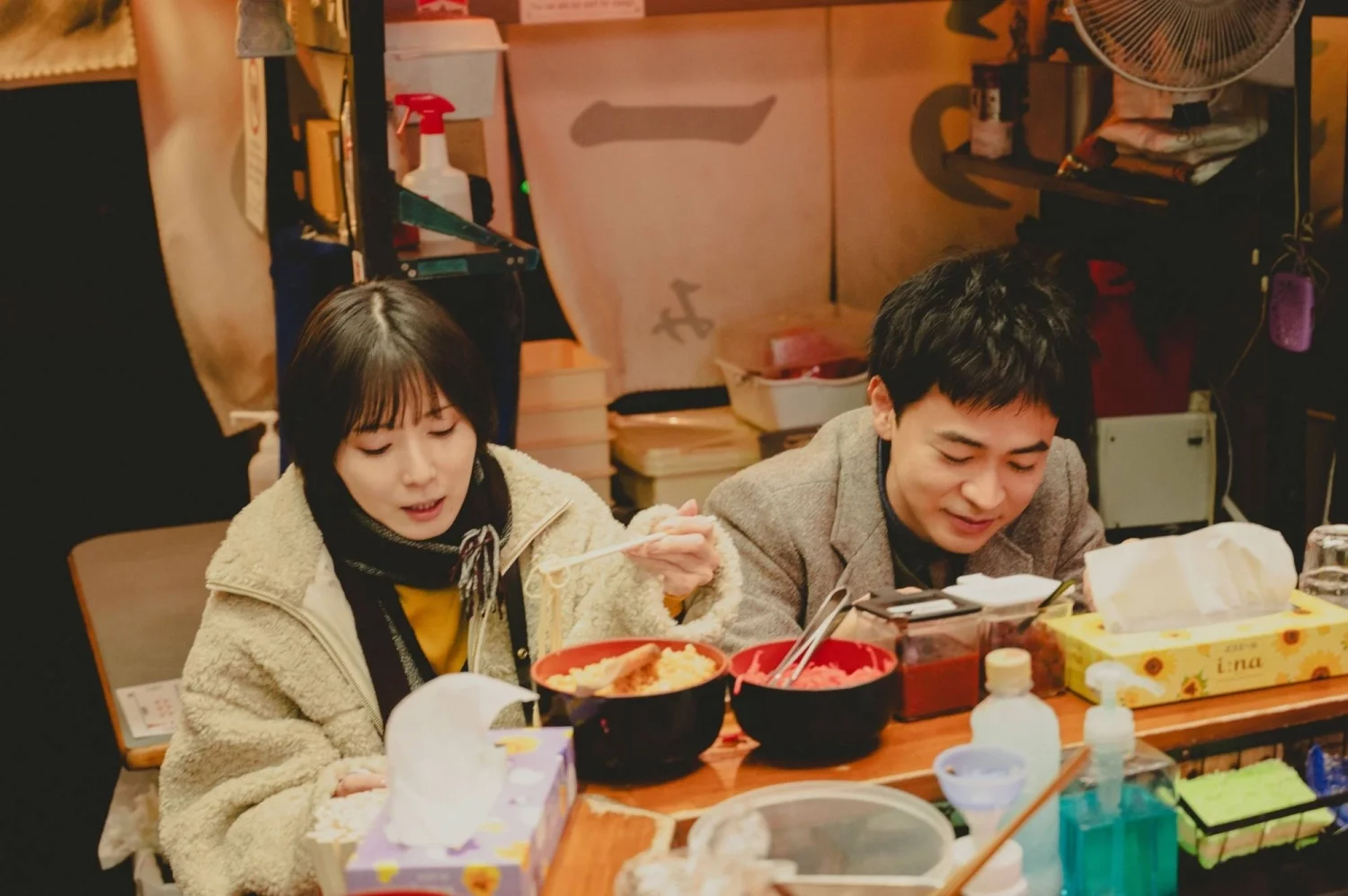
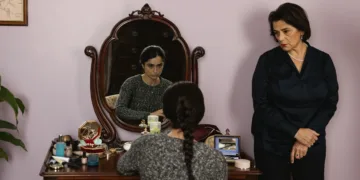
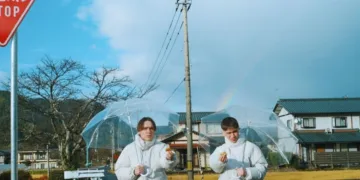
Their candor about sex makes it easy to overestimate how plainly they speak about their own attachment. Cinematographer Otsuka Ryo puts that discrepancy to work in the wide frame, where the space between two people remains visible even when their conversation suggests they have nothing to hide.
Mishima also returns to hands and feet, parts of the body that can give away a hesitation the speaker’s face keeps under control. There’s a kinship here with the attention Wenders gives to people who have no idea how closely they’re being observed. In Mishima’s film, we can attend to Kanna and Haseo at the same time. Neither has quite that view of the other.
Narita can make one of Haseo’s cutting remarks funny enough to pass as a privilege of old friendship. It’s easy to see why Kanna would value someone willing to say things other people would avoid. The performance also shows how easily that privilege can grow. Haseo scolds Kanna about her sex life, and when the two meet in Hiroshima, the feelings they’ve been able to leave in the background are much harder to keep there.
With a ferry to catch, he offers to be her voice of reason. There’s affection in the offer. Giving him that parting line lends his earlier judgments a generosity they haven’t always earned. A man who has some difficulty saying what he wants from Kanna sounds remarkably sure of what she needs from him.
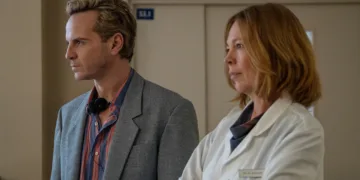
The scene with the art dealer Narasaki gives Kanna a different kind of difficult encounter. His harsh appraisal addresses the work she has made. That specificity matters in a film where so much conversation invites Kanna to understand herself through the company she keeps.
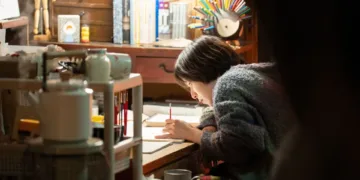
Narasaki’s assessment leaves her with a problem she would still have if her love life were settled. What does she want to make after the success of that first book? The drawings by Chisato Tanaka give this part of Kanna’s life a presence before she can explain it. They’re evidence of what she can do with an image, something even her most intimate conversations with Haseo can only approach from the outside.
Mishima gives painting a passage of its own late in the film. I wanted that attention for Kanna earlier. The three nights have taught us to discover things about her in the time she spends with someone else, and the shift to painting asks us to learn a different way of watching just as that rhythm feels complete.
The passage takes a little too long to make the change. There’s still a pleasure in being left with something Kanna has made after so much time listening to people tell her what they see in her. On New Year’s Eve, she shared someone else’s film with Haseo. Here, the thing we’re asked to spend time looking at is hers.
Two Cigarettes, Three Nights had its world premiere at the 39th Tokyo International Film Festival on October 27, 2026, ahead of its Japanese theatrical release on November 6, 2026. Directed by Yukiko Mishima, the Japanese romantic drama follows a disaffected illustrator in Kyoto whose life and romantic entanglements shift after spending three nights with a close male friend she hasn’t seen in seven years.
Full Credits
Title: Two Cigarettes, Three Nights (Japanese: 男ともだち)
Distributor: Happinet Phantom Studios
Release date: October 27, 2026 (Tokyo International Film Festival) / November 6, 2026 (Theaters)
Running time: 2 hours 11 minutes (131 minutes)
Director: Yukiko Mishima
Writers: Kaori Sawai, Akane Chihaya (based on the book by)
Producers and Executive Producers: Yusuke Sugimoto
Cast: Mayu Matsuoka, Ryo Narita, Yuki Inoue, Ayumu Nakajima, Miyu Sakihime, Takahiro Miura, Kimiko Yo, Shinnosuke Ikehata
Director of Photography (Cinematographer): Ryo Otsuka
Editors: Hitomi Kato
Composer: Goro Yasukawa
The Review
Two Cigarettes Three Nights
Yukiko Mishima calls Haseo a “male friend” in the Japanese title, then gives him and Kanna an evening with Wings of Desire to see how much that ordinary label can hold. The film is most assured when the distance between two bodies in a wide frame tells us what their frank conversation leaves unsaid. Mishima gives Haseo’s advice too much authority, and the late painting passage lingers. Still, there’s a pleasure in finally spending time with something Kanna made herself.
PROS
- The Wings of Desire screening makes shared taste a form of intimacy.
- Widescreen framing and close attention to hands and feet give hesitation a physical shape.
- Ryo Narita’s comic delivery makes Haseo’s bluntness feel like a privilege of friendship.
- Chisato Tanaka’s drawings give Kanna’s creative life a presence of its own.
CONS
- Haseo’s parting offer lends his earlier judgments too much authority.
- The late painting passage lingers after the rhythm of the three meetings feels complete.