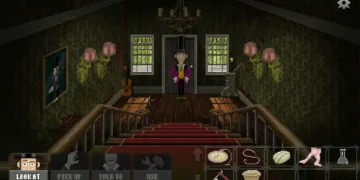




















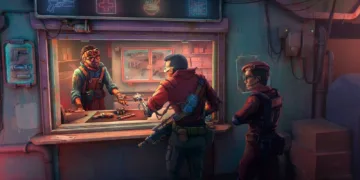


Cummerbund Bandersnatch has the plum vowels of a man who expects to be listened to, which makes him an especially funny choice to explain how to operate a point-and-click adventure. He talks you through the controls himself, addressing you directly with the same assurance he brings to the business of being a Victorian gentleman. In Heir of the Dog, that assurance will soon carry him as far as drinking an experimental tonic in his uncle’s wrecked workshop. For the moment, it makes learning how to click on things feel like the first joke you and Cummerbund are in on together.
The relationship gets better once you start trying things the game has given you very little reason to try. Some failed interactions have voiced responses written for the occasion. A bad guess can make you laugh, and a laugh can send you looking for the next bad guess.
There’s a lovely difference between clicking on something because you suspect it belongs in a solution and clicking because you want to hear what Cummerbund will say. Tall Story Games gives you room to do both. You can spend a stretch of an evening getting virtually nowhere and come away fond of the people who kept you there.
That fondness buys the story time. Cummerbund’s uncle disappears after an explosion, the tonic leaves Cummerbund with a condition straight out of a very silly reading of Dr. Jekyll and Mr. Hyde, and the search for his uncle leads to the disappearance of London’s stray dogs.
The bigger revelations take hours to arrive. In the meantime, the local urchins have Ragamuffin Idol, a bit of business that gets funnier once its setup pays off. There’s a nearer thing to look forward to than the answer to the case. It matters that the kids get to be funny on their own time, since a city full of people waiting to hand over clues would make those hours feel considerably longer.
There’s a different kind of lift when a street seems to have given up everything it has and you remember you can wind the pocket watch. It switches between day and night on demand, and at night Cummerbund becomes a small dog. The human can question people.
The dog can sniff them, get into some places the human can’t, and speak to other dogs. The uncle’s dog makes the best early case for the change. An animal already at the workshop becomes someone Cummerbund can ask about the disappearance. The condition he’d like to be rid of gives him access to a witness he’d have had every reason to overlook.

I wanted that feeling to last longer. Both forms can look, pick things up and use them, with some objects and routes restricted to one body. Much of the conversation and inventory work still falls to human Cummerbund. As London opens up, the watch can make a familiar stretch of street feel worth another visit, but there are plenty of errands where the most promising move is still to go back as a man and talk to somebody. Once the game has made a dog seem like a plausible source of information, it’s hard to shake the wish that it would let you spend a little longer thinking like one.
The East End’s tug-o-eel contest offers its own pleasure of looking again. Getting in takes a password, and the clues include a poster full of symbols and a set of statues on the beach. At first, each belongs to the local scenery. Bring the two together and the poster becomes something you can read.
The satisfying part comes a beat before you have the answer, when you realize you have enough information to work it out. A London that has spent hours training you to look at strange things for the fun of it can now ask you to remember what you saw. The joke and the clue can both benefit from that extra moment of attention.

A late puzzle involving a jail window has a different effect. The obstacle is clear, and the sticking point is which of Cummerbund’s actions the game will accept. The window gives you little reason to favor the specific verb it expects.
You can spend a while there with a perfectly sound understanding of the situation, trying inputs to see which one will count. Several open errands make that uncertainty harder to sit with. The longer an interaction refuses to yield, the easier it is to wonder if you should have left it alone and followed a different lead.
The notebook helps when those errands start to crowd one another out. It keeps the main objectives handy, the map saves you a walk back across town, and the hotspot indicator can direct your attention to the places that matter on a screen.
Those are welcome ways to pick up a thought you dropped half an hour ago. The game has no built-in hint system, so the help runs out at a very particular point. You can remember exactly why you came back to that window, find it in seconds, and still be standing there wondering which word the game wants you to click.
The Review
Heir of the Dog
I like spending time in a London where a bad guess can be worth making for the line it gets out of Cummerbund. Heir of the Dog turns that affection into curiosity. Winding the watch can give a familiar street a fresh lead, and the tug-o-eel puzzle makes it feel good to remember an odd detail. I wanted the game to spend longer in the dog’s company, and a few puzzles leave you guessing which command will count. Still, there’s a warmth to an adventure that gives you something to enjoy while you’re getting stuck.
PROS
- Voiced jokes make failed experiments fun
- The pocket watch gives familiar streets fresh possibilities
- The tug-o-eel puzzle rewards close observation
- Ragamuffin Idol gives the slow mystery a welcome comic detour
CONS
- Too much of the detective work falls to human Cummerbund
- A few puzzles give too little guidance about which command to try