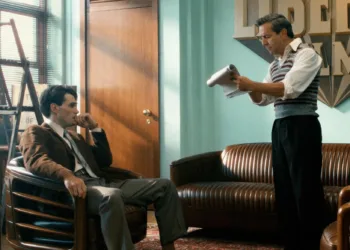



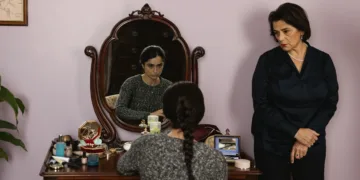
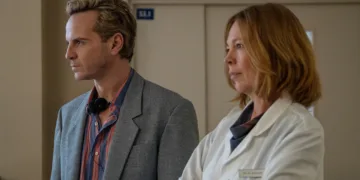








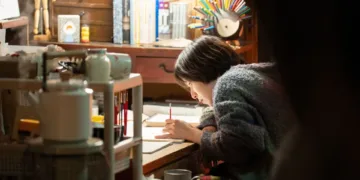












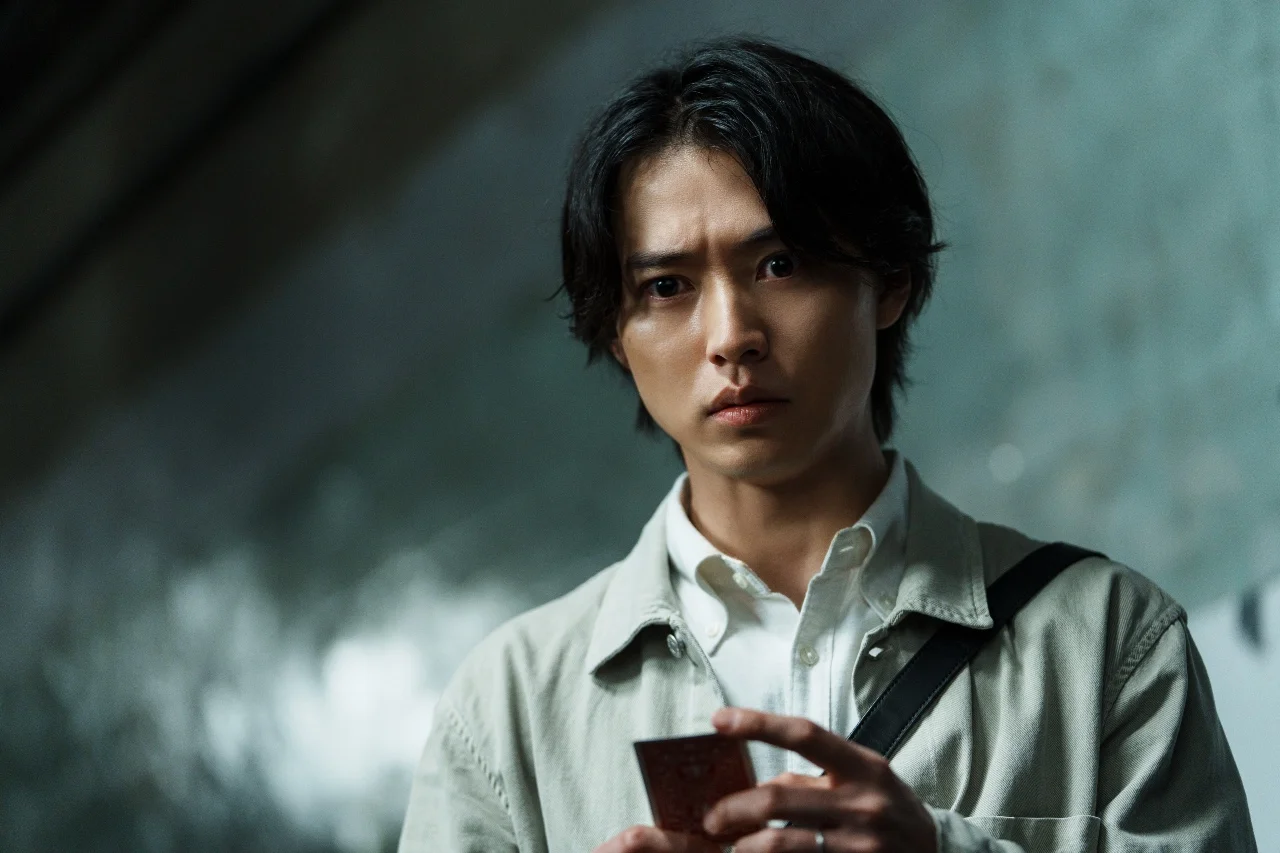
Kai books an appointment to find himself. He sees a poster in the woods, follows up on its promise of self-discovery, and arrives at a clinic where Asumi’s assistant slips him a drug. Soon he and Asumi are sharing a dream. It’s an efficient appointment, if you leave out the part where the patient gets to decide what happens to him. Kai has agreed to be curious about himself. The clinic takes that as permission to satisfy somebody else’s curiosity.
Kyo tries a different shortcut. With the drug that gives Kefi its title, she switches bodies with her sexual partners. In one encounter she ends up having sex with her own body from inside a man’s. I initially took the swap as an experiment in empathy, which is probably the most respectable thing anyone could call what happens in that hotel room. But look where Kyo’s attention goes. The change gives her a way to experience herself from the outside. The man whose body she occupies remains harder to imagine. Kisin Saito gets a sharp joke out of the difference between occupying someone’s position and having any idea what it’s like to be them.
The clinic occupies the sisters’ childhood home. Asumi lives there, and she and Kyo have a younger sister, Kino, who happens to be Kai’s girlfriend. Their father has died, and Saito gives the sisters separate stretches of a single day before bringing them together at the house in Fukui. Their father gets to introduce them from beyond the grave. The introductions are fond, and his wish for a happy family and an ordinary life sounds modest until you consider the number of people required to cooperate. He can tell us who his daughters are with the assurance of someone who will never have to hear them correct him.
I wondered if that made his narration an imposition. Kino’s walk complicates the thought. She retraces a route she used to take through the woods with him. It’s a small, practical form of remembering. She knows where to go because they went there together, and she can go there now for reasons she owes nobody. There’s room in the film for affection that she gets to exercise on her own. I wanted a little of that freedom for Asumi and Kyo, whose episodes give us considerable access to their peculiar activities and comparatively little sense of how either sister understands the family she’s returning to.
Saito’s debut has a weakness for any device that gets people past the awkward preliminaries of knowing each other. At the clinic, that impatience has teeth. The film has found a nasty little idea about care here, especially in a house where someone once wanted everybody to get along. The wish to know what someone needs can shade into a willingness to decide it for them. I wanted the shared dream to put greater pressure on Asumi’s part in that arrangement. Once the drug has done its work, the novelty of the encounter takes up space that could have gone to her understanding of what she’s doing.
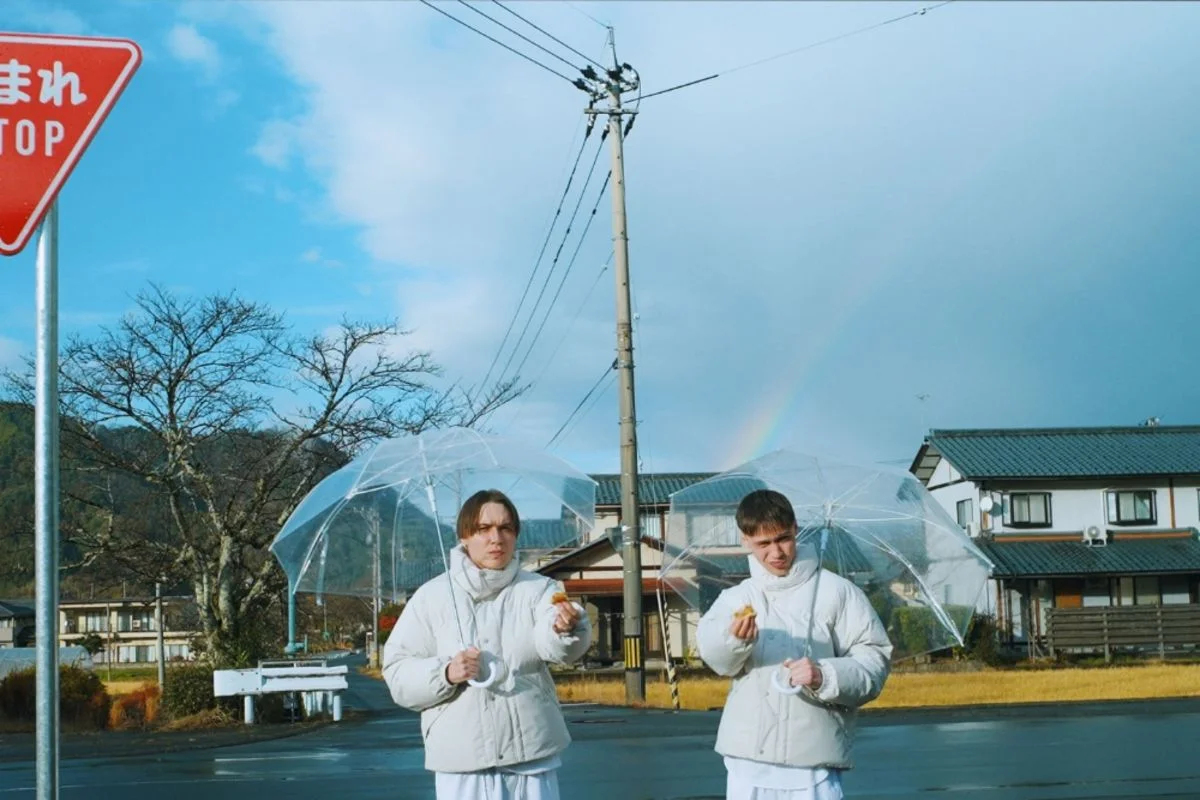
The film’s freedom with tone is part of its pleasure. The aliens in matching silver jackets speak in unison, a wonderfully economical way to make two people seem incapable of disagreeing. Then Saito leaves the sisters to spend time with a traditional washi papermaker. The documentary-like attention to his work has a patience I missed in the sisters’ separate episodes. The episode veers into sexual assault, and that patience acquires an uncomfortable weight. I kept waiting for the film to give the violence the kind of attention it had given the craft. The shift has force in the moment, and its place in the film remains difficult to justify. I was relieved when the sisters finally got to quarrel.
Saito has kept them apart long enough that hearing them answer one another feels almost indecently direct. An apology in this house has to be spoken by somebody who can hear what comes back. I believed in the exchange, and I wished the film had risked one earlier. We’ve spent most of the day getting to know the sisters separately, so the reunion has to establish how they speak to one another while suggesting a history of getting it wrong. The father had the privilege of introducing each daughter on her own. I wanted time to hear how any one of them would introduce the other two, with both of them there to interrupt.
Kefi had its world premiere at the 39th Tokyo International Film Festival on October 27, 2026. Directed by Saito Kisin, the surreal Japanese drama follows three estranged sisters who reunite after their father’s death to navigate grief and extraordinary daily occurrences.
Full Credits
Title: Kefi
Distributor: KEFI Film Partners
Release date: October 27, 2026 (Tokyo International Film Festival)
Running time: 1 hour 19 minutes (79 minutes)
Director: Saito Kisin
Writers: Saito Kisin
Producers and Executive Producers: Sekiya Nami, Iwamoto Hiroshi
Cast: Takada Riho, Kaiya Tone, Iriki Mari, Kato Konatsu, Takei So, Nikita & Danil, Mimura Kazunori
Director of Photography (Cinematographer): Saito Kisin
Editors: Saito Kisin
The Review
Kefi
Kefi is funniest when it mistakes a change of body for a change of perspective. The clinic’s shared dream has a nastier idea about the way care can become control, and I wish Saito had stayed with Asumi long enough to see what she made of it. The papermaking detour gives the craft a patience it scarcely extends to the assault that follows. Then the sisters finally quarrel, and I believe them. One scene has to carry a relationship the film could have spent the day getting to know.
PROS
- Kyo’s body swap makes a sharp joke about the limits of empathy.
- The clinic gives self-discovery a sinister edge.
- Kino’s woodland walk makes grief feel ordinary and specific.
- The sisters’ quarrel and apology feel candid.
CONS
- The shared dream gives too little space to Asumi’s understanding of her own actions.
- The papermaking detour gives its assault too little dramatic attention.
- Keeping the sisters apart leaves the reunion to establish too much of their relationship.