



























David Nicholas Wilkinson keeps trying to explain a medical procedure, and the medical staff keep interrupting him to prepare for it. The scene has two schedules. One belongs to a filmmaker seeking a usable take; the other belongs to the people treating his cancer. Retaining the interruptions gives the sequence its comic rhythm, while placing a practical limit on his authority. He can direct the documentary. Getting everyone to wait for his explanation is another matter. In 1 in 2, his account of living with stage-four bowel cancer, the camera repeatedly encounters a body whose requirements take precedence over the production.
Wilkinson extends that access to the toilet, appearing there in live action and animation, and speaks about bowel function with a candor that makes the usual discretion around illness look faintly absurd. These images strip the director of certain protections routinely granted to the person behind the camera.
He supplies the embarrassing evidence himself. Yet exposure remains a choice, and the film benefits from placing his bodily disclosures alongside contributors whose experiences reach us through interviews. His willingness to be filmed establishes the terms of his participation; it creates no corresponding debt for anyone else. Privacy survives as a legitimate position within a documentary so committed to disclosure.
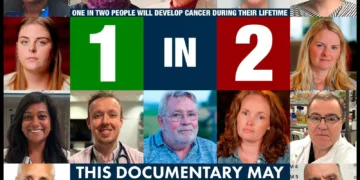
Milli Tanner’s interview demonstrates how little visual elaboration such testimony needs. Filmed in an unremarkable auditorium, she recounts thirteen doctors’ appointments before a stage-three bowel cancer diagnosis, alongside tests and hospital visits. The setting offers no expressive architecture to compete with the account. Its plainness leaves the accumulation of attempts to secure a diagnosis carrying the scene’s force.

Tanner also discusses bowel habits and a stoma bag, speaking directly about experiences that embarrassment can make difficult to communicate. Here, the documentary’s act of looking depends on its capacity to listen. A young patient explains what happened while the frame gives her an audience she previously struggled to obtain.
That struggle recurs in younger contributors’ accounts of dismissed symptoms and delayed recognition. Wilkinson places these experiences beside medical testimony and his own friendly exchanges with nurses and doctors, preserving an uncomfortable coexistence of trust and failure. The staff caring for him can be attentive without answering for every earlier decision described by another patient.
This gives the institutional criticism useful precision. The film also asks why bowel cancer is appearing among younger adults, considering diet, lifestyle, and environmental possibilities without producing a settled explanation. Its firmer ground is the testimony about what happens once symptoms appear: repeated appointments, uncertainty, and the effort of getting someone to take the concern seriously.
Wilkinson’s humor changes the pressure of this material. A montage of him swearing at cancer converts anger into a repeatable piece of performance, giving an otherwise uncontrollable adversary something approaching a verbal address. The editing makes frustration available as laughter.
His easy exchanges with staff work differently, locating treatment within recognizable social behavior: people joke while doing their jobs, and patients retain personalities alongside their diagnoses. These moments help prevent medical exposure from consuming his identity. The man receiving chemotherapy can still be an irritable filmmaker attempting to finish a scene. Illness has acquired considerable influence over the schedule, with no evident qualifications in production management.
The more revealing comic passage occurs on Ilkley Moor, where cinematographer Don McVay questions Wilkinson’s handling of incontinence and the humor grows awkward. Wilkinson leaves room for that objection. A film built around its director’s readiness to speak and expose himself briefly has to accommodate someone challenging the manner of that exposure.
Keeping the exchange changes the status of the joke: his own coping mechanism becomes something open to examination, including its effect on patients who find little amusement in the same experience. The camera records a limit to the personality organizing the documentary. Wilkinson’s discomfort gives the scene an ethical substance that another successfully delivered joke would have missed.
The accounts of community support extend this question beyond the director’s temperament. Contributors describe relief in being able to discuss intimate treatment details with people who understand them. Stoma bags can acquire a different meaning within that company, associated with the life they help sustain rather than solely with shame or disruption.
The film makes space for that change through people speaking about their experience. Their candor matters because it permits several responses to inhabit the same conversation. Gratitude for a treatment and distress about living with it can remain equally intelligible. Wilkinson’s comic approach is one available response among those gathered here.
Deaths among the contributors make the documentary’s responsibility to its subjects painfully concrete. Brief funeral footage introduces images these people can no longer answer or qualify, changing the filmmaker’s position from fellow patient to custodian of a record. The brevity of those passages matters: a funeral can acknowledge a loss without furnishing an explanation for the life preceding it.
Their presence also complicates the film’s encouragement to seek help and accept treatment. The audience has encountered individuals with particular experiences, and their deaths resist being tidied into either a warning or a reassurance. Wilkinson has to keep making editorial decisions in the company of those absences.
His difficulty finding a stopping point becomes the clearest weakness in the construction. Apparent endings yield to further material, and a comic post-credit sequence offers another adjustment of emotional register. Each return asks the viewer to settle into a revised position after the film has already suggested a place to stop.
The cumulative effect diffuses some of the preceding material’s force. There is understandable care behind the desire to leave viewers with something bearable, but repeated closure makes that care conspicuous as an organizing hand. The documentary’s frankness about bodily experience becomes less assured when it tries to determine the feeling that should accompany departure.
Producer Edwina Forkin’s account of ovarian cancer gives the hopeful material a specific subject and experience. Her attention to mental wellbeing alongside physical treatment introduces care that continues beyond a diagnostic result, allowing reassurance to take a practical form.
Wilkinson’s own cancer is shown regressing, a development that changes his circumstances without resolving every fear the documentary has recorded. These accounts need room beside the losses, and the edit strains to find it. At the point where filming stops, improvement has become part of Wilkinson’s experience, while treatment continues to make demands on his body and his time.
1 in 2 is a compelling documentary released in UK cinemas in November 2026. Directed by David Nicholas Wilkinson, the film follows the filmmaker’s own journey facing Stage 4 bowel cancer twice over, exploring the rising rates of the disease and the critical shortcomings of early screening tests.
Full Credits
Title: 1 in 2
Distributor: Guerilla Films
Release date: November 2026
Rating: 15
Running time: 2 hour 22 minutes (142 minutes)
Director: David Nicholas Wilkinson
Writers: David Nicholas Wilkinson
Producers and Executive Producers: David Nicholas Wilkinson
Cast: Dr. Ravindhi Murphy, David Nicholas Wilkinson, Prof Seamus Martin, Lisa Andrews – Dhapre, Dr. David Burke, Yasemin Hirst, Slaine Kelly, Laura Lee
The Review
1 in 2
Wilkinson turns control of his own image into a serious question about care: who gets seen, who gets heard, and who decides how an audience should feel? The frank treatment footage and Tanner’s testimony give 1 in 2 its authority; the Ilkley Moor exchange gives that authority a useful limit. Repeated endings weaken its composure, particularly as it works to leave viewers reassured. Its candor remains persuasive because embarrassment, anger, and gratitude retain their separate claims.
PROS
- Treatment footage makes vulnerability concrete.
- Treatment footage makes vulnerability concrete.
- Humor remains open to challenge.
- Community accounts preserve differing patient responses.
CONS
- Repeated closures diffuse emotional force and expose the effort to reassure.