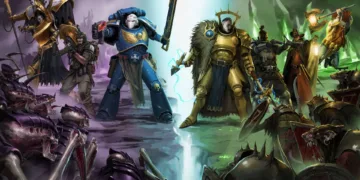
























Warhammer Survivors treats preparing a miniature army as a source of military hardware. Measuring tape expands the area covered by your attacks, while Nuln Oil, normally used to shade painted figures, becomes a weapon that can spread lethal pools across the ground.
Bristol-based Auroch Digital has reached into the British hobby culture behind Games Workshop’s fictional wars and given its equipment battlefield functions. The relationship between reference and effect matters. Measuring an attack and increasing its reach belong to the same activity; the absurdity comes from letting the measuring instrument do the fighting.
These objects also provide common ground for the game’s two settings. Warhammer 40,000 and Age of Sigmar retain separate characters, enemies, and maps, yet dice and painting supplies belong comfortably to both. Their shared culture exists around the table where their armies are assembled.
The Hobby Table stage makes that relationship literal by placing the fighting on a crafting surface. Recognizing Nuln Oil adds a joke about the hobby, but understanding a dangerous pool requires no such knowledge. As Warhammer travels into another gaming tradition, its familiar equipment offers pleasures at different levels of acquaintance.
That other tradition supplies an immediately understandable foundation. Developed in partnership with Vampire Survivors creator poncle, the game follows its collaborator’s pattern of automatic attacks, manually controlled movement, and upgrades chosen between increasingly crowded stretches of combat.
You collect experience from defeated enemies, add weapons and passive bonuses, and try to survive until an Extremis Boss arrives at 25 minutes. Much of the satisfaction lies in arranging attacks that eventually seem capable of fighting without you. Movement remains essential because the places where damage happens do not necessarily coincide with the places where you need protection.
Followers make that distinction particularly interesting. Select certain weapons and their owners join your character: Malum Caedo can acquire tank support through Knight-Commander Pask, whose vehicle accompanies him into battle. The weapon fires from its bearer, moving the origin of an attack away from the hero under direct control.
An aura surrounding a follower provides different protection from one surrounding you; an orbiting axe must be brought into contact with enemies through the movements of the figure carrying it. Collecting an arsenal starts to resemble assembling a small force, with its members occupying useful and sometimes awkward positions. Their invulnerability removes the need to protect them, leaving you to manage the consequences of where they stand.
The factions give those positioning decisions a recognizable purpose. Death Guard poison hazards make patches of ground dangerous, while an Ork WAAAGH intensifies the crowd pressing toward you. These identities register through behavior before they require an explanation from the fiction.

Someone unfamiliar with Nurgle can still learn to avoid the poisoned floor. The pleasure for an established fan comes from seeing a faction’s association translated into a practical problem, while a newcomer receives that problem directly. The adaptation is most persuasive where recognition and learning can happen together.
Enclosed stages develop the tactical possibilities. A room with one entrance can support a temporary defensive arrangement of area damage, direct fire, and knockback. Walls interrupt your movement and can stop projectiles, giving attacks that descend from above a use beyond their damage numbers.
Holding a doorway produces a small, legible version of the war: there is a front, a defensive position, and a reason to choose one weapon over another. Enemy interaction with barriers is less dependable. Foes can pass through some obstacles while respecting others, making it difficult to judge how long that position will remain useful. Retreat is an interesting demand when the approach of danger can be understood.
The growing squad also makes that understanding harder. Followers, broad weapon effects, and dense enemies compete for space until the ground beneath them becomes difficult to read. Situational transparency helps, but a confined room can still conceal the source of incoming damage beneath companions and attacks.
This is a particular cost of making the collection visible. Every additional figure gives the expanding force a satisfying physical presence, then occupies space needed to distinguish an escape route from a hazard. The formation whose attack origins demand attention can become the thing obstructing it.
Permanent progression keeps those frustrations from making every defeat feel wasted. Gold purchases lasting improvements or additional characters, and character-specific challenges can release weapons for use across the roster. Evolutions give the growing armoury something to discover: an upgraded Boltgun can become a faster-firing Heavy Boltgun through a crate reward, with weapon and passive combinations encouraging plans beyond the next level-up. The appeal comes from bringing another possibility into circulation. A failed attempt can still change the equipment available for the following one, giving repetition a purpose beyond reproducing the same successful build.

Early combat makes that promise work harder than it should. Experience skulls do not drop consistently from enemies, slowing the accumulation of upgrades while the assault gathers strength. Permanent improvements help produce the later surge of destructive power, but reaching it can involve stretches where accumulating statistics matters more urgently than exploring combinations.
The separate progression paths in 40,000 and Age of Sigmar extend this investment, with links between their enhancement systems offering incentives to move between settings. There is room to pursue a preferred universe, though access to a second collection does not by itself remedy the effort required to get the first moving.
The Extremis encounters expose a sharper problem with what repeated play teaches. Surviving to 25 minutes is insufficient: each stage requires particular preparation before its boss can be damaged. Discovering a weapon evolution rewards experimentation with a new tool; discovering that a completion requirement was missing can invalidate an entire attempt.
The preparation interface supplies too little guidance, with a partially concealed menu appearing after the long run needed to reach the encounter. That delay makes the next attempt harder to plan for reasons unrelated to steering a squad or choosing complementary attacks. Without the required preparation, the Extremis Boss remains invulnerable and the game cuts to the hero’s death.
The Review
Warhammer Survivors
Warhammer Survivors carries the culture of the miniature table into its weapons, humor, and moving formations. Its best adaptations let newcomers understand the effect while hobbyists recognize the joke. Followers and faction behavior give familiar combat useful tactical texture, and unlocks keep failed runs productive. Slow early growth, crowded visuals, uncertain obstacle rules, and poorly explained boss requirements weaken that pleasure. Assembling this little army is satisfying; understanding what threatens it can be needlessly difficult.
PROS
- Hobby references become effective weapons and upgrades.
- Followers add meaningful attack-positioning decisions.
- Faction behavior turns familiar identities into tactical pressures.
- Unlocks and evolutions reward continued experimentation.
CONS
- Crowded effects and followers obscure hazards.
- Inconsistent obstacle interactions undermine defensive planning.
- Slow early growth encourages grinding for permanent upgrades.
- Boss preparation requirements receive inadequate, delayed guidance.