















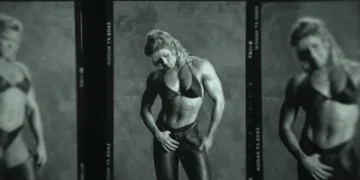














Nora skates while Wayne Gretzky’s greatest goals return to her imagination. The association gives her ambition a ready-made visual language: she can picture the future because hockey has already supplied its images. There is something touching about that borrowed certainty. Molly Peyton makes Nora’s admiration feel unembarrassed, the absorption of a player imagining herself capable of the same things. Yet those celebrated goals belong to another player. The film places her desire beside the evidence of his achievement, leaving a small but significant gap between them.
Her own place in hockey comes with a less distinguished uniform. At the local rink, Nora cleans toilets and serves concessions wearing a puck-shaped hat with her name on it. Professional identity is available in several price brackets. Written and directed by Nick Hagen and Hamid Torabpour, Before the Ice Melts gives this small-town player a looming professional draft, presented as her final chance at eligibility. The rink work makes her attachment tangible: she remains close to the game even when the job offers little recognition. It also gives the film an everyday version of commitment that the Gretzky imagery cannot supply.
The hockey sequences have energy, with dynamic photography and choreography lending the skating a welcome physical immediacy. There simply is not enough of that activity to establish Nora’s readiness with equal confidence. Athletic process receives scant attention, so the progression from dedicated player to plausible professional candidate stays thin. This matters because the film makes selection carry such weight. Seeing someone want an opportunity and seeing what she might do with it create different kinds of investment.
That imbalance puts considerable pressure on the people discussing her future. Her mother, Carol, played by Sonia Satra, worries about marketable skills and employment prospects. These are sensible concerns in a story whose heroine already holds an unglamorous service job.
Carol’s anxiety gives the potential disappointment a practical dimension: Nora will still need work after the names have been read. The film’s preference for encouragement limits its engagement with this problem. Belief is easily dramatized through supportive company; the prospect of building an acceptable life after a failed ambition receives less room.
Ted, the realtor played by Charles Hubbell, supplies a much easier person to oppose. He considers giving Nora office work, then objects when he discovers her teaching his daughter hockey instead of the figure-skating lessons he purchased. His complaint contains two distinct grievances, and the screenplay’s handling of them is revealing. A customer can reasonably expect the lesson he paid for. His insistence that hockey is unsuitable for a young lady is another matter. By attaching that prejudice to the dispute, the film gives us an immediate reason to dismiss him, letting the legitimate question about Nora’s responsibility recede behind his objectionable manners.
Peyton keeps Nora from becoming merely the agreeable figure left standing after such encounters. Her confidence and sincerity lend the character a human ease that the screenplay’s arrangement of allies and obstacles cannot quite manufacture. She is likable without seeming to petition for approval. That steadiness is especially useful in the coaching episode, where her enthusiasm for sharing hockey can be understood without making Ted’s every complaint invalid.
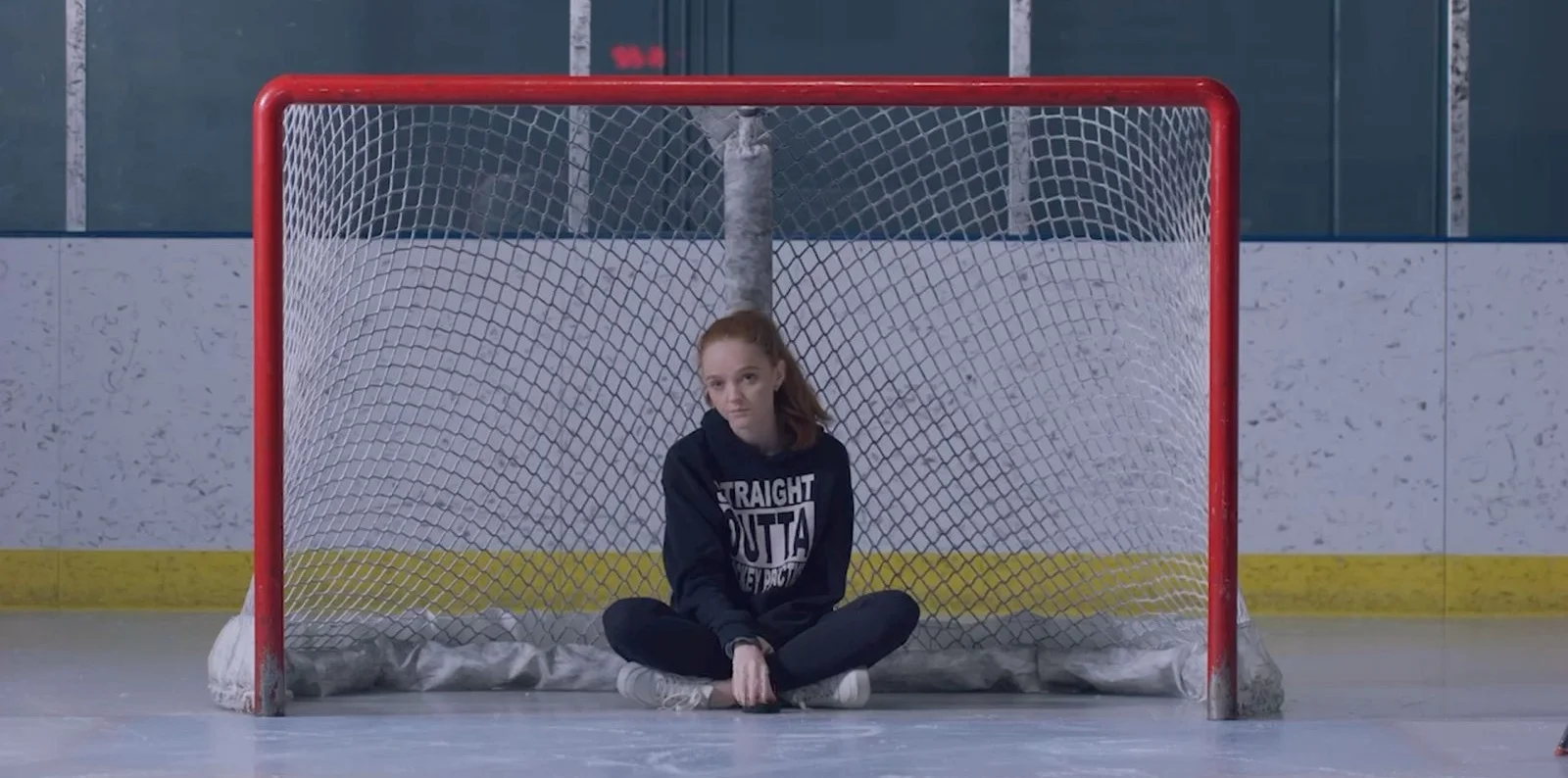
The earnest light-rock songs do some of the persuading for her. Their emotional emphasis keeps encouragement close at hand, steering our response toward hope even when Nora’s prospects should invite doubt. This is familiar inspirational grammar, and its accessibility has value. Younger viewers can follow the emotional stakes without negotiating much tonal friction. The cost is a reduced range of feeling. Uncertainty repeatedly arrives accompanied by reassurance, leaving Peyton to supply the credibility that the music is already asking us to grant.
Appearances by established hockey figures, including Luc Robitaille, give the film a pleasant proximity to the sporting world it celebrates. Their presence offers recognition and a little borrowed authority. At roughly 74 minutes, the picture moves briskly through its familiar material. Brevity protects the sentimental register from becoming exhausting, while also narrowing the space available for the work, setbacks, and competing obligations behind a professional ambition.
The draft gathering still generates interest. Nora waits with family, friends, and other candidates as names are announced, and the communal setting gives her private hope a public vulnerability. The outcome can remain uncertain even when the film’s comforting temperament is easy to read. As the names are read, Nora must listen alongside people whose affection cannot influence the next announcement.
Before the Ice Melts was released digitally on VOD platforms via Vision Films on September 8, 2026. Directed by Nicholas Hagen and Hamid Torabpour, the family-friendly sports drama follows a dedicated young small-town hockey player as she works at a local rink while anxiously waiting to see if she will be drafted into professional hockey.
Where to Watch Before the Ice Melts (2026) Online




Full Credits
Title: Before the Ice Melts
Distributor: Vision Films, Winter State Entertainment
Release date: September 8, 2026
Rating: PG
Running time: 1 hour 15 minutes (75 minutes)
Director: Nicholas Hagen, Hamid Torabpour
Writers: Nicholas Hagen, Hamid Torabpour
Producers and Executive Producers: Nick Hagen, Christopher V. Nelson, Camille Torabpour, Hamid Torabpour, Marv Dauer
Cast: Molly Peyton White, Charles Hubbell, Nikki Leigh, Sonia Satra, Tommy Self, Luc Robitaille, Lou Nanne
Director of Photography (Cinematographer): Jeff Hamm
Composer: Erick Schroder
The Review
Before the Ice Melts
Molly Peyton gives Nora a persuasive human presence, even when the film borrows athletic credibility from Gretzky’s goals and famous faces. The skating has energy, and the compact running time suits this gentle inspirational story. Simplified opposition and insistent musical reassurance leave little uncertainty beyond the draft result, making Nora’s hopes easier to share than her professional readiness is to assess.
PROS
- Peyton’s confident, sincere lead performance.
- Energetic photography and choreography in the hockey sequences.
- Compact runtime keeps the sentimental material moving.
CONS
- Limited development of Nora’s athletic preparation.
- Supporting conflicts simplify practical and ethical questions.
- Musical reassurance narrows the emotional range.