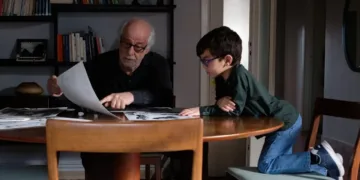












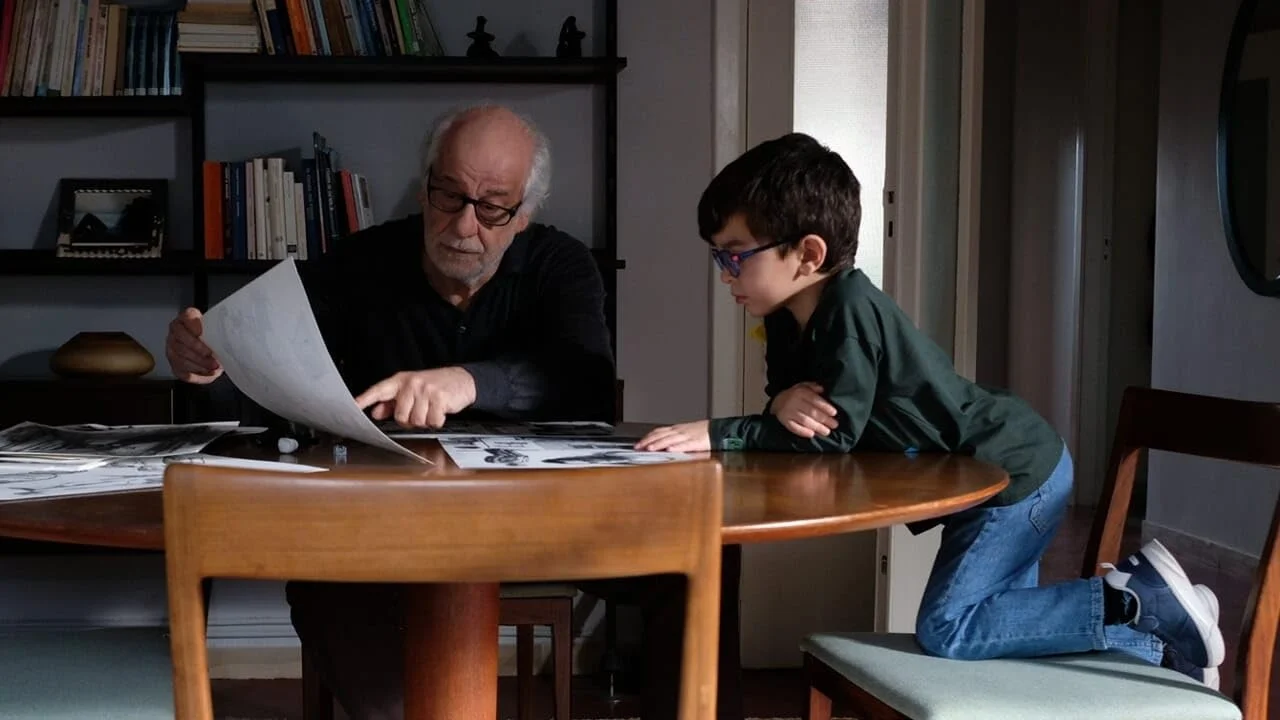

Daniele suspects the printer. His illustrations for The Odyssey look too dark, and a fault in reproduction would be a reassuring explanation: the artist remains sound, the machinery has let him down. Then his five-year-old grandson Mario notices the same darkness. There is an awkward piece of corroboration, too. Daniele’s drawings for a new edition of Henry James’s The Jolly Corner have already been rejected on similar grounds. A professional problem has followed him into the family apartment, where nobody observes the proper channels for submitting feedback.
Mario has no qualifications to inspect and no career to defend. His observation can be accurate without being profound, which makes it especially inconvenient. Mario Martone’s Scherzetto finds an effective source of friction here: a child can see something an accomplished adult would prefer to explain away. The boy’s lack of deference exposes the gap between Daniele’s confidence in his craft and his confidence in these particular drawings.
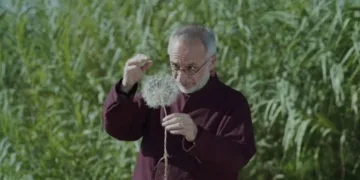
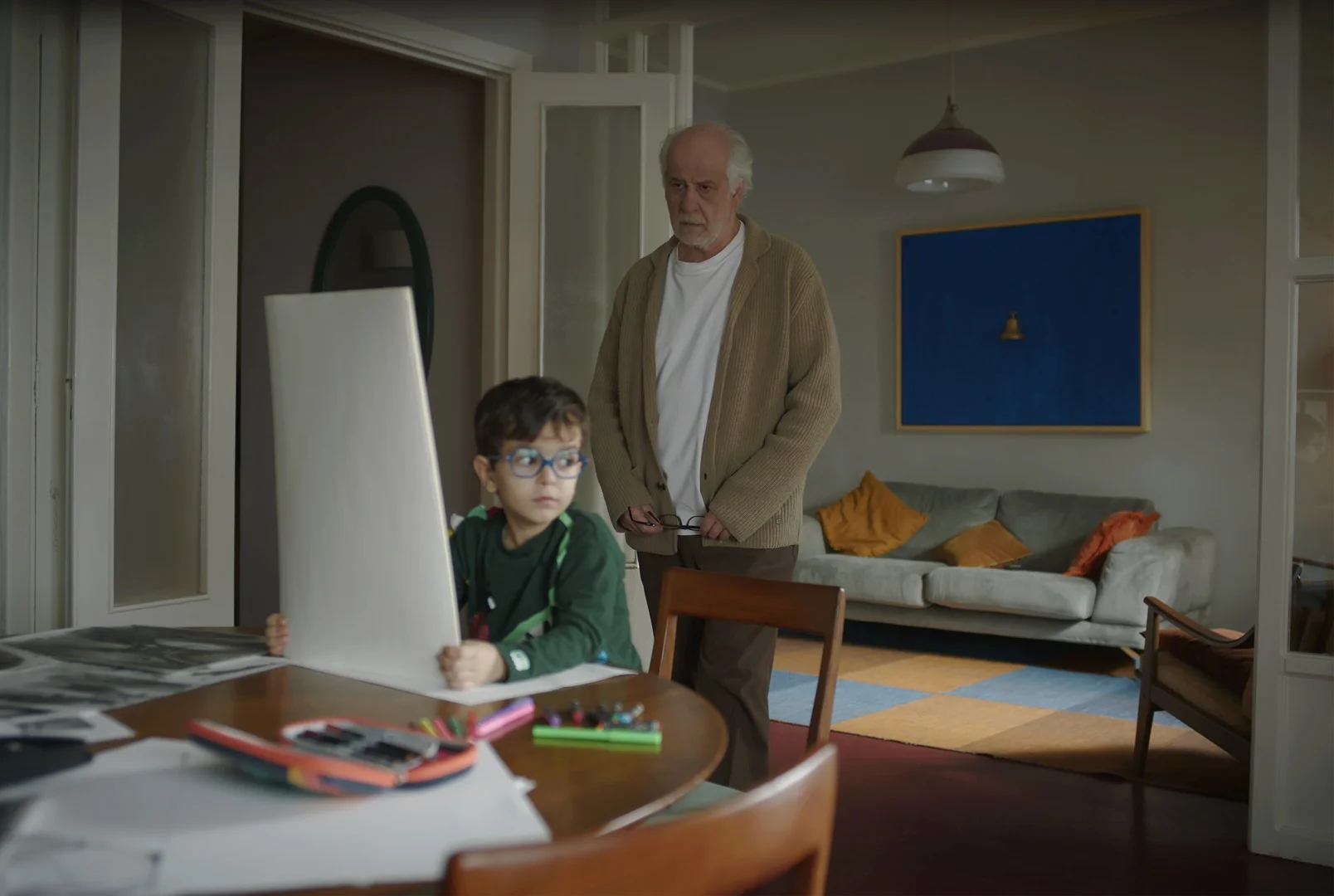
Adapted from Domenico Starnone’s novel, the film brings the elderly illustrator, played by Toni Servillo, back to Naples for a few days of childcare. His daughter Betta and her husband are away, leaving him with Mario, played by Lorenzo Perrotta. The arrangement also returns Daniele to the apartment where he grew up. He arrives expecting to continue his commission while the boy reads or colours quietly. This is an optimistic assessment of both artistic concentration and five-year-olds.
I was inclined to defend his wish to work. A lifetime spent acquiring a skill ought to count for something; being a grandfather need not dissolve every other identity a person possesses. Yet that defense quietly borrows Daniele’s assumption that Mario should make the arrangement possible. He has accepted a task requiring attention and budgeted for one requiring occasional supervision. The interruptions expose an error in the adult’s calculations, even when the child is being a pain. And he can be a pain.
Perrotta gives Mario’s directness enough disruptive force to keep the relationship from becoming a procession of adorable lessons. His perceptiveness about the pictures coexists with his refusal to supply the quiet Daniele expects. Servillo’s prickliness has something substantial to resist: a small person whose needs cannot be dismissed through professional seniority. Their exchanges sustain affection without making either participant consistently agreeable. The comedy has room for the grandfather’s exhaustion and the grandson’s entirely reasonable lack of interest in managing it.
The apartment complicates this dispute over attention. For Daniele, the rooms contain the family he remembers and the life he left. For Mario, they are home. Returning gives the grandfather access to his past, yet the present occupants have made lives there which proceed without consulting his memories. His inward absorption must compete with a child who has immediate uses for his company.
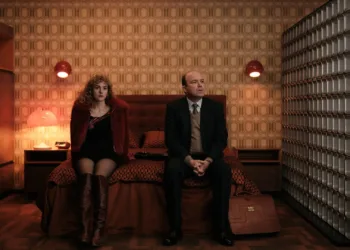
Martone makes that past visible through apparitions of former family members. The connection with Daniele’s ghost-story commission is clear: the artist drawing a haunting is being visited by his own. The difficulty lies in how little the encounters tell us about the particular relationships behind his unease. I can understand that Daniele is troubled while remaining uncertain about what, in these encounters, troubles him.
This is where the film’s intellectual design becomes easier to admire than to feel. The drawings have a specific problem, a rejection, and a child’s unsolicited diagnosis. Asking for sharper relationships here is hardly asking the ghosts to explain themselves at length. The apartment begins to store a quantity of sadness whose contents remain frustratingly indistinct.
The walks through Naples offer a useful release from that accumulation. Grandfather and grandson occupy the streets together, temporarily outside the room-by-room insistence of Daniele’s history. These passages give their companionship an existence beyond his crisis. Mario can be someone with whom he spends time, rather than a persistent interruption to the serious business occurring inside his head.
The balcony supplies the haunting with firmer ground, precarious as that ground happens to be. Daniele has feared this small ledge since childhood, and the drop below retains its power over him. A troublesome door handle adds the possibility of being trapped outside. Here, anxiety has a location and a mechanism. The apartment can expose him to an old terror through an ordinary defect; no apparition needs to appear and certify its meaning.
That physical vulnerability also makes the film’s movement between playfulness and fear understandable. A child’s mischief and an adult’s terror can occupy the same household without either experience becoming false. The unevenness comes when the lightly defined family ghosts ask for an emotional investment that the concrete balcony fear earns much more readily.
Martone’s tenderness works best under this pressure, where affection has to accommodate a grandfather who remains irritable, distracted, and frightened. Daniele is responsible for Mario while carrying a child’s fear of his own, and the faulty handle gives that divided attention an immediate practical cost.
Scherzetto had its world premiere at the 83rd Venice International Film Festival on September 10, 2026. Directed by Mario Martone and adapted from Domenico Starnone’s novel, the Italian drama follows an elderly illustrator who returns to Naples to look after his young, unruly grandson, triggering an intense existential battle of wills and memories.
Full Credits
Title: Scherzetto (Trick)
Distributor: 01 Distribution
Release date: September 10, 2026 (Venice International Film Festival)
Running time: 1 hour 45 minutes (105 minutes)
Director: Mario Martone
Writers: Mario Martone, Ippolita Di Majo, Domenico Starnone
Producers and Executive Producers: Maria Carolina Terzi, Carlo Stella, Lorenza Stella, Luciano Stella, Mauro Luchetti, Francesco Grisi, Giorgia Priolo, Roberto Sessas
Cast: Toni Servillo, Lorenzo Perrotta, Serena Rossi, Leonardo Lidi, Gianluca Di Gennaro, Giovanni Ludeno
Director of Photography (Cinematographer): Paolo Carnera
Editors: Jacopo Quadri
Composer: Valerio Vigliar
The Review
Scherzetto
Daniele’s expertise has limited jurisdiction in a room containing a five-year-old. Martone turns that inconvenience into an affectionate examination of artistic pride and adult responsibility, with Servillo and Perrotta keeping irritation alive inside the tenderness. The family apparitions remain emotionally indistinct, weakening the film’s movement into haunting. Its balcony fear is far more persuasive: an old terror makes the grandfather’s authority suddenly precarious.
PROS
- Servillo and Perrotta sustain affection through believable friction.
- Mario’s criticism gives artistic insecurity a concrete dramatic basis.
- The apartment connects family memory with present responsibilities.
- The balcony turns childhood fear into immediate tension.
CONS
- Underdefined family apparitions weaken the haunting’s emotional impact.