




























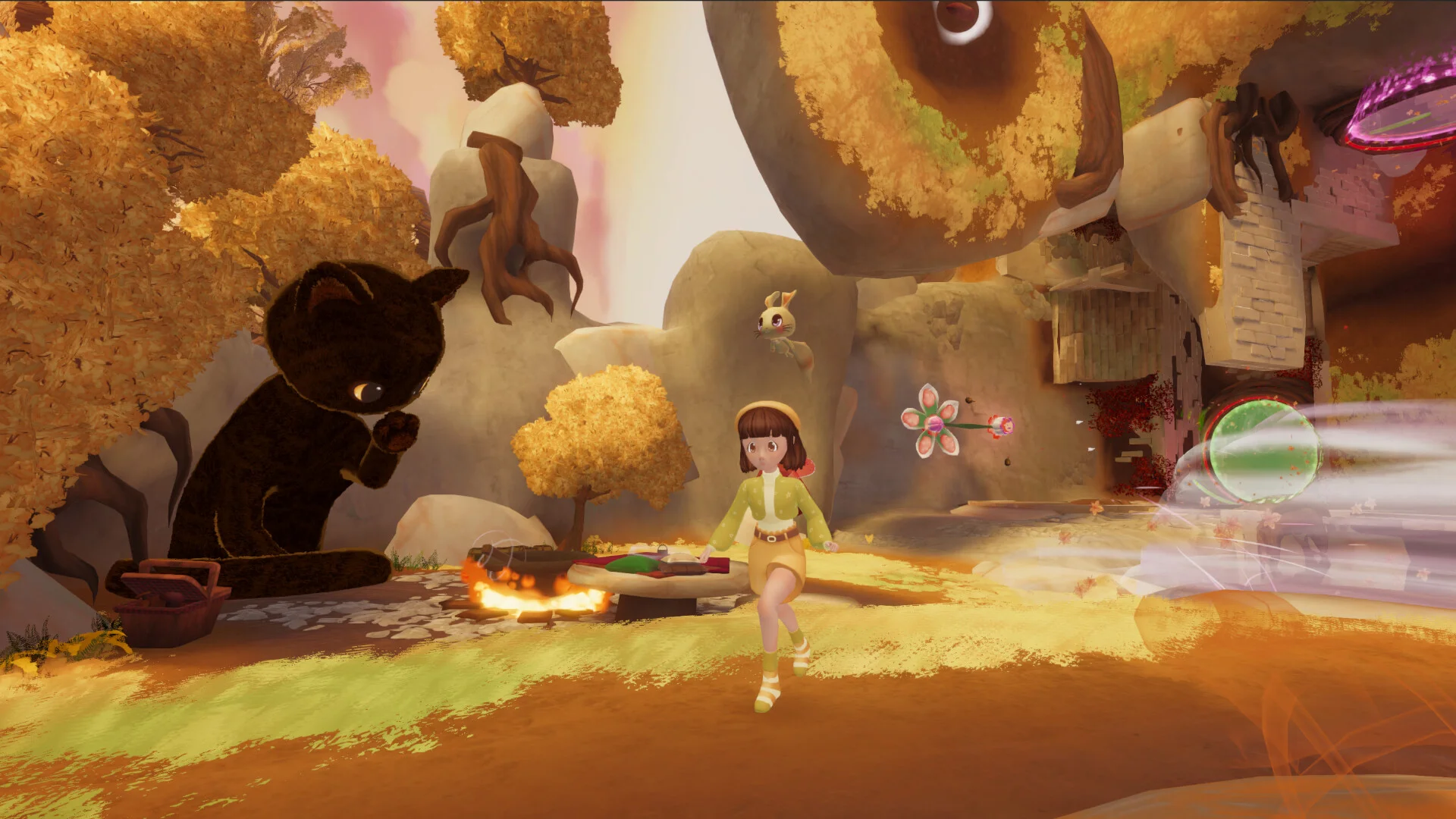

Portal teaches players to look at a wall and imagine a doorway. Nomori asks them to imagine that wall as the floor, then work out how to carry a rabbit-faced block across it. Enchanted Works has found an appealing variation on a familiar puzzle-game formula, one that makes ordinary questions of distance and direction surprisingly difficult. The trouble is that a game built around shifting perspective needs exceptionally clear rules. Nomori supplies some terrific spatial challenges, but its growing collection of abilities too often gets ahead of the puzzles designed to use them.
The adventure gives that elaborate machinery a simple purpose. Kiko, a young girl gathering mushrooms for her grandmother, finds herself in a spirit world and must help four Spirit Guardians before she can return home. Around forty puzzle islands are spread across four seasonal regions, beginning with autumn.
Most stages ask her to bring a Slimebun, a living cube with rabbit-like features, to the purple goo blocking an exit. The block clears the obstruction, and the route onward opens. There are occasional variations and optional Kodama creatures to collect, but the important question is always how Kiko and her unusual cargo can reach the same destination.
That question is at its best in the opening stretch. Fixed portals connect surfaces that appear to face incompatible directions, allowing Kiko to pass from what looked like a floor to what now behaves like a wall or ceiling. A platform that seems unreachable from one angle can become an ordinary landing spot after crossing a portal.
For players who know Portal, the adjustment is substantial. Finding the doorway is often the easy part; understanding which way everything will fall on the other side takes real attention. These early stages are easy to recommend to anyone who enjoys working through a three-dimensional space in their head.
Slimebuns give that spatial trick its practical purpose. Kiko can lift and move them with Wind Grasp, place one beneath a ledge to gain height, or use one to bridge a gap. Their relationship with gravity changes as they pass through portals, so delivering a block to the exit can require a different route from the one Kiko takes herself.
Later levels allow the blocks to grow or shrink, bounce, smash through barriers with enough momentum, and move along tracks. The better puzzles make several of these properties matter at once. You study an isolated platform, notice the portal attached to another face of the island, and begin to see how a block can become the missing step.
Nomori keeps adding tools as its seasons change. Eventually, Kiko can rotate portals to alter the orientation of the connected space and place portals into empty frames. Blocks can have their movement recorded and rewound, allowing a previous trajectory to become part of a fresh solution. That last ability invites a useful comparison with The Legend of Zelda: Tears of the Kingdom.
Both games let a player turn an object’s past motion into a new opportunity, such as using a moving object to reach somewhere higher. Zelda gives that experimentation room to breathe across a large environment. Nomori places it inside tightly constructed stages, where the idea ought to produce especially satisfying, carefully designed challenges.
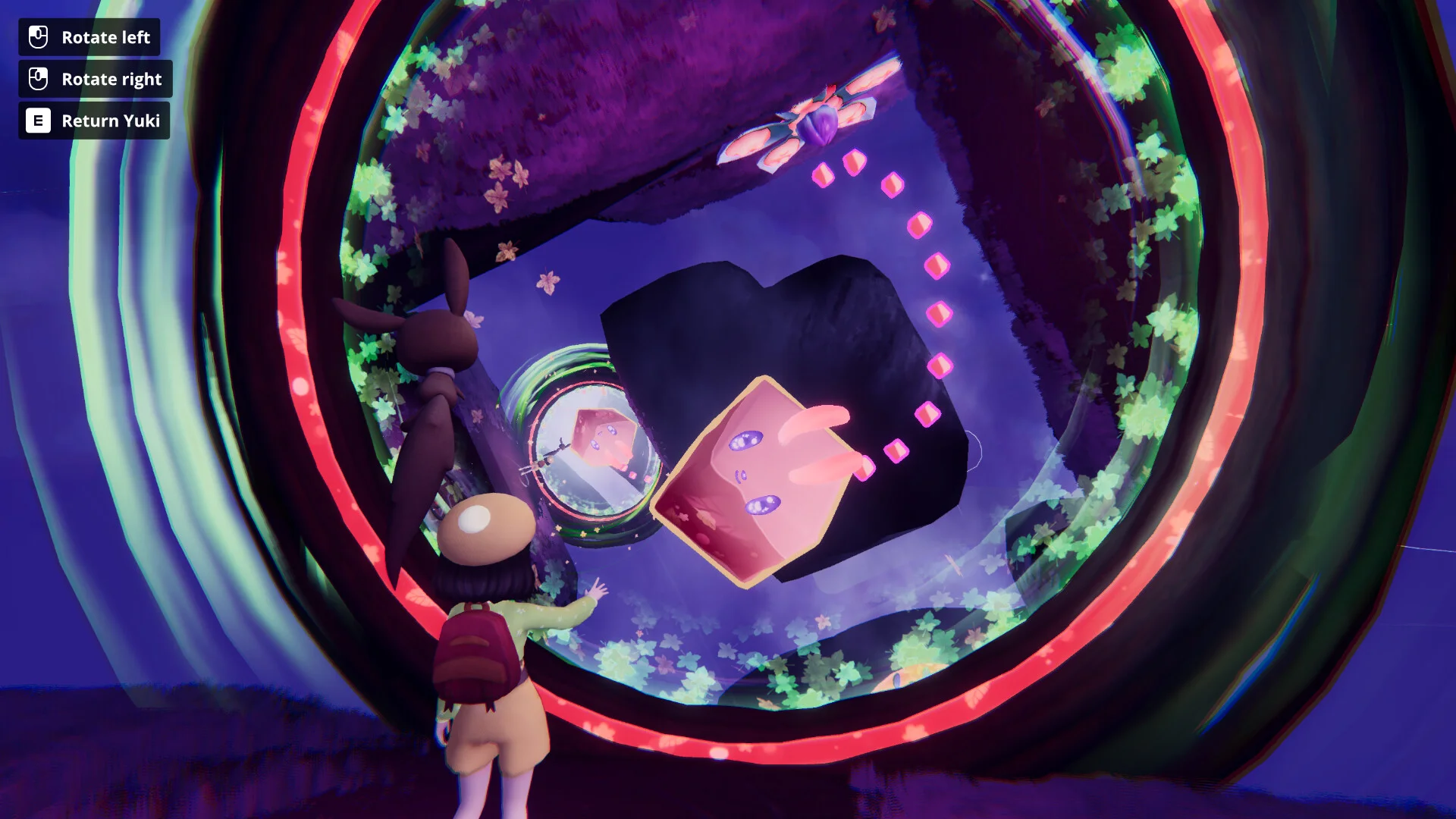
Sometimes it does. The problem is the pace at which the game abandons one lesson for the next. Autumn introduces several variations on the basic Slimebun interaction before their possibilities have been fully explored. Later stages pile rotation, resizing, rewinding, and precise placement together, but added complexity does not reliably lead to a better solution. Too many levels feel like brief demonstrations of the newest tool, followed by a test that expects the player to have mastered it already.
Portal remains the more accomplished teacher. It establishes what a mechanic does, proves how it behaves, and then finds a surprising new demand to place on that knowledge. Nomori can make you struggle for considerably longer and still leave you unsure what you learned. This becomes especially noticeable when an improvised solution works. The physics sometimes allow a Slimebun to reach a portal at a strange angle, bypassing the route a level appears designed around. Discovering an unexpected route should feel exciting, and occasionally it does.
Elsewhere, reaching the exit feels closer to getting lucky with object placement than solving the problem set in front of you. There is no built-in hint system or stage skip to help when the intended interaction remains obscure. A difficult puzzle can occupy half an hour; if its logic never becomes clear, reaching the end provides very little satisfaction.
The controls make these weak spots harder to forgive. Kiko’s basic jump is functional, yet her movement can feel awkward when a small adjustment is needed at the edge of a platform. The camera struggles to make distance and depth readable in layouts that repeatedly turn ceilings into walkable ground.
A task as straightforward as moving a Slimebun past a fence can become fiddly when its position and momentum must be judged across changing directions of gravity. Collisions can send blocks off the intended course. Checkpoints reduce the cost of falling or resetting an attempt, but they cannot make an uncertain jump or a poorly communicated route easier to interpret. A location-pinning feature offers limited help in the most tangled levels.
Technical concerns have affected the Xbox Series X version, too. Reported problems include frame-rate drops, missing visuals, HDR issues, and a particularly severe instance of a save becoming stuck at a loading screen before the final region. That isolated save failure should not be treated as universal, and the current patch status of these problems is unclear. Still, poor performance and visual instability are especially troublesome in levels that depend on accurate object placement.
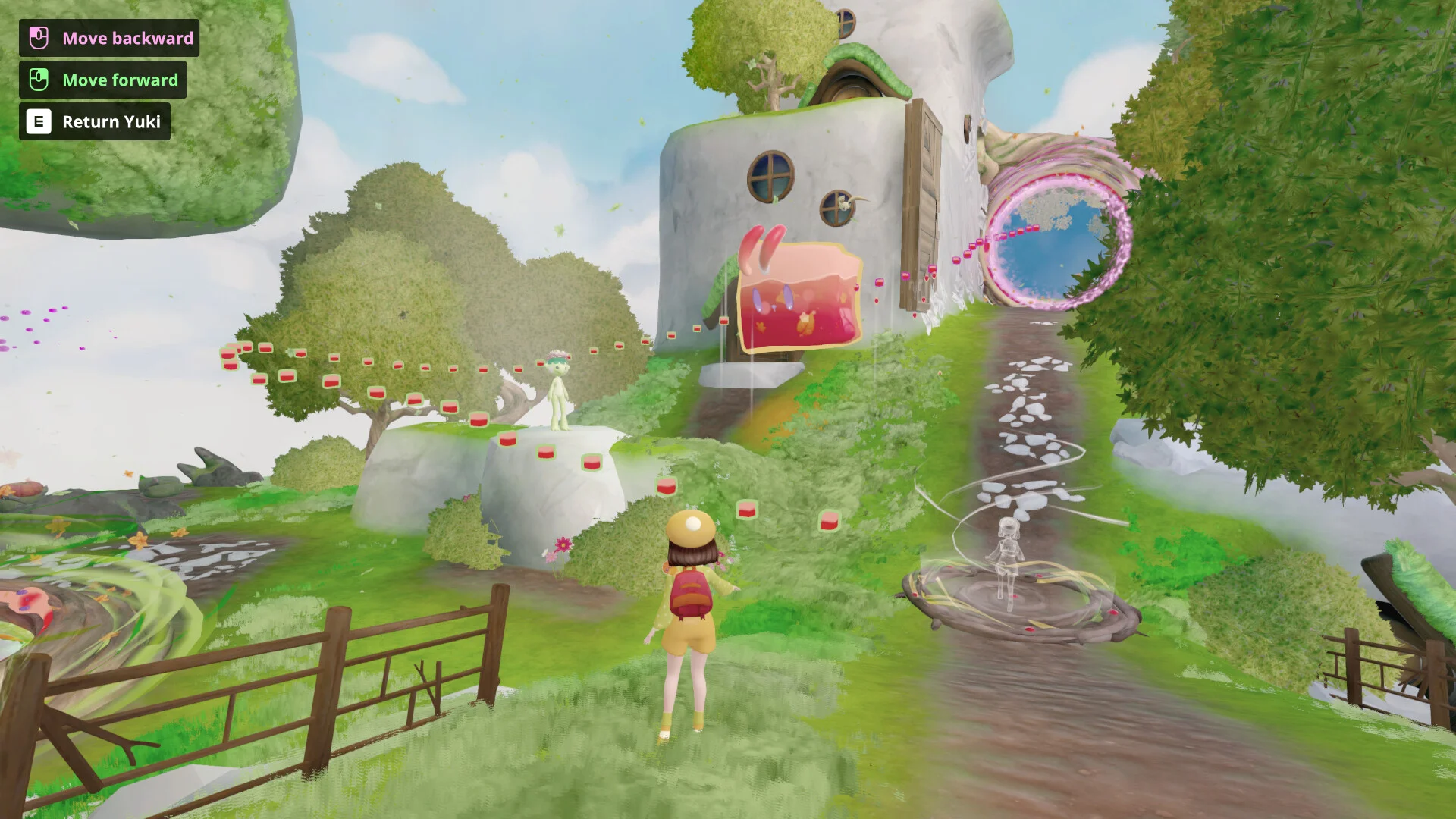
At least the world offers a gentler place to wrestle with these systems. Seasonal scenery, pastel colors, and floating architecture create an inviting atmosphere, and the rabbit-like Slimebuns lend personality to what might otherwise be plain movable cubes. Soft piano music and ambient sounds suit the slower pace of inspecting a level before attempting it. The environments themselves can look basic, however, and repeated textures sometimes make it difficult to distinguish one surface from another. Visual simplicity is perfectly reasonable for a small puzzle game. Here, the problem is what that simplicity does to the player’s ability to read the room.
The story offers less to hold onto. Yuki, a hovering rabbit companion, helps Kiko understand the world, and Ponta introduces the Spirit Guardians who might send her home. Conversations in the Crossworlds hub break up the challenges, but these characters have little room to develop beyond their roles as guides. Kiko’s wish to reach her grandmother is easy to understand, yet her relationships rarely gain the detail needed to make the next meeting especially exciting.
The soft presentation creates a slightly misleading first impression. Newcomers drawn in by the cute creatures should expect a demanding spatial puzzler, not a relaxed platform adventure. The gentle soundtrack cannot do much to ease the frustration of repeatedly trying to position a Slimebun on a distant platform after a difficult change in gravity.
By the later seasons, Kiko can rotate a portal, rewind a Slimebun, and use its movement to reach an exit from an unlikely angle. The game may accept that solution, but the player can still arrive on the other side uncertain why it worked.
The Review
Nomori
Nomori brings an inventive twist to portal-based puzzling, using shifting gravity and Slimebun manipulation to create some genuinely satisfying spatial challenges. Its early stages demonstrate considerable promise, but the constant introduction of mechanics eventually overwhelms the level design. Awkward movement, unreliable physics, and limited guidance make later puzzles frustrating for reasons that have little to do with their intended difficulty. The charming seasonal environments and gentle soundtrack help, though the thin story offers little motivation when progress stalls. Experienced puzzle enthusiasts will find worthwhile challenges here, but Nomori lacks the precision and consistency of its genre's best.
PROS
- Inventive gravity-shifting portal mechanics
- Clever Slimebun interactions and occasional creative solutions
- Challenging spatial puzzles, particularly early on
- Charming seasonal environments and gentle soundtrack
CONS
- New mechanics introduced too rapidly
- Inconsistent puzzle design and unclear solutions
- Awkward platforming, camera, and object physics
- No hint system and limited guidance
- Underdeveloped characters and story