




























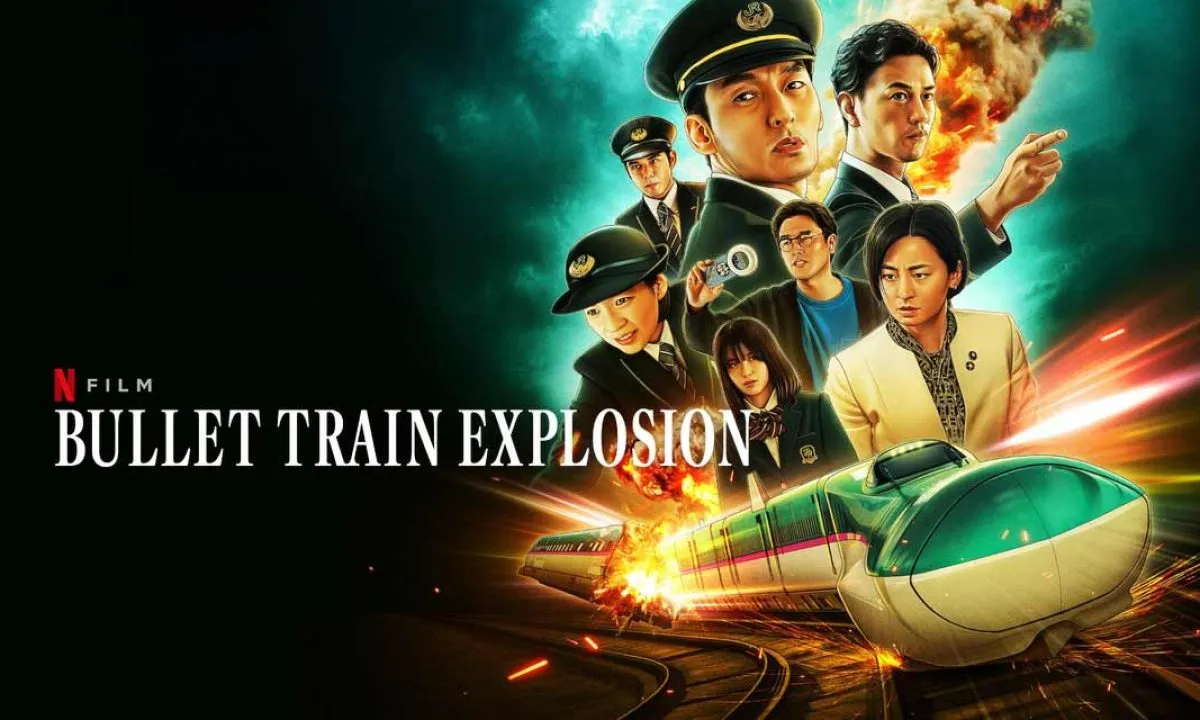

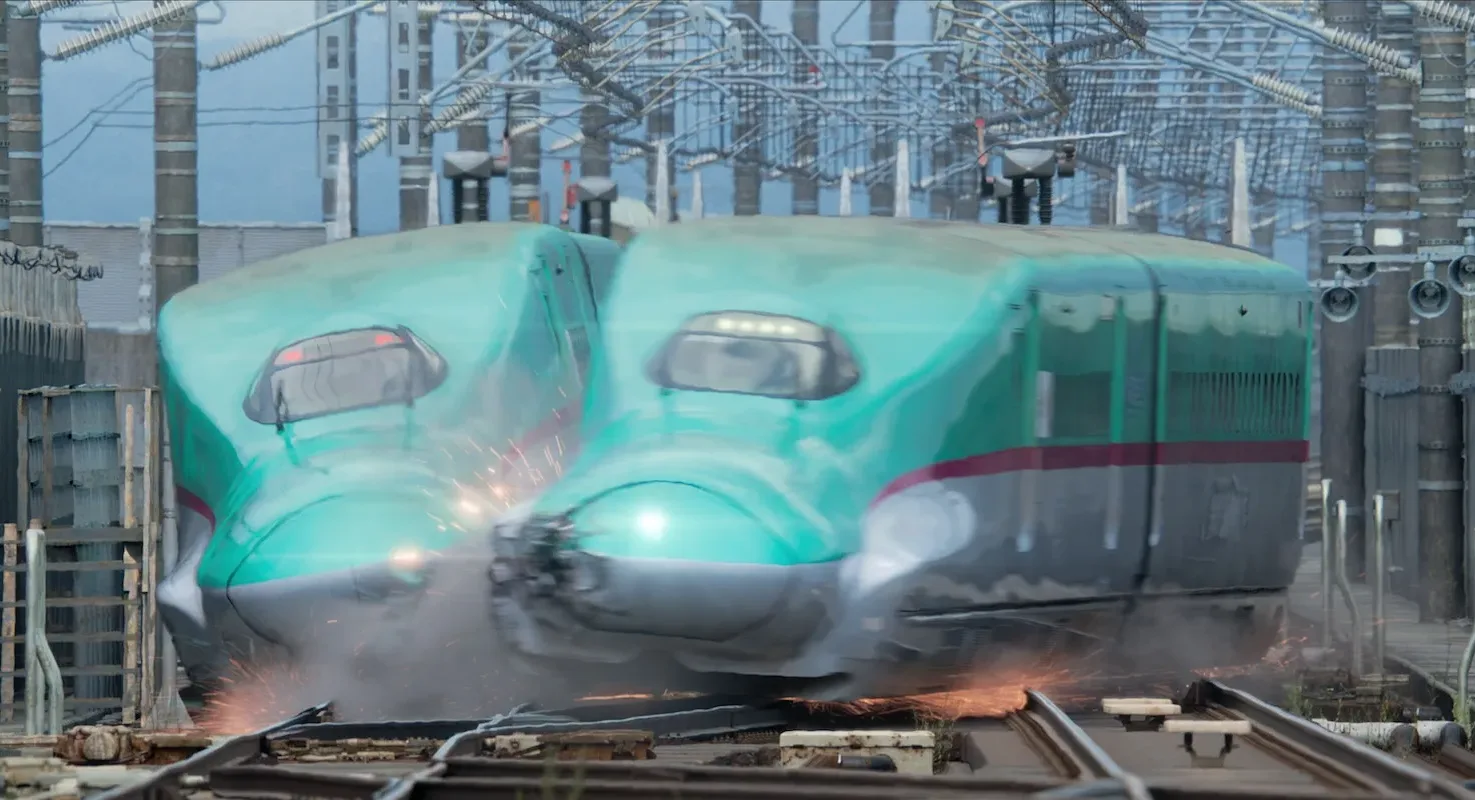
The Hayabusa No. 60, a sleek projectile of Japanese ingenuity, hurtles from Shin-Aomori towards Tokyo. Yet, this marvel is not merely carrying passengers; it’s cradling an ultimatum—a bomb set to redecorate the landscape should its velocity dip below an insistent 100 kilometers per hour. A literal deadline, this one measured in heartbeats and track segments.
This, in essence, is the beautifully unsubtle premise of “Bullet Train Explosion.” Helming this exercise in velocity-enforced suspense is Shinji Higuchi, a director accustomed to orchestrating grand-scale chaos (his portfolio brims with city-imperiling events and national-level headaches). He seems to possess a certain affection for situations rapidly spiraling beyond anyone’s immediate control.
The instigator of this high-speed predicament demands a cool 100 billion yen, a sum that makes one ponder the fluctuating market price of mass existential dread. The narrative, thus, propels itself on the frantic, interlocking efforts to defuse not just an explosive device, but the very human panic threatening to derail everything long before the bomber’s trigger is even contemplated.
What unfolds is less simple action, more an ensemble piece played out in a pressurized steel tube—a rapid-transit microcosm for how societal structures and individual psyches respond when the accelerator is irrevocably jammed and the brakes are, shall we say, strongly discouraged. Prepare for a journey that tests engineering as much as ethics.
The Human Element Amidst a Speeding Menace
At the heart of this hurtling inferno-in-waiting stands Conductor Kazuya Takaichi, a figure seemingly sculpted from the very bedrock of Duty. Tsuyoshi Kusanagi portrays him with a stoicism so profound it occasionally borders on the unnervingly calm, a man whose internal compass perpetually points towards saving souls and seeing the job through.
He’s the operational and, more critically, the moral linchpin, attempting to soothe a carriage-load of unravelling psyches while wrestling with the logistics of not becoming a very fast, very loud firework. His belief in the railway’s higher purpose—a conduit for human connection, no less—feels almost quaintly noble in an age accustomed to far more cynical transactions.
Flanking him are the requisite skilled subordinates: the composed driver Ninomiya Matsumoto and the earnest protégé Keiji Fujii, learning crisis management in the most literal of fast tracks. These professionals form a bulwark, a theme the film clearly cherishes. But it’s the passengers, that randomly assembled slice of Japanese society, who provide the real litmus test for the human spirit under duress; a mobile laboratory of fear.
Among them, novelist-cum-influencer Mitsuru Todoroki, perhaps initially keener on narrating the disaster than surviving it (a truly modern ailment). Then there’s politician Yuko Kagami, for whom the crisis is both existential threat and, potentially, a perverse public relations opportunity. The ubiquitous high school students register the requisite terror—that wide-eyed confrontation with abrupt finality—while an old electrician represents that quiet, practical competence, the sort of analog know-how often dismissed until the digital fails and brute-force ingenuity is all that remains.
Meanwhile, off-train, the East Japan Railway Company’s command center, under Commander Yuichi Kasagi, hums with a portrayal of bureaucratic efficiency that might make a Weberian scholar weep with joy. Their meticulous, technically proficient ballet of problem-solving—a stark contrast to the organic fear on the rails—presents its own kind of drama. Government suits and police add their voices to the chorus, debating the grim calculus of negotiation with an unseen, unblinking foe. This is where the system itself becomes a character, tested for its resilience or, just possibly, its well-meaning rigidity.
Engineering Suspense: The Mechanics of a Crisis
The architecture of this particular crisis is laid out with brutal simplicity: the inviolable 100 km/h threshold, a metallic commandment against deceleration, and a ransom demand of 100 billion yen – a figure so large it almost bypasses greed and enters the realm of abstract performance art. It’s a race, naturally, against the implacable clock and the shrinking kilometers of safe track.

But then, the inevitable spanners are tossed into the works: unexpected obstructions materializing like bureaucratic gremlins, the fog of war descending upon communication channels, and the bomber, possibly weaponizing the digital town square to sow further discord (a chillingly contemporary touch). The official “no negotiation” posture, a steely principle in a world melting under pressure, only ratchets the screws tighter, transforming policy into another ticking component.
Against this backdrop of escalating peril, two distinct theaters of problem-solving emerge, a dialectic of desperation. In the hushed, glowing sanctum of the East Japan Railway control room, a ballet of logistical chess unfolds. We witness meticulous planning over physical models and blinking maps – a kind of analog antidote to digital doom-scrolling, designed to manage the steel behemoth that refuses to sleep.
This meticulousness, bordering on a “bureaucratic sublime,” is the film’s hymn to institutional competence, a fantasy of perfectly interlocking gears. On board the Hayabusa, however, ingenuity is a more frantic, ad-hoc affair: the crew attempting to maintain a semblance of order amidst rising hysteria, passengers perhaps fumbling towards MacGyver-esque solutions born of sheer will, all while the spectre of the explosive device itself whispers its metallic threats.
This dynamic interplay – the coolly calculated versus the desperately improvised – forms the core of the film’s suspense engine. Does it purr with relentless efficiency, or occasionally sputter under its own weight of detail? The narrative certainly dedicates substantial oxygen to its procedural elements, the intricate dance of averting disaster, sometimes at the expense of sheer visceral propulsion.
For some, this will be a riveting display of process-as-plot, a deep dive into the mechanics of saving the day. For others, the film’s considerable runtime (tipping comfortably past the two-hour mark, a modern blockbuster’s indulgence) might feel like an endurance trial mirroring the characters’ own, where the sustained tension occasionally risks diluting into a prolonged state of managed anxiety rather than a series of sharp, escalating shocks. It’s a choice, this lingering gaze at the nuts and bolts of salvation.
Visual Spectacle and Directorial Vision
Shinji Higuchi, a filmmaker whose resume reads like a catalogue of Things That Threaten Japan (often large, scaly, and emitting radiation), brings his signature penchant for effects-laden ensemble drama to “Bullet Train Explosion.” Unsurprisingly, his directorial DNA is all over this speeding narrative.
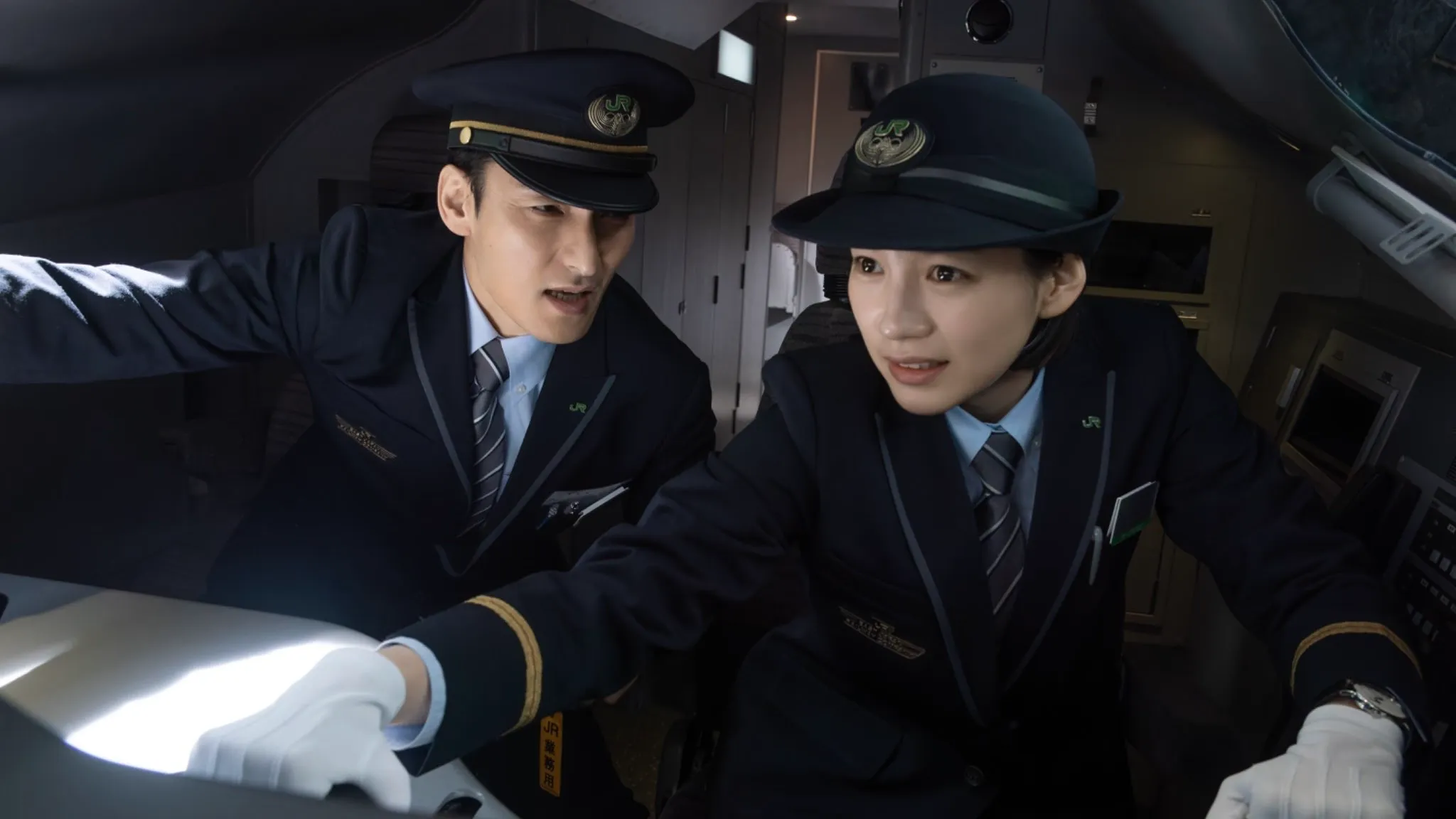
The quick cuts, the occasionally frenetic camerawork that seems to chase its own tail, the on-screen titles that pop up with the insistence of urgent system alerts – these are familiar Higuchi-isms. Sometimes they effectively inject adrenaline into otherwise static scenes of men-in-rooms-talking-logistics (a genre unto itself in Higuchi’s hands); at other moments, one might feel subjected to a particularly high-stakes corporate presentation, albeit one with potentially explosive consequences.
There’s a curious, almost philosophical tension here between the “authentic” and the “artificial,” the tangible and the rendered. The filmmakers trumpet their rare access to real Shinkansen trains and actual railway facilities, lending a certain tactile credibility, a whiff of genuine steel and polished procedure (and perhaps, one might dryly note, a subtle nod to the unimpeachable efficiency of the East Japan Railway Company itself, a piece of almost inadvertent industrial filmmaking).
Yet, when the set-pieces truly ignite – cars decoupling at ludicrous speeds, near-misses choreographed with digital precision – the gloss of computer-generated imagery can sometimes feel a touch too smooth, a little too clean, robbing the mayhem of its grittier, more terrifyingly visceral potential. The balance isn’t always perfect; it’s an ongoing negotiation between documentary realism and the demands of blockbuster fantasy.
Production design effectively contrasts the claustrophobic, increasingly dishevelled train interiors, a metal tube of escalating panic, with the cool, technological command of the railway control rooms – the brains versus the belly of the beast. Cinematography strives to convey both the dizzying velocity and the boxed-in terror, though the vastness of the threatened network occasionally gets lost in the service of immediate, track-level peril.
The score, by Taisei Iwasaki and Yuma Yamaguchi, does considerable heavy lifting, often successfully echoing the tense, percussive undercurrents of the film’s 1975 progenitor, while the overall sound design ensures every clack of the track and roar of the wind feels immediate, if not always subtle in its underscoring of doom.
Deconstructing Disaster: Themes and Motivations
As a cinematic descendant of the 1975 “The Bullet Train,” this “Explosion” doesn’t just tip its hat to its progenitor; it seems to be actively wrestling with its legacy, perhaps even its shadow, like a dutiful son trying to fill enormous, slightly outdated shoes.
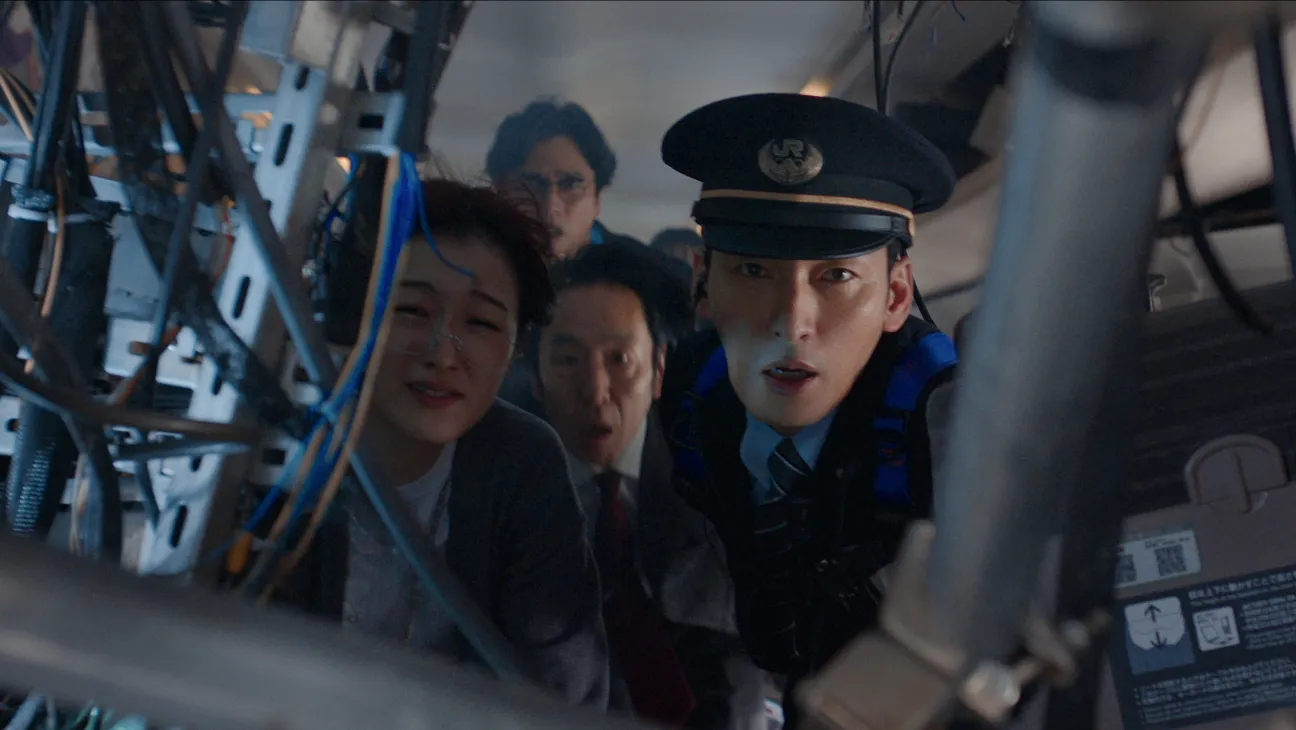
While it dutifully updates the core premise for an era more attuned to digital anxieties and sprawling ensemble casts (everyone gets a moment, however fleeting), the question lingers: does it achieve the same gritty, desperate resonance, or does it opt for a glossier, more sanitized form of peril? The fundamental disaster scenario – a technological marvel turned rolling coffin – remains potent, though its modern iteration feels less about raw, elemental survival and more about showcasing a highly orchestrated (almost balletic, if deafeningly loud) response.
The architect of this chaos, our bomber, employs methods that feel both classic and disconcertingly contemporary – the high-stakes demand, the ticking clock, but also the curious, almost sociologically experimental notion of a crowd-sourced ransom, turning a national crisis into a perverse form of collective GoFundMe.
Their motivation, when finally unveiled through a somewhat melodramatic gear-shift, appears to be a rather bleak philosophical experiment designed to prove widespread human apathy, a grand, explosive “I told you so” directed at society itself. It’s a suitably nihilistic premise for our often cynical times, yet one can’t help but feel the intellectual scaffolding around this motive is a tad wobbly, perhaps more intriguing in concept than entirely persuasive or psychologically grounded in its execution. Is it a profound commentary on societal detachment, or just a villain needing a suitably grand, if slightly undercooked, raison d’être for maximum mayhem?
Beyond the pyrotechnics and procedural fervor, the film champions a surprisingly earnest, almost wholesome set of ideals. Teamwork and collaboration are presented not merely as survival strategies but as inherent virtues, the bedrock of civilized response.
Conductor Takaichi’s unwavering professionalism and deep-seated decency become the moral lodestar, a “quiet heroism” that feels almost defiantly old-fashioned in an age of anti-heroes. The film’s depiction of bureaucracy, particularly the railway’s efficient response, leans heavily towards the idealized, a comforting vision of systems actually working under extreme pressure (a fantasy many might find appealing).
This overarching optimism, the belief that “we’re all heading in the same direction” (to borrow Takaichi’s hopeful, if crisis-tinged, mantra), is either a refreshing tonic in a weary world or a slightly naive gloss, depending heavily on one’s own reserves of cynicism regarding humanity’s capacity for collective grace under fire.
The Journey’s End: Impact and Reflection
So, does “Bullet Train Explosion” ultimately deliver on its high-velocity, high-stakes promise? Mostly, yes, with certain caveats. As a suspenseful thriller, it maintains a decent clip, even if its extensive runtime occasionally makes the journey feel more like a marathon of managed anxiety than a pure terror sprint.
The ensemble drama aspect fares reasonably well; amidst the meticulously choreographed chaos, glimmers of human connection and professional fortitude surface, preventing the characters from becoming mere cogs in the disaster machine, most of the time.
What lingers after the Hayabusa reaches some non-explosive stasis? Perhaps a quiet admiration for its unwavering belief in competence, a cinematic balm in an era of celebrated ineptitude. The film’s brand of heroism – less about capes and quips, more about procedural correctness and stiff upper lips – is its most distinctive, if not universally thrilling, offering. Its earnest themes of duty and cooperation might not etch themselves indelibly onto the soul, though the bomber’s muddled philosophy provides a curious, if not entirely satisfying, intellectual chew-toy for the ride home.
In the crowded terminal of modern disaster films, “Bullet Train Explosion” pulls in as a rather orderly, well-maintained express. It doesn’t seek to radically reinvent the genre, preferring instead a respectful adherence to its well-worn tracks, albeit with a distinctively Japanese polish and a certain bureaucratic tidiness.
This will likely appeal to those who appreciate a straightforward spectacle valuing methodical problem-solving over narrative flash, alongside existing admirers of Higuchi’s particular brand of organized mayhem. A solid, if not earth-shattering, ride that, despite bumps and a leisurely pace, leaves most passengers reasonably satisfied.
Bullet Train Explosion premiered on Netflix on April 23, 2025.
Full Credits
Director: Shinji Higuchi
Writers: Kazuhiro Nakagawa, Norichika Ōba
Producers and Executive Producers: Kota Ishizuka (Producer), Yoshihiro Satō (Executive Producer)
Cast: Tsuyoshi Kusanagi, Kanata Hosoda, Non, Machiko Ono, Jun Kaname, Hana Toyoshima, Daisuke Kuroda, Satoru Matsuo, Suzuka Ohgo, Naomasa Musaka, Takumi Saitoh, Matsuya Onoe, Kenji Iwaya, Kentaro Tamura, Pierre Taki, Bandō Yajūrō
Directors of Photography (Cinematographers): Yusuke Ichitsubo, Keizō Suzuki
Editors: Kaori Umewaki, Atsuki Satō
Composers: Taisei Iwasaki, Yuma Yamaguchi
The Review
Bullet Train Explosion
"Bullet Train Explosion" delivers a commendably engineered thrill ride, celebrating quiet professionalism and systemic cooperation amidst its high-stakes premise. While its methodical pacing and a somewhat philosophically wobbly antagonist may test patience, Higuchi's direction offers a polished, if not groundbreaking, spectacle. It's a disaster film more interested in the nuts and bolts of salvation than pure adrenaline, offering a solid journey for those who appreciate competence over chaos.
PROS
- Gripping high-concept premise that immediately engages.
- Strong, compelling portrayal of steadfast professionalism and "quiet heroism."
- Meticulous and fascinating depiction of crisis management procedures.
- Authentic atmosphere enhanced by the use of real Shinkansen locations.
- Earnest and sincere exploration of teamwork, duty, and societal cooperation.
CONS
- Extended runtime can occasionally lead to sluggish pacing and diluted tension.
- The antagonist's motivations lack convincing depth and feel underdeveloped.
- Some CGI sequences can appear artificial, undercutting the realism.
- The director's distinct stylistic choices (e.g., quick cuts, on-screen text) may prove divisive.
- Suspense is sometimes undercut by an intense focus on procedural detail over visceral thrills.